Pak Imtehan
CSS PMS Current Affairs
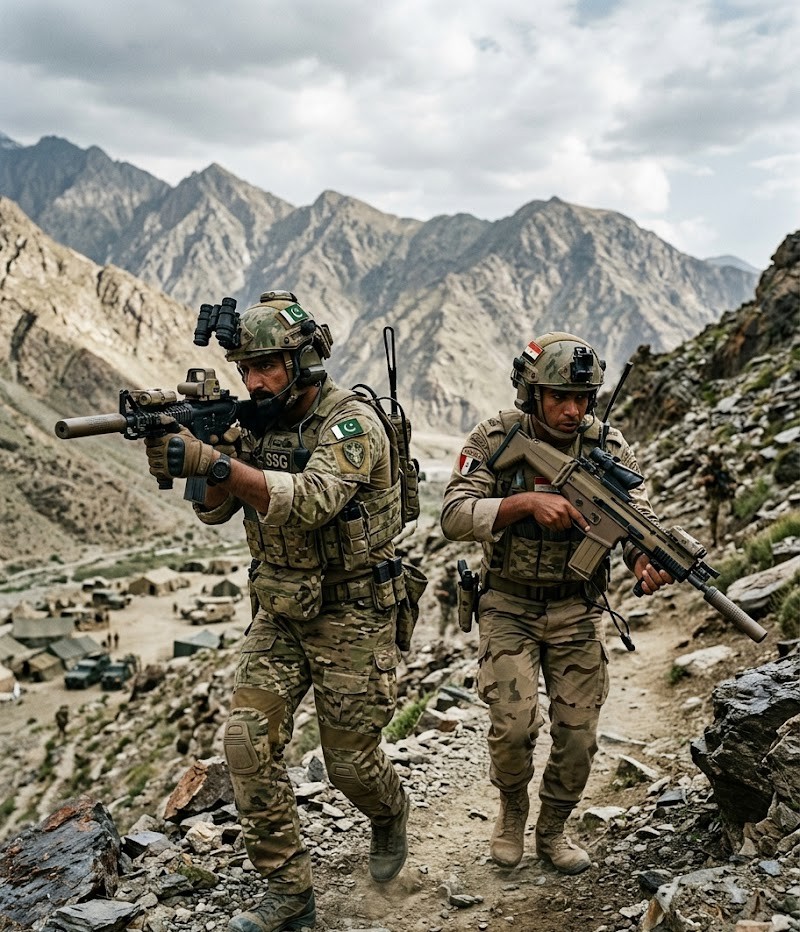
The tactical landscape of the Hindu Kush has long served as a crucible for unconventional warfare. In Cherat, the historic headquarters of Pakistan’s Special Services Group (SSG), the commencement of the Thunder-II (Raad-II) joint exercises between the Egyptian and Pakistani special forces signifies a shift from routine bilateral cooperation toward a specialized strategic alignment. While joint drills are common in modern diplomacy, the specific convergence of Cairo and Islamabad, two states navigating the complex transition from kinetic counterterrorism to sophisticated counter-insurgency (COIN) in urban and mountainous terrains, carries weight beyond the immediate tactical exchange.
The Geography of Shared Threat Vectors
The choice of Cherat as a staging ground is deliberate. The rugged, high-altitude terrain of northwestern Pakistan offers a unique laboratory for testing endurance and specialized maneuvers. For the Egyptian forces, primarily accustomed to the arid, flat, yet equally treacherous landscapes of the Sinai Peninsula, the verticality of Cherat provides a fresh perspective on asymmetric logistical constraints. Egypt’s ongoing struggle against Wilayat Sayna (ISIS-Sinai) has increasingly moved toward tunnel warfare and urban siege tactics. Conversely, Pakistan’s decade-long experience in the Federally Administered Tribal Areas (FATA) and more recent operations in Balochistan has refined a doctrine of high-mobility mountain warfare. Thunder-II allows for a cross-pollination of these distinct but overlapping combat experiences. The exchange centers on the reality that modern terrorism no longer respects borders or traditional battlefield geometry; it occupies the gray zones where state sovereignty is most difficult to project.
Tactical Synchronization and Interoperability
Thunder-II is not a performance for cameras; it is an interrogation of technical compatibility. The drills focus heavily on Advanced Sniper Marksmanship, Cordon and Search Operations (CSO), and Combat Medic protocols. However, the most critical element remains the integration of intelligence-led operations.
In modern counterterrorism, the delay between sensor and shooter, the time it takes to process intelligence and launch a strike, is the difference between success and a missed opportunity. Pakistani and Egyptian special forces are focusing on shortened kill-chains, utilizing localized drone surveillance to feed real-time data to ground units. This interoperability is essential because both nations utilize a mix of Western and indigenous hardware. Developing a shared tactical language allows these forces to operate in a hypothetical multilateral environment without the friction of mismatched communication systems.
"The synergy between Egyptian and Pakistani special forces represents a consolidation of two of the world's most battle-hardened infantries, focusing on the precision required to dismantle non-state actor networks without traditional collateral damage," notes a senior regional defense analyst.
The Geopolitical Logic of the Nile-Indus Axis
To view Thunder-II solely through a military lens would be to miss the broader diplomatic architecture being built. Both Egypt and Pakistan occupy pivotal positions in the Islamic world and maintain special relationships with the Gulf monarchies, particularly Saudi Arabia and the UAE. As the Middle East and South Asia face a period of American right-sizing, a reduction in direct military footprints, regional powers are forced to create their own security nets.
Pakistan seeks to diversify its defense partnerships beyond its traditional reliance on Beijing and Washington. Egypt, as a Mediterranean power with significant influence in the Arab League, offers Islamabad a gateway to African security discourse. For Cairo, Pakistan’s expertise in domestic defense production, ranging from small arms to tactical UAVs, presents an opportunity to reduce its own dependence on expensive European or American hardware.
The cooperation also serves as a subtle signal to regional adversaries. By conducting high-visibility drills in the sensitive region of Cherat, Pakistan demonstrates a high level of internal stability and operational readiness despite domestic economic pressures. For Egypt, practicing in Pakistan’s mountains reinforces its image as a proactive regional security provider, capable of projecting power far beyond the Nile Valley.
Addressing the Hybrid Warfare Challenge
The nature of the threat facing Cairo and Islamabad has evolved from organized insurgencies to decentralized, hybrid cells. These actors utilize digital platforms for recruitment and kinetic strikes for propaganda. Thunder-II incorporates Cyber-Physical response training, where special forces must secure physical infrastructure while specialized units manage the information fallout.
A major focus of the Cherat drills is the neutralization of High-Value Targets (HVTs) in densely populated areas. The difficulty of these operations lies in the necessity of surgical precision. In the Sinai or the valleys of Khyber Pakhtunkhwa, the presence of civilian populations makes heavy artillery or unguided aerial bombardment a political liability. Thunder-II emphasizes the use of small-unit tactics, teams of 4 to 12 operators, who can infiltrate, neutralize, and exfiltrate with minimal signature. This light footprint approach is the preferred method for both nations as they attempt to win the hearts and minds of restive border populations while simultaneously uprooting militant infrastructure.
Economic and Defense Industry Linkages
Military exercises are often the precursor to defense procurement contracts. Pakistan’s Heavy Industries Taxila (HIT) and the Pakistan Ordnance Factories (POF) have been actively seeking export markets for their battle-proven equipment. Egyptian officials observing Thunder-II are likely evaluating the performance of Pakistani-made protective gear, night-vision optics, and specialized ammunition.
The economic dimension of security cannot be ignored. Both countries are currently under IMF programs and face stringent budget constraints. Joint exercises allow for cost-sharing in R&D and training. Rather than each nation independently developing a doctrine for a specific type of urban insurgent threat, they can share the lessons learned from blood-bought experience in the streets of Cairo or the outskirts of Peshawar.
"The convergence of defense interests between Islamabad and Cairo is a pragmatic response to the rising costs of modern warfare; by pooling tactical knowledge, both states enhance their deterrence capabilities at a fraction of the cost of solo doctrinal development," states a policy brief from a leading Karachi-based think tank.
Strategic Autonomy in a Multipolar World
The timing of Thunder-II coincides with a period of intense global polarization. While the West is focused on Eastern Europe and the South China Sea, the threat of localized radicalization in the Global South remains a primary concern for regional capitals. By strengthening the Egypt-Pakistan axis, both nations are asserting a form of strategic autonomy. They are demonstrating that they do not require external great power mediation to manage their own security neighborhoods.
This partnership is particularly relevant in the context of the Red Sea security corridor. While Cherat is far from the sea, the special forces being trained there are the same units tasked with protecting critical infrastructure, including ports and transit hubs. Stability in Pakistan’s western borders and Egypt’s Sinai is a prerequisite for the smooth flow of trade through the Suez Canal and the Gwadar Port, both of which are central to the global maritime economy.
Implications for Regional Stability
The conclusion of Thunder-II will likely result in a permanent liaison framework between the two special forces branches. This goes beyond annual meetings; it involves the creation of a shared database of militant tactics, techniques, and procedures (TTPs). As groups like Daesh-K or Al-Qaeda in the Arabian Peninsula (AQAP) evolve, the Egyptian and Pakistani response will now be informed by a collective intelligence.
For the international community, this drill should be seen as a stabilizing development. A more capable, professional, and interconnected Egyptian and Pakistani military reduces the likelihood of state-collapse scenarios that previously fueled mass migration and global terror networks.
Conclusion
Thunder-II in Cherat is a testament to the reality that in the 21st century, security is a networked commodity. The transition from large-scale conventional maneuvers to elite, precision-based counterterrorism drills reflects a sophisticated understanding of the modern threat landscape. By training together in the daunting heights of Pakistan’s northwest, Egypt and Pakistan are not just polishing their tactical skills; they are defining a new, south-south security architecture that prioritizes regional solutions to regional crises.
Their real value lies far beyond what unfolds on the training grounds of Cherat, resting instead in the durability of the security environment in the Sinai and the Indus Valley over the years ahead. As both nations continue to share blood, sweat, and tactical data, the Thunder resonating through Pakistan’s mountains sends a direct signal to those aiming to exploit the gaps between state borders and regional interests.
Comments (0)
No comments yet. Be the first to comment!