Pak Imtehan
Competitive Exams Prep App (CSS, PMS)
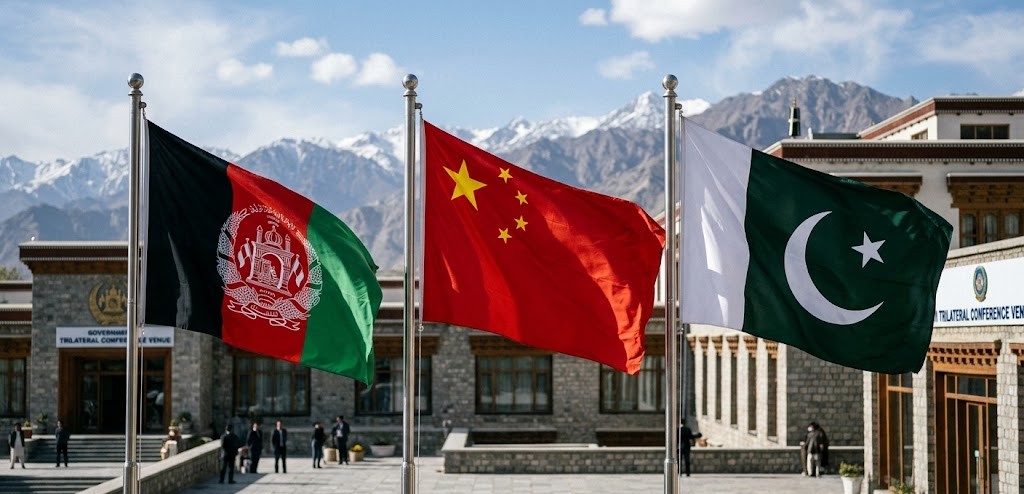
The durability of the border between Pakistan and Afghanistan has long been tested by fluctuating degrees of militant activity and diplomatic friction. However, the emergence of the Urumqi Framework, a consultative mechanism involving China, Pakistan, and Afghanistan, represents a fundamental shift toward institutionalized trilateralism. By embedding the Kabul-Islamabad relationship within a broader regional security and economic architecture, the framework seeks to move beyond bilateral gridlock. This approach prioritizes neutral third-party mediation and infrastructure connectivity as the primary drivers of stability, attempting to decouple economic necessity from historical territorial disputes. The following analysis examines how this framework restructures regional incentives and whether a Chinese-brokered peace can survive the inherent volatility of the Durand Line.
The Institutionalization of Trilateral Mediation
The Urumqi Framework serves as a departure from the failed bilateralism of the past two decades. Historically, Pakistan and Afghanistan have engaged in a cycle of accusation and denial regarding cross-border militancy. The inclusion of Beijing as a guarantor changes the calculus for both parties. For Pakistan, Chinese involvement provides a diplomatic buffer and a source of developmental capital, while for the Taliban-led government in Kabul, it offers a pathway toward international legitimacy and economic survival without total reliance on Western recognition.
This shift suggests that regional stability is now being treated as a collective economic asset rather than a zero-sum security game. By hosting these dialogues in Xinjiang, China signals that its own internal security, specifically the prevention of spillover from groups like the East Turkestan Islamic Movement (ETIM), is permanently linked to the cooperation between Islamabad and Kabul. Consequently, the framework forces a level of accountability that bilateral meetings lacked, as neither party wishes to alienate their most significant source of foreign investment.
Economic Connectivity as a Security Prerequisite
At the heart of the Urumqi discussions is the extension of the China-Pakistan Economic Corridor (CPEC) into Afghanistan. This is not merely an infrastructure project but a strategic attempt to create "enforced interdependence." If Afghanistan becomes a transit hub for Central Asian energy and trade reaching the Arabian Sea, the cost of hosting anti-Pakistan militants becomes prohibitively high for the Kabul administration.
As Ahmed Rashid noted in his analysis of regional power plays, “The challenge for the Taliban is to transform from a movement into a government, and that requires a functional economy which only regional integration can provide.” This observation mirrors the framework's logic: economic desperation is a primary driver of regional insecurity. By focusing on the Trans-Afghan Railway and fiber-optic links, the Urumqi Framework attempts to build a material reality where peace is more profitable than proxy warfare. The implication is clear: the Durand Line must evolve from a site of military friction into a corridor of commercial exchange if the state structures on either side are to remain viable.
Counter-Terrorism and the Xinjiang Nexus
Security remains the most contentious pillar of the Urumqi Framework. China’s primary interest is the containment of the Tehrik-i-Taliban Pakistan (TTP) and ETIM, both of which utilize the porous border regions. Unlike previous Western-led efforts that focused on democratic nation-building, the Urumqi approach is transactional and security-centric. It demands that Kabul provide "verifiable" assurances that Afghan soil will not be used for external attacks in exchange for continued diplomatic and financial support.
The challenge lies in the Taliban’s internal cohesion. While the central leadership in Kabul may desire Chinese investment, local commanders often maintain ideological ties to militant groups. Pakistan’s role within this framework is to provide the intelligence and logistical baseline for these security guarantees. The success of this arrangement depends on whether China can leverage its "all-weather" friendship with Pakistan to moderate Islamabad’s border policies while simultaneously pressuring Kabul. If this security-first model succeeds, it provides a blueprint for a post-Western security architecture in Eurasia that prioritizes state stability over political liberalization.
Navigating the Legitimacy Gap
The Urumqi Framework operates in a unique diplomatic space where the Afghan government is recognized as a functional reality, if not a legal one. This pragmatism allows Pakistan to engage with the Taliban under a multilateral umbrella, reducing the domestic and international political costs of bilateral concessions. For Islamabad, the framework acts as a mechanism to socialize the Afghan problem, ensuring that the burden of managing Kabul does not fall on Pakistan alone.
This collective engagement creates a "stabilization by association" effect. By involving Afghanistan in regional high-level talks, the framework gradually integrates Kabul into the regional order. However, this creates a tension between regional pragmatism and global human rights standards. The framework effectively bets that long-term social stability will follow economic development, a direct inversion of the Western model that demands political reform before economic aid. The implication is a narrowing of the policy window for Western influence, as Kabul finds a regional alternative that does not demand internal secularization.
The Durand Line and Border Management
Technical border management remains the most frequent point of failure in Pakistan-Afghanistan relations. Under the Urumqi Framework, there is a push to move beyond the physical fence toward digital and intelligence-based border monitoring. The framework envisions a border that is "hard" for militants but "soft" for trade. Achieving this requires a level of data-sharing between Islamabad and Kabul that has historically been nonexistent.
The causation of border tension is often found in the lack of synchronized customs and security protocols. When trade stalls at crossings like Torkham or Chaman, it fuels local resentment and provides cover for illicit movement. The framework proposes the establishment of Joint Border Trade Zones, which would formalize the local economies that have traditionally relied on smuggling. By regularizing these borderland economies, the framework seeks to remove the social base of militancy, turning "rebels" into "traders."
The Role of Central Asian Energy
Afghanistan’s potential as a land bridge to Central Asia is the "carat" within the Urumqi Framework. Projects like CASA-1000 (Central Asia-South Asia power project) and the TAPI (Turkmenistan-Afghanistan-Pakistan-India) pipeline are often discussed within these trilateral sessions. For Pakistan, which faces a chronic energy deficit, the stability of Afghanistan is a prerequisite for national industrial survival.
This creates a linkage between Pakistan’s domestic energy security and its foreign policy toward Kabul. If the Urumqi Framework can facilitate the physical security of these pipelines, it binds the two nations together in a way that political treaties cannot. The geopolitical implication is the creation of a North-South energy corridor that bypasses traditional maritime routes. This not only benefits the immediate parties but also aligns with China’s broader "Go West" strategy, which seeks to develop its landlocked interior by connecting it to global markets through the Karakoram and the Hindu Kush.
Mitigating the Risk of Proxy Competition
A significant risk to the Urumqi Framework is the interference of external actors who may view a China-led regional bloc with suspicion. To counter this, the framework emphasizes "inclusive regionalism," theoretically leaving the door open for other neighbors like Iran and Uzbekistan. However, the core remains the Pakistan-Afghanistan-China triangle. The framework must manage the delicate balance between Islamabad's security concerns and Kabul's desire for strategic autonomy.
The risk of a return to proxy competition is high if the economic benefits of the framework do not materialize quickly. As noted by Barnett Rubin, “Afghanistan is not just a country; it is a regional system, and no solution can work if it ignores the interests of all the surrounding powers.” The Urumqi Framework attempts to solve this by making China the lead investor, effectively upping the ante for any actor, domestic or foreign, that seeks to disrupt the status quo. The framework is, in essence, a hedge against the chaos of a fragmented region.
The Limits of Transactional Diplomacy
While the Urumqi Framework offers a pragmatic path forward, it faces the "sincerity gap" that plagues all relations in this corridor. Can a framework built on economic interests overcome decades of ideological and territorial mistrust? The real-world grounding of this policy lies in the diminishing options for both states. Pakistan’s economy cannot sustain a permanent state of high-intensity border conflict, and the Taliban cannot govern a starving population indefinitely.
The framework’s success will be measured not by grand declarations but by the frequency of trade convoys and the reduction in cross-border "skirmishes." It represents a shift toward a Westphalian realism where the internal nature of the Afghan state is ignored in favor of its external behavior. This may lead to a cold but functional peace, where both sides accept the other’s existence out of a shared fear of economic collapse.
A Forward-Looking Strategic Alignment
The Urumqi Framework is more than a diplomatic venue; it is an attempt to rewrite the rules of engagement in South and Central Asia. By placing economic connectivity at the center of the security discourse, it offers a departure from the purely military solutions of the past. For Pakistan, this represents a transition from a "frontline state" in the war on terror to a "bridge state" in the era of Eurasian integration.
The future of Pakistan-Afghanistan relations now rests on whether the material benefits of the Urumqi Framework can outpace the historical grievances of the borderlands. If the infrastructure projects move from the planning phase to the construction phase, the gravity of shared prosperity may finally stabilize the most volatile frontier in the world. The strategic insight here is that peace in the Hindu Kush will not be achieved through a treaty, but through a supply chain. The Urumqi Framework provides the first credible structure to build that chain, provided all parties recognize that their survival is now a collective endeavor.
Comments (0)
No comments yet. Be the first to comment!