Pak Imtehan
CSS,PMS Pakistan Affairs
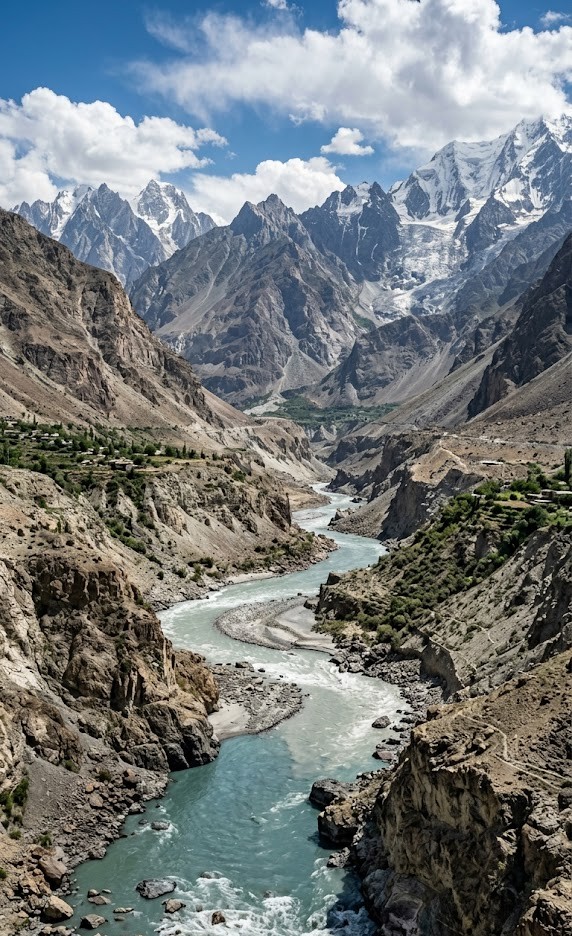
The Indus River System serves as the primary arterial network for Pakistan’s economic and physical survival. Originating in the Tibetan Plateau and fed by the vast cryosphere of the Hindu Kush-Himalayan and Karakoram ranges, the basin supports over 240 million people. As of April 2026, the structural integrity of this water supply is facing unprecedented volatility. The system relies on a delicate balance between seasonal snowmelt, glacial discharge, and monsoon rainfall; however, the equilibrium that sustained the Indus Basin for millennia has shifted into a state of permanent disruption.
The Indus is unique among the world’s major river systems due to its high dependency on cryospheric melt. Unlike the Ganges or the Brahmaputra, which receive significant contributions from lower-altitude rainfall, nearly 80% of the Indus’s flow is derived from snow and ice melt at high elevations. This makes the basin exceptionally sensitive to thermal variations in the upper atmosphere. Current climate data indicates that the Third Pole, the region encompassing these peaks, is warming at a rate 0.3°C faster than the global average, leading to a phenomenon known as elevation-dependent warming.
Glacial Retraction and the 2026 Cryospheric Assessment
Recent satellite telemetry and field observations conducted in early 2026 by the Pakistan Council of Research in Water Resources and international partners confirm that glacial mass loss in the Karakoram has moved beyond the "Karakoram Anomaly" phase. For years, glaciers in this specific sub-range showed stability or slight growth, a stark contrast to the global trend. That buffer has now vanished.
Statistical modeling shows that glacial retreat in the upper Indus basin has accelerated by 14% compared to the 2018–2022 mean. The loss of ice volume is not merely a long-term environmental concern; it is a current driver of catastrophic hydrological events. The proliferation of Glacial Lake Outburst Floods (GLOFs) has reached a critical frequency. In the first quarter of 2026 alone, Gilgit-Baltistan and Khyber Pakhtunkhwa recorded seven significant GLOF events, damaging infrastructure and altering downstream siltation levels.
The mechanism of this crisis is two-fold. First, the immediate increase in meltwater creates an illusion of abundance, leading to temporary surpluses in reservoir levels. Second, this "peak water" signifies the beginning of a terminal decline. Once the glacial volume reaches a tipping point, the annual discharge will inevitably contract, leading to a permanent reduction in the base flow of the Indus. Experts at the International Centre for Integrated Mountain Development suggest that the Indus may reach its "peak water" discharge before 2030, after which the region will face a precipitous drop in available perennial water.
The Nexus of Water Scarcity and Food Security
The implications of a destabilized Indus flow extend directly into Pakistan’s agricultural sector, which accounts for approximately 23% of the national GDP and employs 37% of the labor force. The Indus Basin Irrigation System is the largest contiguous irrigation network in the world, yet its efficiency is declining as water variability increases.
In 2026, the per capita water availability in Pakistan has fallen to approximately 840 cubic meters, well below the international scarcity threshold of 1,000 cubic meters. This shortage is exacerbated by the timing of water delivery. The agricultural calendar depends on the predictable arrival of water for the Kharif and Rabi crops. As glacial melt occurs earlier in the spring due to rising temperatures, the water often arrives before the crops require it, leading to runoff waste in the absence of adequate storage capacity.
Conversely, by the time the peak growing season arrives, the flow often diminishes. The 2025–2026 winter crop cycle saw a 12% reduction in wheat yield in the southern province of Sindh, directly attributed to water stress during the critical heading stage of the plant.
Crop Productivity and Salinity Challenges
Water scarcity is not only a matter of volume but also of quality. As surface water becomes scarce, farmers increasingly rely on groundwater extraction. In many parts of the Punjab and Sindh provinces, the water table is receding at a rate of 0.5 to 1 meter per year. Much of this extracted water is brackish. The continuous application of saline groundwater, combined with high evaporation rates, is leading to widespread soil degradation.
Current estimates suggest that over 4.5 million hectares of land in Pakistan are affected by salinity, a figure that continues to rise as the Indus flow fails to provide the necessary flushing action to clear salts from the soil profile.
Infrastructure and Storage Limitations
A central component of Pakistan’s water crisis is the lack of storage infrastructure. The country currently possesses a water storage capacity of roughly 30 days of mean daily flow. For comparison, nations with similar hydrological profiles maintain capacities exceeding 1,000 days. This lack of "hydrological insurance" means that Pakistan is unable to capture the excess meltwater and monsoon surges that characterize the current era of climate volatility.
The Tarbela and Mangla reservoirs, the twin pillars of Pakistan’s water management, are facing significant sedimentation issues. Silt carried down from the eroding mountain ranges, exacerbated by the lack of vegetation and rapid glacial melt, has reduced the original storage capacity of these dams by over 25%. While large-scale projects like the Diamer-Bhasha and Mohmand dams are underway, their completion remains a long-term goal. As of mid-2026, the reliance on aging infrastructure remains a critical vulnerability. The lack of small-scale dams and check-dams in the arid regions of Balochistan further ensures that seasonal rainfall is lost to the sea rather than being diverted to groundwater recharge.
Demographic Pressure and Urban Demand
The crisis is intensified by a population growth rate that remains among the highest in the region. The urban centers of Karachi, Lahore, and Islamabad are expanding at a pace that outstrips their water delivery systems. Karachi, a megacity of over 20 million, currently experiences a water supply-demand gap of approximately 450 million gallons per day.
The competition for water between the agricultural and domestic sectors is creating internal friction. As cities demand more water for human consumption and industrial use, the allocation for agriculture is squeezed. This is compounded by an inefficient distribution network; in major cities, up to 40% of the water supply is lost through leakages and unauthorized siphoning.
Transboundary Water Governance and the Indus Waters Treaty
The water crisis is not contained within Pakistan’s borders. The Indus is a transboundary river, and its management is governed by the 1960 Indus Waters Treaty (IWT). For over six decades, the IWT has survived multiple conflicts, but the pressures of climate change and 2026-era engineering are testing its limits.
The treaty was drafted based on historical flow data that did not account for the drastic changes in glacial behavior or the increased frequency of extreme weather events. Tensions often arise over the construction of hydroelectric projects on the western rivers: the Indus, Jhelum, and Chenab which are allocated to Pakistan but where India is permitted limited "run-of-the-river" usage.
"The Indus Waters Treaty remains a vital framework, but it was designed for a static climate that no longer exists," notes a 2025 report from the World Bank. The absence of data-sharing mechanisms regarding real-time glacial melt and flow rates increases the risk of miscalculation and conflict during periods of drought or flood.
Economic Implications of Water Insecurity
The financial toll of water mismanagement and climate-driven disasters is staggering. The 2022 floods provided a preview of the economic devastation possible, with losses exceeding $30 billion. In 2026, the cumulative effect of chronic water scarcity is estimated to be shaving 4% to 6% off Pakistan’s annual GDP.
The energy sector is particularly vulnerable. Since nearly 30% of Pakistan’s electricity is generated through hydropower, fluctuations in the Indus flow lead to immediate power shortages. This energy insecurity forces a reliance on expensive imported fossil fuels, worsening the country’s balance-of-payments crisis. The interconnectivity of water, food, and energy means that a failure in water management triggers a systemic economic contraction.
Technical and Policy Interventions
Addressing a crisis of this magnitude requires a transition from "supply-side" management to "demand-side" efficiency. The historical focus on building larger dams must be complemented by a radical overhaul of water use practices. Various technical strategies are currently being deployed to mitigate waste and improve resource management across the basin.
One primary focus is the implementation of laser land leveling in the agricultural sector, which has demonstrated the capacity to reduce water wastage by 20% to 30% by ensuring more uniform distribution across fields. In the realm of horticulture and high-value crops, the adoption of drip irrigation is being prioritized, as it can increase water use efficiency by up to 90%. Beyond the farm, industrial and urban centers are looking toward wastewater recycling, which carries the potential to recover up to 50% of urban water demand if properly scaled. Additionally, comprehensive aquifer mapping is essential for resource management to prevent the continued over-extraction of groundwater.
The 2026 National Water Policy update emphasizes the need for water pricing reform. Currently, the water tax collected from farmers is negligible and does not cover the maintenance costs of the irrigation system. Implementing a volumetric pricing model is seen as essential to incentivize conservation, though it remains politically sensitive. Furthermore, the integration of AI-driven hydrological forecasting is beginning to provide better lead times for flood and drought warnings. In 2026, the Pakistan Meteorological Department updated its satellite-based monitoring of the cryosphere, allowing for more precise predictions of seasonal inflows.
The Role of the Karakoram Anomaly and Future Projections
Scientists continue to study the Karakoram region to understand why certain glaciers resisted melting longer than those in other major mountain ranges. The 2026 consensus suggests that specific meteorological patterns including increased winter precipitation and lower summer temperatures at extreme altitudes, provided a temporary shield.
That shield is now failing. As the zero-degree isotherm moves higher, even the most resilient glaciers are entering a phase of negative mass balance. By 2050, if current warming trends persist, the region could lose up to one-third of its total ice volume. For Pakistan, this represents a transition from a river-fed civilization to one that must survive on erratic seasonal rainfall.
Conclusion
The crisis of the Indus is a confluence of rapid glaciological change and internal systemic inefficiency. The acceleration of glacial melt in 2026 serves as a definitive warning that the hydrological patterns of the last century are no longer a reliable guide for the future. Pakistan’s ability to withstand this pressure depends on its capacity to modernize its irrigation infrastructure, stabilize its transboundary water diplomacy, and implement rigorous conservation measures. The Indus remains the lifeblood of the nation, but it is no longer an inexhaustible resource. The coming decade will determine whether the country can adapt its economic and social structures to a new era of permanent hydrological volatility.
Comments (0)
No comments yet. Be the first to comment!