Pak Imtehan
Competitive Exams Prep App (CSS,PMS)
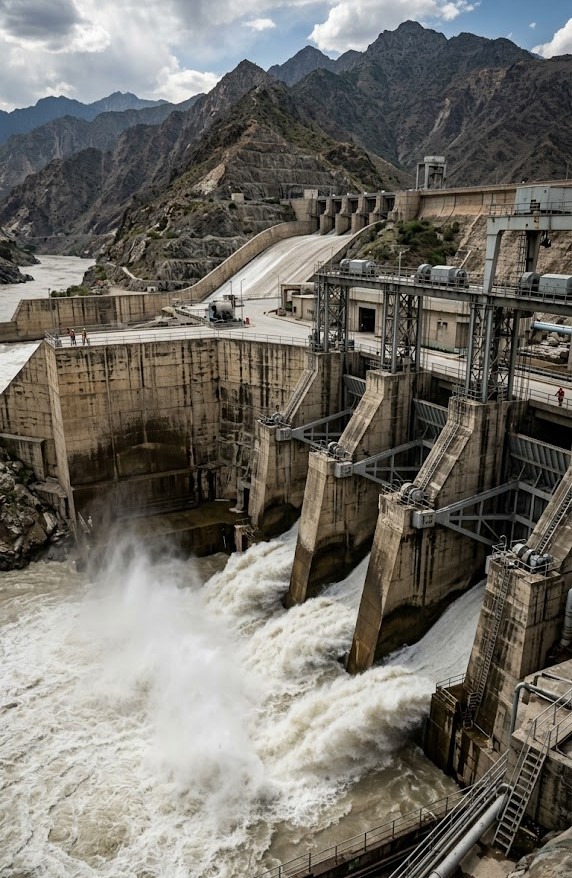
The Indus River System operates as the vascular system of Pakistan’s economy, yet its management remains a persistent source of friction between provinces. At the center of this tension is the Tarbela Dam, the country's primary regulatory organ for water distribution. In recent years, a recurring pattern of maintenance delays and infrastructure bottlenecks at Tarbela has intersected with the onset of the Kharif sowing season, creating a perfect storm of economic risk and political distrust. When the gates at Tarbela fail to open on schedule or technical faults limit discharge during the critical weeks of April and May, the resulting water scarcity is not shared equally. Instead, it exacerbates a long-standing zero-sum game between the upper and lower riparian regions, turning a technical engineering issue into a foundational threat to national cohesion.
The timing of these infrastructure failures is particularly ruinous. The Kharif season, which includes high-value crops like cotton, rice, and sugarcane, relies heavily on the early availability of water for nurseries and initial sowing. Unlike the late-summer monsoons that provide a surplus, the early Kharif period is characterized by low river inflows and high dependency on stored reservoir water. When maintenance projects at Tarbela, such as the T5 Hydropower Project or tunnel repairs, spill over into this window, the Water and Power Development Authority (WAPDA) and the Indus River System Authority (IRSA) find themselves arbitrating a crisis of their own making.
The Mechanics of Riparian Friction
The 1991 Water Apportionment Accord was intended to settle the distribution of Indus waters, yet its implementation remains haunted by the "Paragraph 14" dispute regarding the sharing of shortages. Infrastructure delays at Tarbela act as a catalyst that brings these dormant legal disagreements to the surface. When Tarbela cannot discharge its full capacity due to technical constraints, the immediate impact is felt by Sindh, the lower riparian province.
Geographically, Sindh is at the end of the line. Any reduction in the "indent," the amount of water requested by a province, due to upstream infrastructure hurdles is viewed not as a technical necessity but as a systemic bias. The delay in the Kharif transition often means that while Punjab may utilize its proximity to the rim stations and its groundwater reserves, Sindh faces acute shortages that delay sowing by weeks. This delay has a cascading effect: late sowing leads to lower yields, higher pest vulnerability, and a shorter window for the subsequent Rabi (winter) crops.
The technical nature of Tarbela's current challenges, specifically the T5 expansion and the management of siltation, complicates the water-sharing math. Silt buildup has already reduced the live storage capacity of the reservoir by over 30% since its inception. Consequently, the margin for error in infrastructure management has vanished. When a tunnel is closed for retrofitting and the work hits a snag, IRSA is forced to slash provincial quotas. In this environment, "technical difficulty" becomes a politically loaded phrase.
"The lack of transparency in water flow data at the entry and exit points of the barrages creates a trust deficit that no amount of engineering can fix," notes a senior representative from a leading international development bank.
The Economic Cost of the Sowing Gap
The synchronization of water release with the biological clock of the Kharif crops is the most significant variable in Pakistan’s agricultural GDP. In 2024 and 2025, the mismatch between Tarbela’s discharge capabilities and the sowing requirements for cotton in the lower Indus basin led to a measurable decline in acreage.
Cotton Vulnerability: Early Kharif water is essential for the cotton belt in Sindh and Southern Punjab. Infrastructure delays that push sowing into the high-heat months of June increase seedling mortality.
The Rice Shift: Shortages at the start of the season often force farmers to switch from high-delta crops like rice to less profitable alternatives, or worse, leave the land fallow, impacting the national export balance.
Groundwater Dependency: In the absence of canal water due to Tarbela's constraints, farmers with means turn to tube wells. This increases the cost of production due to high electricity and diesel prices, while further depleting the already stressed aquifers.
The economic fallout is not limited to the farm gate. Pakistan’s textile sector, which accounts for roughly 60% of total exports, relies on a predictable domestic cotton crop. When Tarbela’s infrastructure delays ripple through the Kharif season, the state is forced to spend precious foreign exchange on importing raw cotton. Thus, a delayed turbine installation or a botched tunnel repair translates directly into a balance of payments crisis.
Institutional Gridlock and the Data War
The primary arbiter of these disputes, IRSA, often finds itself paralyzed by the conflicting data provided by WAPDA and the provincial irrigation departments. The core of the problem lies in the telemetry system, or the lack thereof. For decades, the measurement of water flow at key points like the Taunsa, Guddu, and Sukkur barrages has been manual, leading to allegations of "water theft" and misreporting.
When Tarbela's infrastructure fails to deliver, the provinces engage in a "war of cusecs." Punjab argues that transmission losses, water that seeps into the ground or evaporates as it travels south, are higher than historical averages, justifying lower deliveries to Sindh. Sindh, conversely, argues that these losses are being used as a cover to divert water to illegal canals or to over-irrigate upstream lands.
The institutional failure here is two-fold. First, there is a failure of project management. Large-scale interventions at Tarbela are frequently planned without a realistic buffer for the Kharif start date. Second, there is a failure of communication. WAPDA’s technical timelines are often siloed from IRSA’s seasonal planning, leaving the provincial irrigation departments to manage a crisis they did not see coming.
"Water management in Pakistan is treated as an engineering problem, when in reality, it is a socio-political contract that requires constant renewal," argues a former chairman of the Planning Commission.
The Geopolitical and Internal Security Dimension
Inter-provincial water disputes are not merely administrative hurdles; they are a threat to the federation. The narrative of "water injustice" is a potent tool for political mobilization. In Sindh and Balochistan, the sight of dry canals during the Kharif season provides fertile ground for nationalist rhetoric that portrays the center as indifferent to the periphery's survival.
The Tarbela infrastructure delays provide a specific grievance: the prioritization of hydropower over irrigation. WAPDA, driven by the need to bridge the country’s energy deficit, often prioritizes maintaining water levels for power generation (the "power head") rather than releasing water for downstream agriculture. This creates a fundamental clash of interests. The farmer in Badin sees electricity for the city of Lahore as being bought at the cost of his parched fields.
This internal friction weakens Pakistan’s position in international water diplomacy. When the country cannot manage its internal distribution efficiently, its arguments regarding the Indus Waters Treaty and upstream violations by India lose moral and technical weight. A house divided over its own reservoir cannot stand firm on transboundary rights.
Technical Solutions vs. Political Will
To break this cycle, the approach to Tarbela’s infrastructure must move beyond ad-hoc repairs toward a Climate-Smart Hydrological Calendar. This involves several critical shifts:
Strict Seasonal Deadlines: Infrastructure projects at Tarbela must be governed by "drop-dead" dates. If a project is not completed by March 15th, it must be put in a state that allows for maximum discharge by April 1st, regardless of the delay in power generation. The priority must be irrigation, as the economic multiplier of a successful Kharif season far outweighs the marginal gains from early power synchronization.
Digital Transparency: The installation of an automated, real-time telemetry system is no longer optional. Data on reservoir levels, tunnel discharge, and barrage flows must be accessible to all provincial stakeholders in real-time. This "digital trust" is the only way to depoliticize technical failures.
The Rise of Small-Scale Storage: Over-reliance on Tarbela is a strategic vulnerability. The delay in the construction of the Diamer-Bhasha and Mohmand dams has left Pakistan with no "spare tire." While these large projects continue, there must be a push for off-stream storage and small dams in all provinces to buffer against Tarbela’s maintenance windows.
Beyond the Concrete: A New Water Compact
The recurring crisis at Tarbela during the Kharif season is a symptom of a larger malaise: the treating of water as a static resource rather than a fluctuating, precious commodity. As climate change makes Indus inflows more erratic, with rapid glacial melt followed by prolonged droughts, the margin for infrastructure inefficiency will shrink further.
The solution is not just more concrete and steel. It is a fundamental redesign of the Inter-Provincial Water Compact. This requires a move away from the rigid, often-ignored quotas of 1991 toward a dynamic management system that accounts for real-time storage constraints and transmission losses.
If Pakistan continues to allow infrastructure maintenance to dictate the fate of the Kharif season, the country will remain trapped in a cycle of agricultural underperformance and provincial resentment. The water is there, even in lean years; the tragedy lies in the fact that the gates meant to manage it have become the very obstacles to its flow. The survival of the Kharif season, and by extension the national economy, depends on turning Tarbela from a source of dispute into a reliable, transparent cornerstone of the federation.
Comments (0)
No comments yet. Be the first to comment!