Pak Imtehan
Competitive Exams Prep App (CSS, PMS)
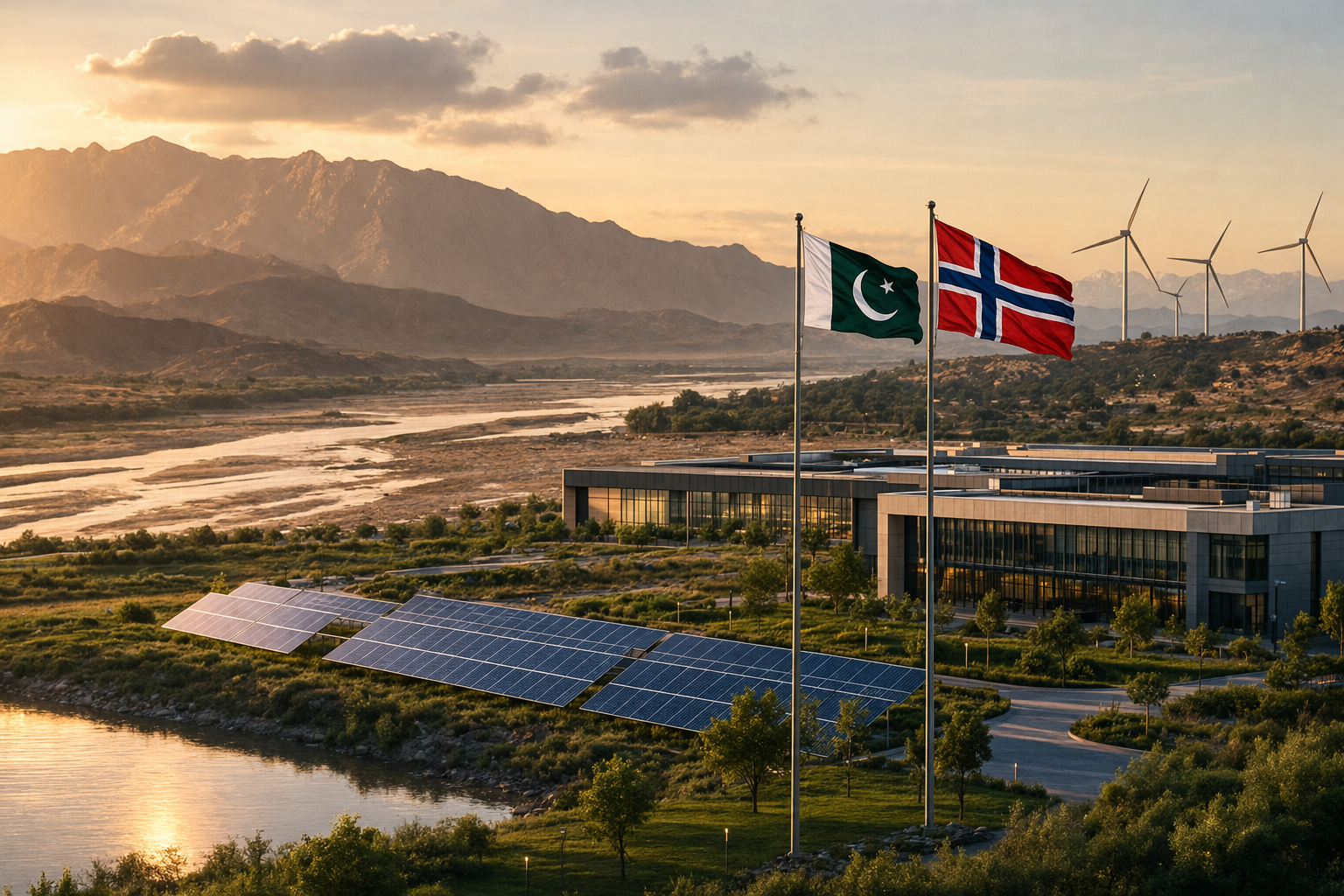
The bilateral agreement signed in early 2026 between Islamabad and Oslo marks a departure from traditional North-South climate aid. Rather than relying on the unpredictability of discretionary grants, the Pakistan-Norway Climate Finance Agreement (PNCFA) establishes a sophisticated marketplace for carbon offsets, leveraging Article 6.2 of the Paris Agreement. This deal is not merely an environmental contract; it is a strategic alignment between a high-emission, capital-rich Nordic state and a climate-vulnerable, debt-distressed South Asian nation.
The arrangement centers on a debt-for-nature swap mechanism intertwined with high-integrity carbon credits. Norway commits to purchasing 15 million metric tons of carbon dioxide equivalent (MtCO2e) over five years, with the proceeds specifically earmarked for retiring high-interest external debt and funding the "Recharge Pakistan" initiative.
The Geopolitical Calculus of the Deal
For Norway, the agreement serves as a vital hedge against its domestic industrial emissions. Despite its leadership in electric vehicle adoption and renewable energy, Norway’s sovereign wealth remains tied to petroleum exports. By securing a reliable pipeline of Internationally Transferred Mitigation Outcomes (ITMOs) from Pakistan, Oslo maintains its ambitious net-zero trajectory without forcing an immediate, economically disruptive shutdown of its North Sea operations.
Pakistan, conversely, views carbon diplomacy as a tool for fiscal survival. Facing a persistent balance-of-payments crisis, the state has realized that its geographical vulnerability to climate change, typified by the catastrophic 2022 floods, can be converted into a financial asset. The PNCFA treats Pakistan’s massive mangrove restoration projects in Sindh and its transition toward decentralized solar grids as "sovereign carbon sinks" that command a premium in the European market.
As noted by climate economist Rachel Kyte, "The shift from climate aid to climate trade represents the maturation of the Paris Agreement, where sovereign states negotiate carbon as a hard currency rather than a charitable request."
Institutional Integrity and the Additionality Problem
The success of the PNCFA hinges on the concept of "additionality," the proof that these carbon-reducing projects would not have happened without Norwegian capital. Historically, carbon markets have been plagued by "phantom credits," where forest protection is claimed for areas that were never actually under threat.
To bypass these pitfalls, the 2026 agreement utilizes a decentralized blockchain ledger for real-time Monitoring, Reporting, and Verification (MRV). Satellite data provided by the European Space Agency (ESA) is integrated into the Pakistani Ministry of Climate Change’s reporting systems. This transparency is crucial because it prevents "double counting," a situation where both Norway and Pakistan claim the same emission reduction toward their National Determined Contributions (NDCs).
Pakistan’s Indus Delta Blue Carbon project is the centerpiece of this technical framework. By restoring over 350,000 hectares of mangroves, the project captures carbon at a rate significantly higher than terrestrial forests. Under the PNCFA, Norway pays a floor price of $35 per ton, a significant increase from the volatile $5–$10 rates seen in voluntary markets during the early 2020s. This price floor provides Pakistan with the predictable revenue required to restructure provincial budgets.
Economic Linkages: From Carbon to Capital
The agreement introduces a novel "Escrow for Energy" structure. The payments from Norway do not enter Pakistan’s general treasury, where they might be diverted to bridge fiscal deficits. Instead, they flow into a ring-fenced fund managed by a joint board. This fund services the interest on green bonds issued to finance the 7,000 MW solar transition in Punjab and Khyber Pakhtunkhwa.
This creates a self-sustaining loop:
Carbon Sequestration: Pakistan protects mangroves and restores wetlands.
Credit Issuance: Verified credits are transferred to Norway.
Debt Relief: Norway’s payments pay down Pakistan’s high-cost bilateral debt.
Energy Transition: Reduced debt allows Pakistan to invest in domestic renewables, further reducing its reliance on expensive imported LNG and coal.
"The Pakistan-Norway model proves that climate finance is most effective when it addresses the underlying debt distress of the Global South," suggests Avinash Persaud, a key architect of the Bridgetown Initiative. By linking carbon credits to debt sustainability, the agreement moves beyond the narrow scope of environmentalism and enters the realm of macro-economic stabilization.
Risks of Sovereignty and Market Volatility
Despite the optimistic framework, the PNCFA faces two significant risks. The first is "carbon colonization." Critics argue that by selling its "low-hanging fruit," the easiest and cheapest emission reduction projects—to Norway today, Pakistan may find it prohibitively expensive to meet its own future net-zero targets in the 2040s. When the easy credits are gone, Pakistan will be left with the high-cost industrial decarbonization tasks but no credits left to sell to fund them.
The second risk is the legal complexity of Article 6.2 authorizations. If the Pakistani government fails to maintain the rigorous MRV standards required by the EU's Carbon Border Adjustment Mechanism (CBAM), the credits could be downgraded to "junk" status, leaving a hole in the projected revenue. The agreement includes a "clawback" clause: if the restored mangroves are destroyed by local industrial activity or neglect, Pakistan must replace those credits or face a reinstatement of the debt it sought to retire.
The Shift in Global Climate Governance
The 2026 agreement is a bellwether for a broader shift in global governance. It suggests that the future of climate action lies in bilateralism rather than multi-lateralism. While UN-led COP summits often struggle with consensus, the PNCFA demonstrates that two nations with complementary needs: one needing offsets, the other needing capital can move with a speed and precision that global forums lack.
This deal also signals the end of the "Global South" as a monolithic bloc of aid recipients. Pakistan is positioning itself as a service provider in the global carbon economy. By exporting environmental mitigation, it is participating in a sophisticated trade relationship.
A Template for the Future?
As the international community looks toward the 2030 milestones, the Pakistan-Norway Climate Finance Agreement offers a pragmatic, if difficult, blueprint. It acknowledges that the transition to a low-carbon economy is as much a financial engineering challenge as it is a biological one.
The success of this partnership will be measured not just in tons of CO2 sequestered, but in the stability of the Pakistani rupee and the resilience of its coastal communities. If the model holds, it could pave the way for similar "Carbon-Debt-Swaps" across Sub-Saharan Africa and Southeast Asia, effectively creating a new asset class where natural capital becomes the primary lever for national development.
The agreement turns the narrative of climate vulnerability on its head. It suggests that for a country like Pakistan, the path to economic recovery may well be paved with the very mangroves and rivers that were once seen as the victims of global warming. The 2026 deal is the first major step in proving that environmental preservation is not a luxury of the rich, but a survival strategy for the developing.
Comments (0)
No comments yet. Be the first to comment!