Pak Imtehan
CSS PMS Pakistan Affairs
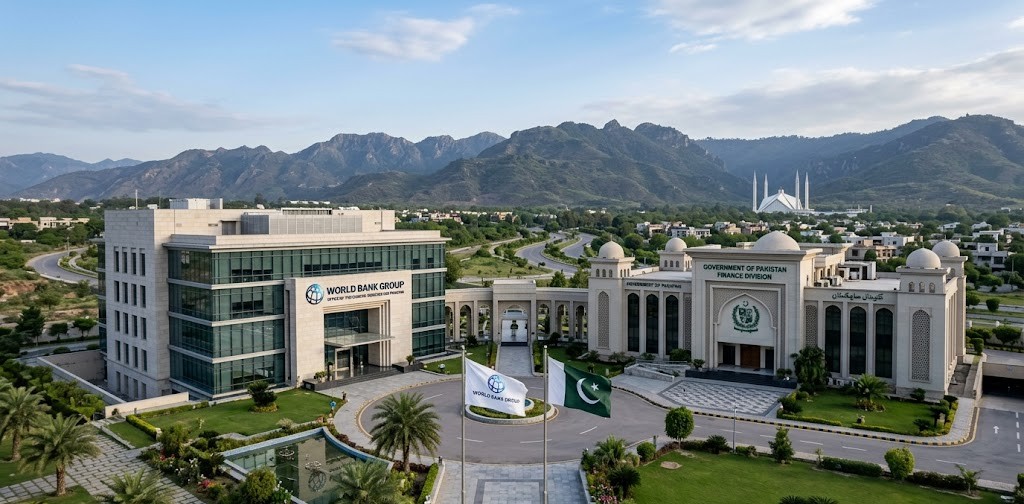
For decades, the geopolitical and economic identity of Pakistan was firmly rooted in the Indian Subcontinent. As a founding member of SAARC and a central player in the shared history of South Asia, Pakistan was analytically inseparable from its neighbors to the east. However, the World Bank’s recent decision in early 2026 to officially move Pakistan out of the South Asia Region (SAR) and into the newly formed MENAAP (Middle East, North Africa, Afghanistan, and Pakistan) grouping marks a historic departure. This reclassification is not merely a bureaucratic shuffle; it is a recognition of a profound shift in Pakistan's economic gravity, energy dependencies, and strategic alignment.
The End of an Era: Why the "South Asia" Label Faded
The South Asia designation always carried a certain degree of historical and cultural logic, yet for years, the economic data began to tell a story of divergence. While India and Bangladesh moved toward export-oriented manufacturing and deeper integration with East Asian supply chains, Pakistan’s economic cycle remained stubbornly decoupled from its neighbors.
The primary driver for this "Subcontinental divorce" is the lack of intra-regional trade. Despite geographical proximity, trade between Pakistan and the rest of South Asia has remained negligible due to long-standing political impasses. When the World Bank looks at a country to assess its risks and growth potential, it looks at who that country trades with and where its money comes from. For Pakistan, the answer hasn’t been New Delhi or Dhaka; it has been Riyadh, Abu Dhabi, and Beijing.
By 2026, the "South Asia" label became an analytical anchor that no longer reflected Pakistan's reality. Grouping a country facing 7.4% inflation and 3.0% growth with neighbors experiencing vastly different fiscal paths made regional reports less accurate. The reclassification is, in many ways, an admission that Pakistan’s economic heartbeat now pulses in sync with the Middle East and the fragile states of Central Asia.
The Logic of MENAAP: Energy and Remittances
The creation of the MENAAP bloc acknowledges that Pakistan’s stability is physically and fiscally tied to the "West" rather than the "East." The logic here is twofold: energy dependence and the labor market.
Pakistan’s energy profile is the most significant factor in this shift. Unlike India, which has successfully diversified its energy mix and increased domestic production, Pakistan remains acutely sensitive to the price of Brent crude and the stability of Gulf shipping lanes. The recent 2026 disruptions in the Strait of Hormuz provided a definitive case study for the World Bank. When the Strait faced effective closure, the economic shockwaves hit Pakistan with the same intensity as they hit Jordan or Egypt. By moving Pakistan into the MENAAP category, the World Bank can now provide policy advice that treats energy security as a shared regional crisis between the Gulf and the Indus.
Secondly, the "human export" model defines Pakistan’s fiscal health. The country’s foreign exchange reserves are essentially a mirror of the Middle Eastern construction and service sectors. When Saudi Arabia or the UAE undergo economic reforms or face oil-price volatility, the impact on Pakistan via remittances is immediate. In the South Asian grouping, these flows were often treated as an outlier; in MENAAP, they are the standard.
Geopolitical Realignment: The "Arc of Fragility"
Beyond the balance sheets, there is a sober strategic reality behind the MENAAP classification. The World Bank and other global lenders are increasingly viewing the region spanning from North Africa through the Levant and into the Hindu Kush as an "Arc of Fragility."
By grouping Afghanistan and Pakistan with the MENA region, the World Bank is aligning its economic strategy with the security realities on the ground. The challenges of cross-border displacement, non-state actors, and climate-induced migration are shared concerns for these nations. Afghanistan and Pakistan, in particular, face a "coupled" destiny. Treating them as part of a broader Middle Eastern and North African framework allows for a more holistic approach to crisis management and humanitarian aid, strategies that are often unnecessary for the relatively more stable South Asian states.
Impact on Policy and Global Benchmarking
What does this mean for the average Pakistani citizen or policymaker? For one, the "yardstick" has changed. For years, Pakistan was compared often unfavorably to the high-growth models of India. This comparison frequently ignored the fundamental structural differences in their economies.
Under MENAAP, Pakistan will be benchmarked against nations like Egypt, Morocco, and Lebanon. These are countries that, like Pakistan, struggle with high debt-to-GDP ratios, significant youth unemployment, and the need for massive structural reforms in the energy sector. This change in peer groups is actually beneficial for Pakistani technocrats. It allows for a "like-for-like" comparison that can lead to more realistic policy prescriptions. Instead of chasing the manufacturing ghost of East Asia, Pakistan can look at how MENA countries are navigating the transition to renewable energy or how they are formalizing their "grey" economies.
The 2026 Economic Outlook: A Cautious Reality
The World Bank’s recent report, which coincided with this reclassification, was not a celebration. A downgraded growth forecast of 3.0% for FY2026 suggests that the move to MENAAP is a move into a "high-risk" neighborhood. The Bank is signaling that Pakistan’s recovery is fragile and highly susceptible to external shocks.
The focus of the World Bank's recent advice, digitalizing social protection and reforming industrial policy reflects a MENA-style approach to governance. The emphasis is on building a social safety net that can withstand global price hikes while trimming state-led interventions that have failed to produce results. The Minister of Finance’s recent engagements in Washington further cement this; the discussion is no longer about "South Asian integration" but about "Global Partnership Frameworks" that secure Pakistan’s place as a pivotal state between the Middle East and Central Asia.
Conclusion:
The reclassification of Pakistan by the World Bank is a watershed moment in the country’s economic history. It represents a move away from a historical identity that had become functionally obsolete and toward a modern identity that is grounded in the reality of its dependencies.
While some may see this as a "demotion" or a distancing from the growth story of South Asia, it is more accurately described as a "clarification." Pakistan is a West Asian power with South Asian roots. By recognizing this, the World Bank is finally providing a framework that matches the country's actual economic behavior. The road ahead for the "MENAAP" member is challenging, fraught with energy crises and regional instability, but at least the map being used to navigate that road now matches the terrain.
As Pakistan navigates its 3.0% growth course in 2026, the focus must remain on leveraging this new regional alignment to secure energy concessions, formalize remittance channels, and finally enact the structural reforms that have remained elusive for decades. The subcontinent may be where Pakistan’s past lies, but its economic future is now officially written in the context of the broader Muslim world and the MENA region.
Comments (0)
No comments yet. Be the first to comment!