Pak Imtehan
Competitive Exams Prep App (CSS-Global Affairs)
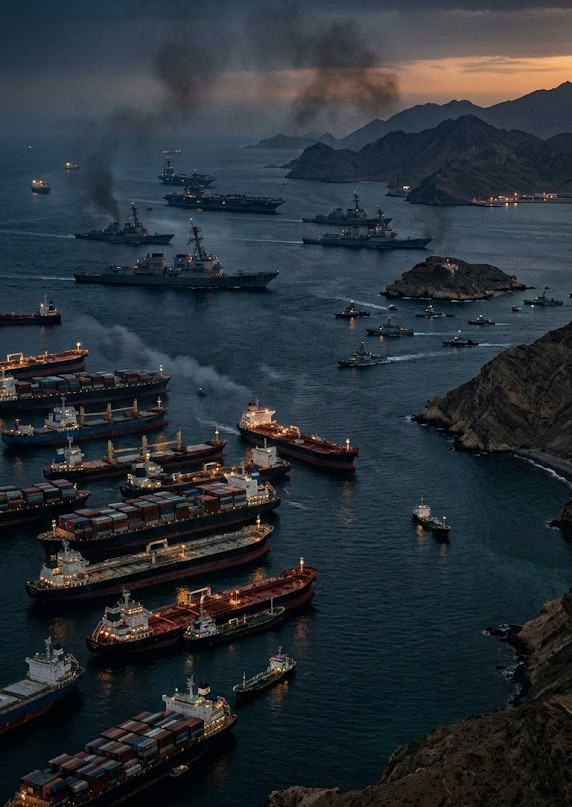
The global energy market currently exists in a state of suspended animation, awaiting the stroke of 8:00 P.M. Eastern Time this Tuesday. For the first time in the history of modern maritime trade, a United States President has placed a hard temporal boundary on the freedom of navigation in the Strait of Hormuz, transforming a 21-mile-wide waterway into the world’s most volatile geopolitical countdown.
The ultimatum issued by President Donald Trump is not merely a tactical threat; it is a fundamental test of the "Peace through Strength" doctrine applied to a theater where the traditional rules of engagement have been discarded. By threatening to target domestic infrastructure, specifically power plants and bridges, if the Strait is not reopened, the administration is attempting to decouple the maritime blockade from the broader regional conflict. The gravity of this deadline lies in the sheer volume of global commerce currently held in check by the narrowest of chokepoints.
The Calculus of the Tuesday Deadline
The decision to set a Tuesday deadline follows a month of escalating friction that has effectively paralyzed the Persian Gulf. Since late February 2026, the Strait of Hormuz has seen its daily traffic drop by more than 90%. In normal market conditions, approximately 21 million barrels of oil transit the passage daily, representing roughly 21% of global petroleum liquid consumption.
The administration’s strategy appears to be rooted in the belief that the current "selective blockade," whereby certain vessels are permitted passage based on destination and cargo, cannot be allowed to become a permanent feature of international law. For Washington, the Tuesday deadline serves three distinct strategic purposes:
Restoration of Predictability: The global insurance market for maritime shipping has reached a breaking point. By setting a hard date, the U.S. is attempting to force a resolution that allows insurers to recalibrate risk, which has currently rendered most commercial transit through the Gulf economically unviable.
Infrastructure-as-Leverage: Unlike previous "maximum pressure" campaigns that focused on banking sanctions, the threat to target bridges and power plants represents a shift toward "functional paralysis." The administration is betting that the internal cost of losing domestic connectivity and energy reliability will outweigh the strategic benefits of maintaining the blockade.
Energy Decoupling: In recent statements, the President has asserted that the United States "does not need" the Strait, citing domestic energy production. This rhetoric is designed to signal to the market that the U.S. can sustain a prolonged disruption better than its competitors, thereby reducing the "energy blackmail" potential of the closure.
The Economic Shiver: Beyond the Price of Crude
While the headlines focus on the price of Brent crude, the deeper analytical concern involves the "downstream shock" to global manufacturing and food security. The Strait of Hormuz is not just an oil artery; it is a critical corridor for liquefied natural gas (LNG) and fertilizers.
Qatar and the United Arab Emirates together account for nearly 20% of global LNG exports, the vast majority of which must pass through the Strait. A prolonged closure beyond the Tuesday deadline would likely trigger a secondary energy crisis in Europe and Asia, where LNG has become the primary bridge fuel for industrial output. Furthermore, the bottlenecking of fertilizer exports, particularly urea and sulphur from Saudi Arabian and Emirati ports, is beginning to impact the 2026 planting seasons in the Western Hemisphere.
"The market impact of a total Hormuz closure is non-linear; once the strategic reserves are tapped, the absence of Qatari LNG and Saudi crude creates a supply vacuum that no other region has the spare capacity to fill." [Global Energy Outlook, 2026]
The logistical reality is that while pipelines like Saudi Arabia’s East-West Crude Pipeline (Petroline) exist, they only offer a partial reprieve. The Petroline has a nameplate capacity of roughly 5 million barrels per day, leaving over 15 million barrels "stranded" behind the chokepoint. If the deadline passes without a resolution, the world faces a physical shortage of molecules, not just a spike in paper trading prices.
Tactical Realities and the "Power Plant Day" Doctrine
The administration’s rhetoric regarding "Power Plant Day" and "Bridge Day" suggests a shift toward a target-rich, low-footprint military strategy. By focusing on fixed infrastructure, the U.S. avoids the complexities of a ground engagement while targeting the "nervous system" of a modern state.
However, the maritime reality inside the Gulf remains complex. The IRGC (Islamic Revolutionary Guard Corps) has utilized the geography of the Strait, specifically the islands of Larak, Qeshm, and Hormuz, to create a layered defense system. The presence of naval mines and shore-based anti-ship cruise missiles means that "reopening" the Strait is not as simple as clear skies; it requires a massive minesweeping and escort operation that could take weeks, regardless of the political will in Washington.
The Tuesday deadline is therefore a race against the clock to secure a diplomatic off-ramp before the kinetic phase begins. Reports suggest that negotiators are currently discussing a "Green Channel" for non-aligned commercial vessels, which would satisfy the U.S. demand for an open Strait without requiring a full cessation of regional hostilities.
The Geopolitical Stakeholders: A Quiet Middle Ground
While the U.S. has taken the lead on the ultimatum, other regional actors are navigating a delicate balance. Saudi Arabia, Kuwait, and the UAE have expressed a desire for the restoration of maritime stability while simultaneously seeking to avoid a total regional conflagration.
For the Gulf Cooperation Council (GCC), the closure is an existential threat to their Vision 2030 and 2040 economic diversification plans. Without the ability to export hydrocarbons and import the materials needed for their massive infrastructure projects, their domestic economies face a sudden cooling. This has led to a flurry of "backdoor diplomacy" in the lead-up to Tuesday, with regional capitals acting as intermediaries to define what "opening the Strait" actually looks like in practice.
The administration’s framing of the issue as a "take care of it yourselves" challenge to other nations, urging those who receive oil through the Strait to "protect it," is a notable departure from the 1980s-era Carter Doctrine, which viewed Persian Gulf security as a primary U.S. responsibility. By threatening unilateral strikes while simultaneously calling for international burden-sharing, the White House is attempting to redefine the U.S. role from "global policeman" to "enforcer of last resort."
Strategic Implications of a Post-Deadline World
If the Tuesday 8:00 P.M. deadline passes without a tangible change in the Strait's status, the global community enters uncharted territory. The transition from economic sanctions to the kinetic targeting of infrastructure would represent the most significant escalation in the Middle East in decades.
Cyber-Kinetic Convergence: Any strike on power grids is likely to be preceded or accompanied by cyber operations. Analysts expect that if the "Power Plant Day" occurs, it will be a multi-domain event designed to demonstrate the technological gap between the parties.
The "Jask" Factor: The investment in the Port of Jask, located outside the Strait on the Gulf of Oman, provides an alternative export point. Its existence serves as a strategic hedge that did not exist during previous periods of tension.
Long-Term Rerouting: A failure to resolve the crisis by Tuesday will likely trigger a permanent shift in maritime logistics. We are already seeing "Chabahar Bay" emerge as a grain import alternative, and shipowners are increasingly looking at overland rail corridors through Central Asia as a "Hormuz-bypass" for high-value goods.
"We are in a position that’s very strong, and that country will take 20 years to rebuild... if they don’t do something by Tuesday evening, they won’t have any power plants." [President Donald Trump]
The core of the "Ultimatum" is the belief that the current global energy architecture cannot survive a prolonged ambiguity. The world can handle a high oil price and localized conflict, but it cannot handle a "closed" Hormuz. By forcing the issue into a 48-hour window, the administration is betting that the clarity of the threat will produce the clarity of a solution.
The Path Forward: Diplomacy in the Shadow of the Clock
The hours leading up to Tuesday evening will likely see a frantic effort to establish a "Technical Reopening," a set of protocols where transits are monitored by neutral third parties or international maritime observers. For such a deal to work, it must address the fundamental security concerns of both the United States regarding freedom of navigation and the region's need for stability.
The Tuesday deadline is more than a threat of force; it is an attempt to shock the international system back into a state of functionality. Whether it results in the resumption of trade or a significant expansion of the conflict depends on whether the parties can find a definition of "open" that satisfies the White House’s demand for strength.
As the clock ticks toward 8:00 P.M., the world is not just watching a countdown; it is witnessing the potential birth of a new maritime order in the Middle East. The outcome will determine whether the Strait of Hormuz remains a global commons or becomes a permanently contested frontier.
Comments (0)
No comments yet. Be the first to comment!