Pak Imtehan CSS, PMS
CSS Global Affairs
The traditional Westphalian concept of victory, defined by territorial acquisition or the total capitulation of an adversary, has been rendered obsolete in the contemporary Middle Eastern theater. The recent escalatory cycle between the United States, Israel, and Iran represents a departure from conventional kinetic objectives, shifting instead toward a sophisticated contest of escalation dominance and domestic political survival. While the international community focuses on the exchange of missile salvos and the precision of air defense systems, the strategic reality suggests that the most significant gains were not made by those pulling the triggers. In the calculus of power politics, the true victor is the actor that successfully leveraged the chaos to solidify its regional position without exhausting its own resources: the Russian Federation.
The Mirage of Deterrence and the Kinetic Trap
The direct confrontation between Israel and Iran signaled a collapse of the shadow war doctrine that had governed the region for decades. However, analyzing this shift solely through the lens of military capability ignores the strategic exhaustion of the primary combatants. Israel, while demonstrating unparalleled technical superiority in its interception rates and targeted strikes, remains trapped in a multi-front war of attrition. The tactical brilliance of the Israeli Air Force (IAF) provides temporary security, but it does not resolve the fundamental strategic encirclement orchestrated by Tehran’s "Ring of Fire" strategy.
Iran, conversely, has demonstrated that it can penetrate the psychological barrier of direct state-on-state conflict. By launching massive drone and missile complexes, Tehran forced a multinational coalition to expend billions of dollars in interceptors to defeat relatively low-cost assets. This asymmetry of cost is a core pillar of Iranian doctrine. Even in failure, Iranian munitions serve as data-collection tools, testing the reaction times and saturation points of the most advanced defense networks on the planet.
The United States, acting as the security guarantor for the regional status quo, finds its strategic focus tethered to the Levant at a time when its primary long-term interest, the Indo-Pacific, demands a pivot that remains perpetually deferred. Every interceptor fired in the Red Sea or over the Galilee is a resource diverted from the containment of a rising China. Sun Tzu noted that "there is no instance of a nation benefiting from prolonged warfare," and the United States currently finds itself financing and facilitating a conflict that offers no clear endgame, only the maintenance of a brittle equilibrium.
Russia: The Beneficiary of Strategic Diversion
While Washington, Jerusalem, and Tehran remain locked in a cycle of action and reaction, Moscow has harvested the geopolitical dividends of this instability. The conflict has effectively decoupled the Middle East from the broader Western effort to isolate Russia following the invasion of Ukraine. For the Kremlin, the US-Israel-Iran friction serves as the ultimate strategic relief valve.
First, the conflict ensures that the global energy market remains sensitized to Middle Eastern instability. Despite the transition toward renewable energy, the "geopolitical premium" on oil prices remains a vital lifeline for the Russian economy. By maintaining a state of perpetual high tension in the Persian Gulf and the Levant, Moscow benefits from a floor on energy prices that offsets the impact of Western sanctions.
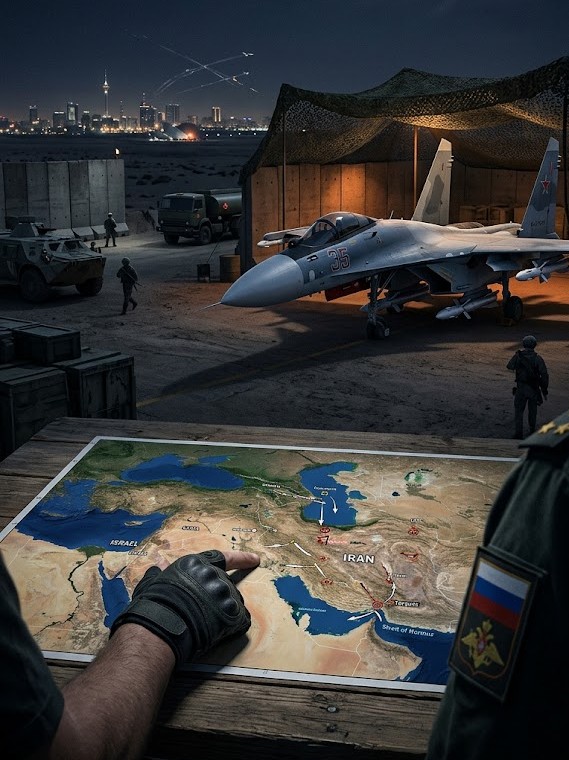
Second, the conflict has solidified the Moscow-Tehran military-industrial axis. This is no longer a marriage of convenience but a structural realignment of Eurasian security. Iran’s provision of loitering munitions and ballistic missile technology to Russia is now being reciprocated with advanced electronic warfare suites and potentially Su-35 fighter jets. This exchange accelerates the obsolescence of Western air superiority in the region. By empowering Iran, Russia creates a persistent security headache for the United States, forcing Washington to commit assets that would otherwise be deployed to the European or Pacific theaters.
The Erosion of the Abraham Accords and Strategic Realignment
A critical casualty of the recent escalation has been the momentum of the Abraham Accords. The strategic logic of the Accords was predicated on the idea that Israel could offer a security umbrella and technological partnership that outweighed the traditional Arab commitment to the Palestinian cause. However, the intensity of the recent conflict has forced regional powers, specifically Saudi Arabia and the United Arab Emirates, into a posture of tactical neutrality.
These states have realized that a full-scale conflagration between Israel and Iran would likely result in the destruction of their own energy infrastructure. Consequently, they have engaged in a sophisticated hedging strategy, maintaining ties with Jerusalem while simultaneously pursuing a detente with Tehran. This multi-vector diplomacy serves to marginalize American influence. If the regional powers no longer believe the U.S. can prevent a war, they will seek security through diversification rather than exclusive alignment with Washington.
Moscow and Beijing have been quick to exploit this shift. By positioning themselves as neutral mediators, most notably in the China-brokered Saudi-Iran deal, they offer a model of engagement that does not require the domestic political costs associated with a U.S. alliance. The strategic vacuum created by American indecision is being filled by powers that prioritize stability over democratic norms or specific regional outcomes.
Geoeconomic Leverage and the Red Sea Chokepoint
The strategic value of the recent conflict is also measured in the disruption of global trade routes. The Houthi insurgency, acting as an Iranian proxy, has effectively weaponized the Bab el-Mandeb Strait. This is not merely a regional maritime issue; it is a geoeconomic assault on the European economy.
As shipping is diverted around the Cape of Good Hope, the cost of goods in Europe rises, contributing to inflationary pressures that weaken the political resolve of NATO members. Russia benefits directly from this disruption. Any factor that increases the economic strain on the European Union reduces the appetite for continued long-term support for Ukraine. The interconnectivity of the Levant conflict and the European theater is a masterclass in grey-zone warfare. Iran provides the leverage, but Russia reaps the strategic relief.
The Doctrine of Strategic Patience vs. Political Survival
To understand the winner, one must analyze the constraints on the leaders involved. Prime Minister Benjamin Netanyahu is constrained by a fragile domestic coalition that views escalation as a necessity for political longevity. The Iranian leadership is constrained by internal dissent and an aging theocracy that views external conflict as a tool for nationalist mobilization. The Biden administration is constrained by an election cycle and a fractured electorate that is increasingly wary of forever wars.
In contrast, Vladimir Putin faces no such immediate domestic constraints. He can afford a doctrine of strategic patience. From the Kremlin’s perspective, the longer the Middle East remains on the precipice of war, the more the West is forced to choose between supporting Israel or containing Russia. This binary trap is the hallmark of effective strategic positioning. As noted by the defense analyst Michael Kofman, "Russia’s strategy in the Middle East is not to win, but to ensure that the United States continues to lose focus and resources."
The recent conflict has also demonstrated the limitations of Western intelligence and technological dominance. While the interceptions were successful, the sheer volume of the Iranian attack suggests that the threshold for saturation is closer than previously estimated. This realization has forced a recalibration of defense posture across the Middle East, leading to a surge in demand for non-Western defense partnerships.
The Future Trajectory: A Multipolar Levant
The true victor of the recent US-Israel-Iran conflict is the actor that has managed to improve its relative power position without firing a single shot in the current exchange. By these metrics, Russia has secured a strategic windfall. It has effectively:
Validated the utility of its Iranian ally.
Distracted the U.S. from the Ukrainian theater.
Increased the economic burden on European rivals.
Positioned itself as an indispensable power broker for regional states seeking an alternative to the American security architecture.
Moving forward, the region is transitioning into a permanent state of managed instability. The era of American hegemony in the Middle East is being replaced by a multipolar reality where regional actors play major powers against one another. Israel remains the dominant kinetic force, but its strategic isolation is increasing. Iran remains the dominant disruptive force, but its economic fragility persists.
The risk projection for the next twenty-four months suggests that we will see an increase in horizontal escalation. Rather than a single big war, the conflict will manifest in peripheral theaters, Sudan, the Caucasus, and the maritime commons. This fragmentation favors the actor that can operate effectively in the grey zone between peace and war.
Strategic Assessment: The New Equilibrium
The "Invisible Victor" is not found on the battlefield but in the ledger of global influence. The United States has proven it can defend Israel, but it has not proven it can deter Iran or resolve the underlying structural tensions. This failure to achieve a definitive strategic outcome creates a permanent drain on American power. In the language of classical strategy, the current situation represents a culminating point of intervention. The U.S. is doing more to achieve less. Meanwhile, the Russo-Chinese alignment is observing, adapting, and integrating the lessons of this conflict into their own doctrines for the Western Pacific and Eastern Europe. The winner is the one who watches the enemy exhaust himself against a third party.
The conflict has unmasked a reality that many in Washington are loath to accept: the Middle East is no longer an American lake. It is a contested space where the asymmetry of will often triumphs over the asymmetry of technology. The true victor is the one who understands that in modern geopolitics, the most effective weapon is not the missile that hits its target, but the conflict that never ends, slowly bleeding the hegemon of its global standing.
Comments (0)
No comments yet. Be the first to comment!