Pak Imtehan
Competitive Exams Prep App (CSS Global Affairs)
The center of gravity in global politics has shifted to a maritime corridor stretching from the Western Pacific to the Indian Ocean. While previous eras were defined by Atlantic stability or Cold War containment, the current period is marked by a fundamental contest between two incompatible visions of regional order. Washington seeks to preserve a "free and open" system based on existing norms, while Beijing views that same system as a legacy of Western dominance intended to stifle China’s rightful return as a primary power. This is not merely a dispute over trade or territory; it is a structural collision between a status quo hegemon and a revisionist challenger, played out across the world's most vital economic artery.
The Architecture of Strategic Competition
The US-China rivalry in the Indo-Pacific is defined by a paradox of deep economic integration and intensifying security competition. Unlike the Soviet Union, China is the primary trading partner for nearly every US ally in the region. This creates a "dual-track" reality where nations like Australia, Japan, and South Korea rely on American security guarantees while remaining tethered to Chinese markets.
Washington’s pivot, initiated over a decade ago but only recently finding its institutional teeth, represents an attempt to reconcile this. Through the AUKUS pact and the elevation of the Quadrilateral Security Dialogue (Quad), the United States is moving away from a traditional "hub-and-spoke" model toward a more integrated, networked security architecture. This shift acknowledges that the US can no longer maintain regional stability alone.
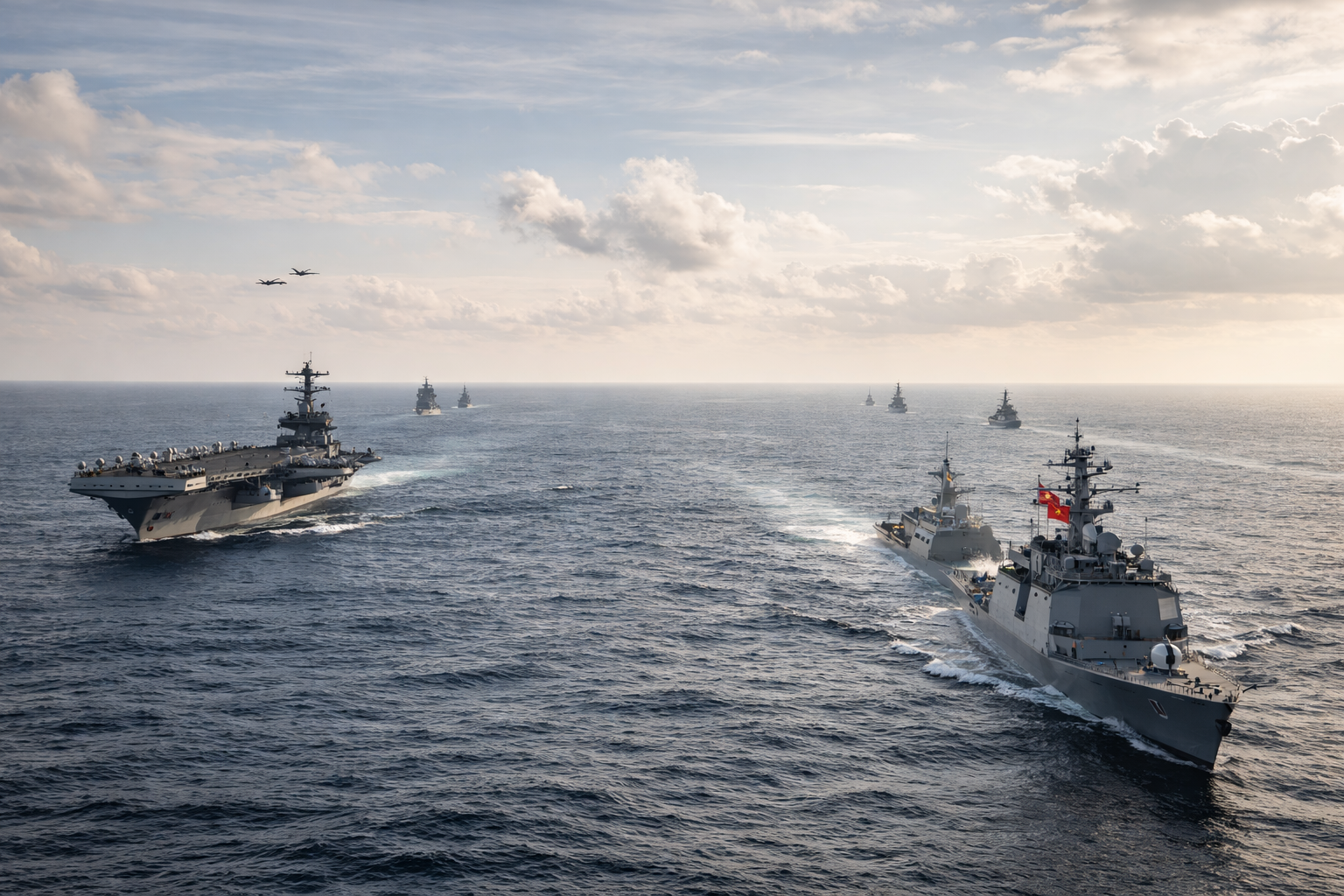
Beijing views these developments through the lens of "Cold War mentality." From the Chinese perspective, US-led minilaterals are an attempt at encirclement. China’s response has been a mix of rapid naval expansion, the People’s Liberation Army Navy (PLAN) is now the largest in the world by hull count and the use of economic statecraft to drive wedges between Washington and its partners. The goal for Beijing is to create a fait accompli where the cost of US intervention in the Western Pacific becomes prohibitively high.
The Maritime Fulcrum: Taiwan and the South China Sea
The South China Sea serves as the primary theater for China’s "gray zone" tactics. By reclaiming land and militarizing features like Subi and Mischief Reefs, Beijing has extended its operational reach far beyond its coastline. These actions are designed to erode the "freedom of navigation" that the US Navy has guaranteed since 1945. If Beijing can effectively control these waters, it gains the ability to throttle the trade of rivals and secure its "blue water" ambitions.
Taiwan, however, remains the most volatile flashpoint. For the US, Taiwan is a critical node in the First Island Chain and a bellwether for American credibility. For China, "reunification" is a core tenet of the "Great Rejuvenation" and a historical necessity. The risk is not necessarily an imminent invasion, but a strategy of exhaustion—using constant air and sea incursions to degrade Taiwan’s defenses and psychological resilience.
As noted by Kurt Campbell, US Deputy Secretary of State: "The most important challenge for US foreign policy is to maintain a steady, predictable relationship with China while simultaneously strengthening our alliances and ensuring the Indo-Pacific remains open." This balancing act is becoming increasingly difficult as the margin for error narrows.
Economic Security and the Technology Front
The competition has expanded into "securitized economics." The Indo-Pacific is the world's manufacturing hub, and the race to control the supply chains of the future: semiconductors, green energy, and critical minerals is now a matter of national security.
The US "small yard, high fence" strategy aims to restrict China’s access to advanced dual-use technologies, particularly AI and high-end chips. The CHIPS and Science Act and stringent export controls on lithography equipment are tools of denial. Beijing has countered by accelerating its drive for self-reliance and leveraging its dominance in the processing of rare earth elements.
This technological decoupling has profound implications for the Indo-Pacific. Countries in Southeast Asia are under pressure to choose sides in their digital infrastructure. China’s "Digital Silk Road" offers affordable 5G and surveillance tech, while US-led initiatives focus on "trusted" networks and data privacy. The result is a fragmenting regional economy where technical standards become geopolitical statements.
The Role of Middle Powers and ASEAN Centrality
The outcome of the US-China competition will not be decided solely by the two giants. The choices of middle powers: Japan, India, Australia, and Indonesia are decisive.
Japan has undergone a historic shift in its defense posture, pledging to double its military spending and acquiring counter-strike capabilities. This makes Tokyo a more capable partner but also a more prominent target in any regional conflict. India, while maintaining its tradition of "strategic autonomy," has leaned closer to the US through the Quad, driven by its own border tensions with China in the Himalayas.
ASEAN remains the diplomatic center, yet it is increasingly strained. The bloc’s "ASEAN Way" of consensus and non-interference is struggling to cope with the sheer scale of the US-China rift. While Southeast Asian nations fear a conflict, they also fear a regional order dominated by a single power that views international law as secondary to its national interests.
Deterrence and the Risk of Miscalculation
The shift from engagement to competition has removed many of the "guardrails" that previously managed the relationship. Military-to-military communication remains sporadic, and the rhetoric on both sides has hardened.
Deterrence in the Indo-Pacific now rests on a "denial strategy." The US is dispersing its forces across the Pacific, moving away from large, vulnerable bases toward smaller, mobile units. This is intended to complicate Chinese targeting and ensure that any attempt to change the status quo by force would be met with a resilient response.
However, deterrence is as much about perception as it is about hardware. If Beijing perceives that the US is permanently committed to containing China’s rise regardless of its behavior, then China may decide that conflict is inevitable. Conversely, if Washington appears to be retreating from its commitments, it could embolden Beijing to take more aggressive risks.
The Carnegie Endowment for International Peace points out: "The goal of US policy should not be a victory that leads to the collapse of the Chinese system, but a durable equilibrium where both powers can coexist without resorting to war." Achieving this equilibrium requires a combination of military strength and sophisticated diplomacy that recognizes China’s legitimate interests without ceding the principles of a rules-based order.
The Long View: A Contest of Endurance
The US-China competition in the Indo-Pacific is a generational struggle. It is not a problem to be solved, but a condition to be managed. The US advantage lies in its network of alliances and the appeal of an open system. China’s advantage lies in its geographic proximity, economic weight, and long-term strategic patience.
Success for Washington will depend on its ability to offer a positive economic vision for the region, not just a security-centric one. The Indo-Pacific Economic Framework (IPEF) is a start, but it lacks the market access components that regional partners crave. For Beijing, success depends on whether it can convince its neighbors that its rise is an opportunity rather than a threat, a task made harder by its assertive behavior in recent years.
The Indo-Pacific is no longer a peripheral theater; it is the arena where the future of global governance will be determined. The pivot is complete, but the hard work of maintaining a stable, prosperous, and free region has only just begun. The hegemon and the challenger are locked in a dance that will define the 21st century, and the world is watching with bated breath.
Comments (0)
No comments yet. Be the first to comment!