Pak Imtehan
Global News
KABUL — In the high-altitude markets of Kabul’s Mandawi bazaar, the price of basic sustenance is no longer dictated by local supply and demand, but by a complex matrix of regional brinkmanship and distant maritime warfare. Already reeling from structural shocks following the 2021 political transition, Afghanistan is currently facing a compounding trade crisis that threatens to completely paralyze its fragile economy. The landlocked nation is trapped in a dual geoeconomic vice: a structural breakdown of transit trade along its eastern border with Pakistan, occurring simultaneously with severe maritime shipping and energy flow disruptions in the Strait of Hormuz.
For a landlocked economy, access to international waters is not a luxury; it is a fundamental requirement for survival. Under international frameworks like the UN Convention on Transit Trade of Landlocked States, access depends entirely on the stability of transit neighbors. Today, those neighbors are either actively hostile or embroiled in broader regional conflicts. The resulting transit trade bottlenecks have effectively severed Afghanistan’s commercial arteries, triggering deep residual economic shocks across a population already highly vulnerable to systemic collapse.
The Pakistan Axis: The Fracturing of the Eastern Land Route
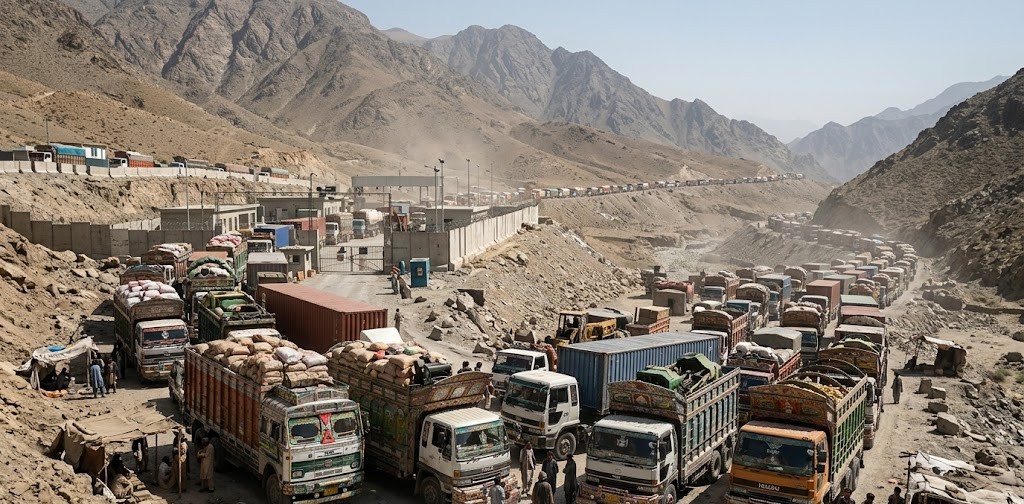
The most immediate catalyst of the Afghanistan trade crisis is the systemic degradation of trade relations along the Durand Line. Historically, Pakistan has served as Afghanistan's primary gateway to international markets, formalized through agreements like the Afghanistan-Pakistan Transit Trade Agreement (APTTA). However, throughout late 2025 and early 2026, this vital land route has repeatedly broken down due to escalating security friction.
The primary geopolitical friction stems from cross-border insurgent activity, specifically involving the Tehrik-i-Taliban Pakistan (TTP). Islamabad has increasingly linked trade facilitation to Kabul’s border management and counter-terrorism assurances. In response to security incidents, Pakistan has implemented stringent border enforcement measures, leading to frequent, unannounced closures of key commercial border crossings, most notably Torkham and Chaman.
Economic Toll on Perishables and Commodities
These Pakistan border closures have fundamentally destabilized the Afghan commercial class. Unlike mineral assets, Afghanistan’s primary export drivers are highly perishable agricultural goods, specifically fresh fruits, dried fruits, and nuts from provinces like Kandahar and Nangarhar.
When borders close without warning, thousands of trucks laden with pomegranates, grapes, and apricots are stranded in multi-mile lines under extreme weather conditions. The economic fallout includes:
Total Inventory Loss: Entire seasonal harvests frequently rot in transit, causing millions of dollars in losses for Afghan merchants who lack cold-storage infrastructure.
Capital Depletion: Unable to fulfill international delivery contracts, Afghan trade houses face severe capital depletion, forcing many multi-generational firms into bankruptcy.
Import Price Spikes: The bottleneck operates in reverse as well. Essential imports—including wheat, flour, cooking oil, and industrial inputs—are delayed on the Pakistani side, causing immediate supply shortages and dramatic cost spikes in urban Afghan centers.
The Hormuz Axis: The Suffocation of the Western Maritime Alternative
As the Durand Line border dispute rendered the Pakistani route increasingly volatile, Kabul attempted a strategic pivot toward its western neighbor, Iran. The cornerstone of this diversification strategy was Iran’s Chabahar Port, located on the Gulf of Oman. Developed with significant Indian investment, Chabahar was specifically engineered to bypass Pakistani territory, offering Afghanistan a direct, unhindered corridor to international shipping lanes.
The operational viability of Afghanistan's primary transit pathways reveals severe structural vulnerabilities across the board:
The Pakistan Corridor (Torkham and Chaman): Historically used for perishable fruits, nuts, wheat, and textile inputs, this route is now defined by intermittent closures and a high security premium driven by the Durand Line disputes and TTP friction.
The Iran Corridor (Chabahar Port): Intended for industrial goods, fuel, and manufacturing inputs, this alternative corridor is severely constrained by soaring maritime insurance and secondary Western sanctions resulting from regional conflicts.
The Central Asian Rail Network (Hairatan and Torghundi): Primarily delivering flour, electricity, heavy machinery, and fuel, this northern route remains stable but suffers from infrastructure gaps, low capacity, and high tariffs that prevent it from absorbing total national import volumes.
Heightened military tensions in the Middle East have led to severe disruptions within the Strait of Hormuz, a critical global supply chain chokepoint through which a significant portion of the world's petroleum and containerized cargo flows.
The Isolation of Chabahar Port
The Strait of Hormuz trade impact has reverberated directly into the Afghan economy. Although Chabahar sits just outside the narrowest point of the strait, it operates within the same maritime ecosystem. The broader regional conflict has driven marine insurance premiums and freight rates in the Gulf of Oman to historic highs.
Global shipping lines have increasingly restricted their port calls in the region, designating the waters as high-risk zones. Consequently, the Chabahar port trade route has become economically unviable for mainstream commercial shipping.
Furthermore, the regional crisis has disrupted Iranian domestic energy markets and transport networks. Refined petroleum products and fertilizers, which Afghanistan routinely sources from or transits through Iran, have experienced extreme price volatility. Instead of serving as a release valve for Afghan economic isolation, the western corridor has tied Kabul’s economic fate to the volatile dynamics of Middle Eastern maritime warfare.
Socio-Economic Fallout and the Humanitarian Reality
The intersection of these two trade disruptions has triggered a severe domestic socio-economic crisis. The macro-economic data translates directly into widespread human suffering across Afghanistan's provinces, compounding the deep structural poverty left in the wake of international asset freezes and banking restrictions.
Hyper-Inflation and Food Insecurity
Food inflation in Kabul and other major urban hubs has reached critical levels. According to reporting frameworks monitored by the Food and Agriculture Organization (FAO) and the World Bank, the basket of basic food commodities—consisting of wheat flour, cooking oil, pulses, and rice—has experienced annualized price increases exceeding 35 percent. In a country where the average household spends upwards of 70 percent of its total income on food, such inflation acts as a direct driver of absolute poverty.
Simultaneously, the agricultural sector, which employs over 60 percent of the Afghan workforce, is facing an acute input crisis. Due to the combined effects of Pakistani export restrictions and shipping disruptions at western ports, the supply of chemical fertilizers and high-yield seeds has plummeted.
Local farmers, unable to afford imported inputs, have been forced to scale back cultivation or revert to low-yield traditional farming methods. This input scarcity has drastically reduced domestic crop yields, worsening the national food deficit and leaving large swathes of the population dependent on international humanitarian assistance.
The United Nations Security Council and food security monitoring networks have noted that multiple provinces have slid toward Integrated Food Security Phase Classification (IPC) Phase 4 (Emergency) conditions. This phase is characterized by acute malnutrition and excessive excess mortality, driven directly by structural supply chain failures rather than localized crop diseases.
Geopolitical Maneuvering and Future Outlook
The Islamic Emirate administration in Kabul finds itself with severely constrained geoeconomic options. The interim government lacks the foreign exchange reserves necessary to subsidize imports or single-handedly build alternative infrastructure, forcing it to navigate a highly complex regional diplomatic landscape.
The Role of Regional Players
Faced with economic strangulation along its southern and western borders, Afghanistan is attempting to adjust its trade architecture toward Central Asia and China.
The Central Asian Redirection: Kabul has intensified engagements with Uzbekistan and Turkmenistan, seeking to expand rail and road transit via the Hairatan and Torghundi border ports. While these northern routes provide a stable flow of flour and electricity, the existing rail infrastructure is insufficient to completely offset the loss of the Pakistani and maritime corridors.
The Chinese Infrastructure Play: Beijing remains an important actor, driven by a desire to protect its nascent investments in Afghan mineral extraction, such as the Mes Aynak copper mine and oil fields in the Amu Darya basin. China has offered minor trade concessions, including tariff reductions on Afghan products, and has explored extending the China-Pakistan Economic Corridor (CPEC) into Afghanistan. However, Beijing’s approach remains highly risk-averse, with actual capital deployment contingent upon strict security guarantees that Kabul struggles to maintain.
Gulf State Mediation: Gulf nations, particularly Qatar and the United Arab Emirates, have consistently offered diplomatic mediation. These states view the stabilization of Afghanistan's trade corridors as an essential tool to prevent total economic collapse, which would likely trigger a massive migration crisis across Central and Western Asia.
The Structural Path Forward
Ultimately, these regional diplomatic maneuvers offer short-term relief rather than a comprehensive structural solution. As long as the Durand Line remains a militarized security zone and the Strait of Hormuz is subject to geopolitical conflict, Afghanistan’s landlocked economic challenges will persist.
To break this cycle of economic vulnerability, the administration in Kabul must engage in sustained, technically focused transit diplomacy. This requires separating trade facilitation from deep-seated political and security disputes, establishing transparent customs protocols, and securing long-term transit guarantees with neighboring countries.
Without a concerted effort to depoliticize regional trade corridors, Afghanistan risks slipping further into systemic economic isolation. In this scenario, the country's economic survival will remain hostage to external geopolitical shocks, leaving its population to bear the heavy costs of an unresolved regional trade crisis.
Comments (0)
No comments yet. Be the first to comment!