Pak Imtehan
Competitive Exams Prep App (CSS,PMS)
The Arctic region has transitioned from a peripheral geographic concern to a primary theater of geopolitical and economic competition. As of 2026, the reduction in perennial sea ice has rendered the Arctic Ocean increasingly accessible for commercial shipping and resource extraction. This shift has forced a re-evaluation of maritime law, national sovereignty, and the logistical frameworks of global trade. The race for the Arctic is defined by a complex intersection of the United Nations Convention on the Law of the Sea (UNCLOS), domestic legislation from the Arctic Five (Canada, Denmark via Greenland, Norway, Russia, and the United States) and the ambitions of non-Arctic states seeking to shorten transit times between Europe and Asia.
The Legal Framework of Polar Sovereignty
The governance of the Arctic is not dictated by a single treaty comparable to the Antarctic Treaty System, which prohibits military activity and mineral mining. Instead, the Arctic is governed primarily by UNCLOS, a 1982 international agreement that defines the rights and responsibilities of nations regarding their use of the world's oceans. Under UNCLOS, coastal states possess an Exclusive Economic Zone (EEZ) extending 200 nautical miles from their territorial baselines. Within this zone, the state has the sole right to exploit natural resources, including fish, oil, and gas.
A critical point of contention in 2026 involves Article 76 of UNCLOS, which allows nations to claim sovereign rights over the seabed beyond the 200-mile limit if they can scientifically prove that the seafloor is a natural prolongation of their continental shelf. Russia, Denmark, and Canada have all submitted overlapping claims to the Lomonosov Ridge, an underwater mountain range that spans the central Arctic. The outcome of these submissions, currently under review by the Commission on the Limits of the Continental Shelf (CLCS), will determine who controls the vast hydrocarbon and mineral reserves located at the North Pole.
The Northern Sea Route (NSR): Russia’s Strategic Corridor
The Northern Sea Route (NSR) runs along Russia’s northern coast from the Kara Sea to the Bering Strait. In 2026, it represents the most viable alternative to the Suez Canal for shipping between Northern Europe and East Asia. Russia treats the NSR as a national transportation route, asserting the right to regulate all traffic passing through these waters.
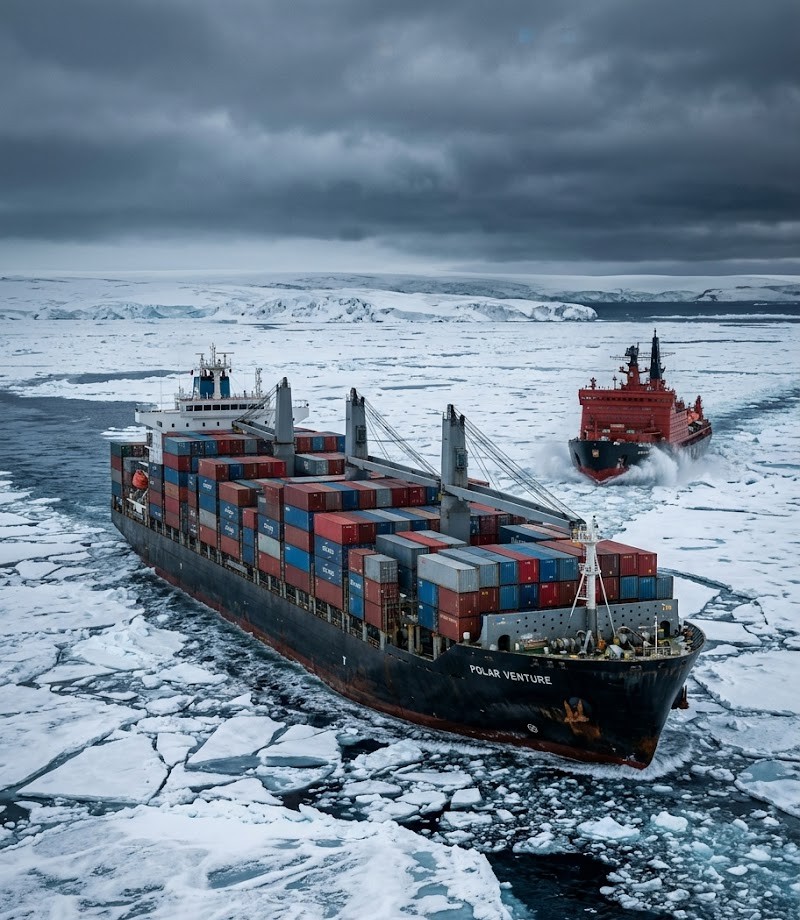
Russian domestic law requires foreign vessels to provide notice, take on Russian pilots, and utilize Russian icebreaking services. The Kremlin has invested heavily in the Project 22220 nuclear-powered icebreakers, the largest and most powerful in the world, to ensure year-round navigation. In 2025, cargo volume on the NSR reached 36 million tons, a significant increase from the 10 million tons recorded in 2017. The primary commodities moved are Liquefied Natural Gas (LNG) from the Yamal Peninsula and crude oil.
The legal status of the NSR remains a point of friction with the United States and the European Union. While Russia claims the straits within the route are internal waters, the U.S. maintains they are international straits where the principle of innocent passage applies. Despite these legal disagreements, the reality of Russian physical presence and icebreaking dominance gives Moscow de facto control over the route's operational logistics.
The Northwest Passage (NWP): Canada’s Sovereignty Challenge
The Northwest Passage winds through the Canadian Arctic Archipelago. Unlike the NSR, the NWP is geographically fragmented, featuring multiple channels with varying depths and ice conditions. Canada classifies the Northwest Passage as Internal Waters, granting the federal government full authority to regulate environmental standards and shipping traffic.
The United States and several European nations contest this, arguing that the NWP is an International Strait connecting two parts of the high seas or EEZs. If classified as an international strait, Canada would lose the right to prohibit or significantly restrict transit. In 2026, the debate is no longer theoretical. The increase in luxury cruise ships and bulk carriers in the Beaufort Sea has forced the Canadian Coast Guard to increase its presence.
Canada’s position is bolstered by the Arctic Waters Pollution Prevention Act, which allows for stringent environmental regulations. However, the lack of deep-water ports and comprehensive hydrographic mapping remains a hurdle. As of 2026, only 15% of the Canadian Arctic is surveyed to modern standards, making the NWP a more hazardous and less commercially attractive option than the NSR in the short term.
The Transpolar Sea Route (TSR): The Future High Seas Route
While the NSR and NWP follow coastal outlines, the Transpolar Sea Route (TSR) is expected to cross the center of the Arctic Ocean, passing directly across or near the North Pole. Because this route stays largely outside the 200-mile EEZs of the coastal states, it would technically be located in International Waters.
Climatologists in 2026 project that the TSR could be ice-free for several weeks during the summer by the mid-2030s. If this occurs, it would bypass the regulatory hurdles and fees associated with Russian and Canadian territorial claims. The TSR would be the shortest distance between the Atlantic and Pacific, potentially reducing the journey from Shanghai to Rotterdam by over 4,000 miles compared to the Suez Canal route. The ownership of this route is non-existent; it is a global common, though its utilization will depend on the development of specialized Polar Class commercial vessels capable of navigating occasional ice floes without icebreaker escort.
The Economic Stakes: Hydrocarbons and Critical Minerals
The race for trade routes is inseparable from the race for resources. The U.S. Geological Survey estimates that the Arctic contains approximately 13% of the world's undiscovered oil and 30% of its undiscovered natural gas. Furthermore, the region is rich in critical minerals essential for the green energy transition, including nickel, platinum, palladium, and rare earth elements.
The Norilsk-Talnakh region in Russia already produces a significant portion of the world's nickel and palladium. In Greenland, the Kvanefjeld project has been a focal point of international interest due to its massive deposits of uranium and rare earths. As ice recedes, the cost of extracting these minerals decreases, making the Arctic a central pillar of global supply chain security.
The Role of Non-Arctic States: China’s Near-Arctic Ambition
China’s 2018 White Paper defined the nation as a Near-Arctic State and proposed the development of a Polar Silk Road as part of the Belt and Road Initiative. Despite having no territorial claims in the region, China has become the most active non-Arctic investor.
Chinese state-owned enterprises hold significant stakes in Russia’s LNG projects and have attempted to invest in infrastructure in Greenland and gold mines in Canada. In 2026, China operates a fleet of sophisticated icebreakers, including the Xue Long 2, and is reportedly developing its own nuclear-powered icebreaking technology. China’s strategy is built on scientific diplomacy and economic partnership, ensuring that it remains a stakeholder in Arctic governance forums like the Arctic Council, even if it lacks a geographic seat at the table.
Militarization and Security Architecture
The opening of the Arctic has led to a measurable increase in military activity. Russia has refurbished over 50 Soviet-era military bases across its northern coastline, including airfields, radar stations, and search-and-rescue centers. The Northern Fleet, based in Severomorsk, remains Russia’s most powerful naval asset, housing the bulk of its nuclear deterrent.
In response, NATO has increased the frequency and scale of its Arctic exercises. The entry of Finland and Sweden into NATO has fundamentally altered the security map, turning the Baltic Sea and the European Arctic into a more cohesive defensive bloc. The GIUK Gap (Greenland, Iceland, and the United Kingdom), a traditional naval chokepoint, has seen renewed strategic importance as NATO seeks to monitor Russian submarine activity entering the North Atlantic.
Admiral James Stavridis noted, "For the first time in a generation, the Arctic is a zone of competition, not just cooperation." This militarization serves a dual purpose: protecting sovereign territory and ensuring the security of the new trade routes that represent future national revenue.
Environmental Governance and the Polar Code
The expansion of shipping in the Arctic is regulated by the International Maritime Organization (IMO) Polar Code, which entered into force in 2017 and was updated for 2026. The Code mandates strict requirements for ship design, equipment, and crew training for vessels operating in polar waters.
Environmental concerns are centered on the risk of Heavy Fuel Oil (HFO) spills. Unlike in warmer waters, oil in the Arctic does not degrade quickly; it can become trapped under ice, making cleanup virtually impossible. In 2024, the IMO implemented a ban on the use and carriage of HFO in Arctic waters, forcing a transition to Liquefied Natural Gas (LNG) or distillate fuels. While this reduces the risk of catastrophic spills, the increased presence of black carbon soot from ship exhausts accelerates ice melt by reducing the albedo effect (the ability of ice to reflect sunlight).
The Role of Indigenous Governance
The Arctic is home to approximately 4 million people, including diverse Indigenous populations such as the Inuit, Sami, and Nenets. These groups are not merely observers but are recognized as Permanent Participants in the Arctic Council.
In Canada and Greenland, Indigenous organizations have significant influence over land-use permits and resource development. The Inuit Circumpolar Council (ICC) has consistently advocated for the Right to Be Cold, emphasizing that new trade routes must not come at the expense of food security and traditional hunting grounds. The 2026 Arctic landscape sees a tension between the top-down strategic interests of national capitals and the bottom-up sovereignty of the people who have inhabited the region for millennia.
Geopolitical Tensions and the Arctic Council
The Arctic Council was once the premier forum for circumpolar cooperation, focusing on environmental protection and sustainable development while explicitly excluding military security from its mandate. However, following the 2022 invasion of Ukraine, the Council's work was largely suspended as Western members refused to engage with Russia, which held the chairmanship at the time.
By 2026, the Council has resumed some technical-level cooperation, but the spirit of Arctic Exceptionalism (the idea that the North is a zone of high cooperation and low tension) has eroded. Russia has increasingly looked toward the BRICS nations (specifically China and India) for Arctic investment, potentially creating a bifurcated Arctic: one governed by Western norms and NATO security, and another integrated into the Russian-Chinese economic sphere.
Logistics and Infrastructure: The Hardware of the Arctic
Ownership of the Arctic is as much about infrastructure as it is about law. To be a viable trade route, a corridor requires:
Deep-water ports for refueling and emergency repairs.
Hydrographic data to prevent groundings in poorly charted waters.
Search and Rescue (SAR) capabilities to handle disasters in extreme conditions.
Satellite communication coverage, which is often unreliable at high latitudes.
Russia’s Sabetta Port on the Yamal Peninsula serves as a blueprint for Arctic infrastructure, combining industrial processing with high-latitude shipping logistics. In contrast, the North American Arctic remains underdeveloped. The U.S. port of Nome, Alaska, is undergoing expansion to accommodate deep-draft vessels, but it remains years behind Russian equivalents. Without this hardware, claims of sovereignty remain difficult to enforce.
Future Projections: 2026 to 2050
The trajectory of the Arctic trade routes depends on the rate of warming and the stability of international law. If ice continues to retreat at the current rate of 13% per decade, the blue water Arctic (an ocean with no summer sea ice) could be a reality by 2040.
In this scenario, the Central Arctic Ocean becomes the primary highway for global trade. The geopolitical importance of the Bering Strait, the narrow passage between Russia and Alaska, will increase exponentially, effectively becoming the New Strait of Malacca. Control over the Bering Strait is shared by the U.S. and Russia, creating a permanent point of strategic contact between the two powers.
Conclusion
The question of who owns the new trade routes of 2026 does not have a singular answer. Legally, the routes are governed by a patchwork of international law and domestic claims that remain contested. Russia currently holds the strongest operational grip on the Northern Sea Route through its icebreaking fleet and coastal infrastructure. Canada maintains a firm legal stance on the Northwest Passage, though its practical capacity to manage heavy traffic is still developing.
Sovereignty in 2026 is defined not just by lines on a map, but by the ability to provide the security, icebreaking, and logistics required to keep these routes open. As the ice thins, the density of international interest grows, ensuring that the Arctic will remain a focal point of global strategic competition for the remainder of the century.
Comments (0)
No comments yet. Be the first to comment!