Pak Imtehan
Competitive Exams Prep App
The Belt and Road Initiative (BRI) has entered a second decade defined by a systemic pivot from expansive, debt-heavy infrastructure projects to a more calculated, risk-mitigated model often referred to as BRI 2.0. Since its inception in 2013, the initiative has facilitated over $1 trillion in cumulative engagement, yet the landscape of 2026 presents a different set of geopolitical and economic constraints. The focus has transitioned from "hard" connectivity, such as megaprojects like railways and ports, to "soft" connectivity, prioritizing digital frameworks, green energy standards, and fiscal sustainability. This evolution reflects a strategic recalibration by Beijing to address mounting debt concerns in partner nations and to align with domestic economic shifts toward high-tech manufacturing and sustainable growth.
The Strategic Pivot: From "Big and Abstract" to "Small and Beautiful"
The initial phase of the BRI was characterized by massive capital outlays and large-scale engineering feats. However, the current iteration prioritizes projects that are economically viable and environmentally sustainable. This shift, formalized during the Third Belt and Road Forum, emphasizes a "small yet beautiful" approach. This does not signify a withdrawal from global markets but rather a refinement of investment criteria.
China’s leadership has integrated the Global Development Initiative (GDI) alongside the BRI to provide a more multilateral framework for its foreign assistance. By focusing on smaller-scale projects, such as localized solar grids, telecommunications upgrades, and industrial parks, China reduces the risk of non-performing loans while maintaining its influence in the Global South. This strategic contraction serves a dual purpose: it shields the Chinese banking sector from external shocks and ensures that projects deliver immediate, tangible benefits to local populations, thereby mitigating the "debt-trap" criticisms that dogged the initiative’s first decade.
The Digital Silk Road and Technological Standards
A cornerstone of BRI 2.0 is the Digital Silk Road (DSR). As traditional infrastructure yields diminishing returns, Beijing is leveraging its domestic strengths in 5G, satellite navigation, and e-commerce to create a digital ecosystem centered on Chinese technology.
The expansion of the Beidou Navigation Satellite System provides an alternative to the American GPS, offering partner nations a critical layer of technological independence. Furthermore, the deployment of fiber-optic cables and data centers across Central Asia, Africa, and Southeast Asia establishes a foundation for long-term technological dependency. By exporting technical standards alongside hardware, China ensures that the future digital architecture of emerging markets remains compatible with and reliant upon Chinese innovation.
Institutional data suggests that digital infrastructure investments now account for a significantly higher percentage of total BRI engagement than they did in 2018. This transition is not merely about connectivity; it is about standard-setting. Establishing protocols for artificial intelligence, data privacy, and cross-border digital payments allows China to exert influence over the regulatory environments of participating states.
Green Silk Road: Decarbonization as a Geopolitical Asset
The transition toward a Green Silk Road represents a fundamental realignment of China’s energy exports. Following the 2021 pledge to cease the construction of new coal-fired power plants abroad, Chinese investment has flowed into renewable energy sectors. China currently controls a dominant share of the global supply chain for solar panels, lithium-ion batteries, and electric vehicles (EVs).
Investment in green energy under the BRI 2.0 framework serves several strategic objectives:
Market Expansion: It creates export markets for China’s overcapacity in green technologies.
Climate Leadership: It positions Beijing as a leader in the global energy transition, particularly in regions where Western financing for energy projects has become increasingly restrictive.
Resource Security: Many green energy projects are coupled with investments in critical mineral extraction, securing the raw materials necessary for China’s own industrial base.
According to the Green Finance & Development Center, renewable energy investments now outpace fossil fuel engagement within the BRI. This shift is critical for the initiative’s longevity, as it aligns Chinese capital with the global imperative for decarbonization and the Paris Agreement targets.
Fiscal Sustainability and Debt Restructuring
The most significant challenge facing BRI 2.0 is the management of existing debt. A substantial number of partner nations have faced liquidity crises, exacerbated by global inflationary pressures and currency devaluations. In response, China has moved away from the informal, bilateral debt negotiations of the past toward more structured, though still largely opaque, debt workout mechanisms.
The People’s Bank of China has increased its use of swap lines and "rescue loans" to prevent sovereign defaults among its largest debtors. While this provides short-term stability, it has led to concerns regarding the long-term sustainability of these credit lines. To address this, BRI 2.0 emphasizes the Debt Sustainability Framework (DSF), a tool intended to align lending practices with international standards, such as those used by the IMF.
"The Belt and Road Initiative is no longer just a series of infrastructure projects; it is a mechanism for the systemic integration of the Global South into a China-centric economic order." — International Institute for Strategic Studies Analyst
This integration is increasingly managed through the Asian Infrastructure Investment Bank (AIIB) and the Silk Road Fund, which employ more rigorous vetting processes than the policy banks, specifically the China Development Bank and Export-Import Bank of China, did during the initiative’s early years.
Geopolitical Competition and Alternative Frameworks
The evolution of BRI 2.0 is also a response to the emergence of competing infrastructure frameworks, such as the G7’s Partnership for Global Infrastructure and Investment (PGII) and the European Union’s Global Gateway. These initiatives offer alternative sources of financing, often emphasizing transparency, labor rights, and democratic values.
In this competitive environment, China has adapted by deepening its involvement in regional trade blocs. The Regional Comprehensive Economic Partnership (RCEP) and the potential expansion of the BRICS+ grouping serve as institutional anchors for the BRI. By embedding infrastructure projects within broader trade agreements, China secures preferential market access and ensures that its investments are backed by institutional commitments.
The rivalry is particularly acute in the Indo-Pacific and Central Asia, where infrastructure is a proxy for geopolitical alignment. BRI 2.0 seeks to counter Western "de-risking" strategies by creating a web of economic interdependencies that make it costly for partner nations to pivot away from Beijing.
Legal and Regulatory Harmonization
As the BRI matures, the focus has expanded to include the harmonization of legal systems and dispute resolution. China has established specialized international commercial courts in Shenzhen and Xi'an to handle BRI-related litigation. This movement toward a Chinese-led legal infrastructure is a significant development in the "soft power" aspect of the initiative.
By promoting its own arbitration mechanisms, China reduces its reliance on Western legal hubs like London or Singapore. This ensures that the resolution of commercial disputes remains within a framework that is more aligned with Chinese legal principles and state interests. It also provides a degree of legal certainty for Chinese enterprises operating in volatile jurisdictions, which is essential for the "high-quality" development phase of BRI 2.0.
Impact on Global Supply Chains
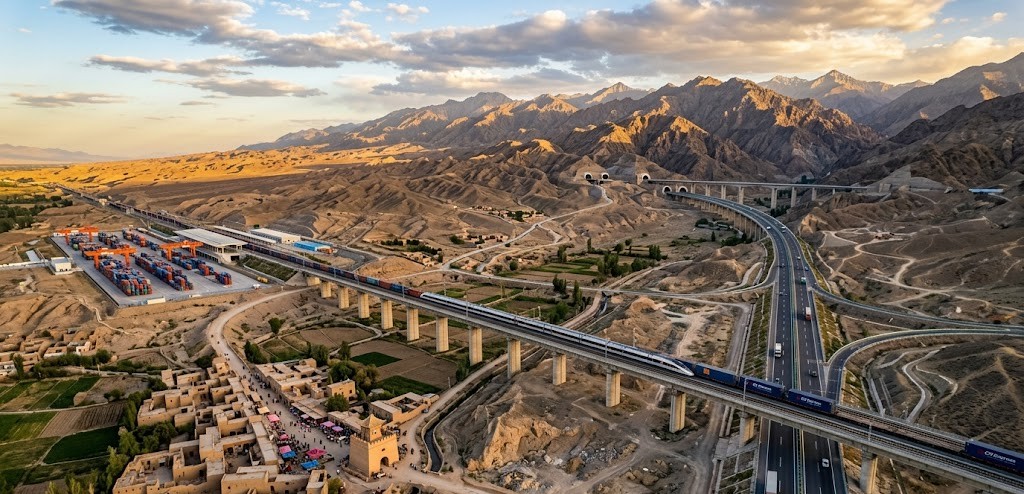
The BRI 2.0 is fundamentally reshaping global supply chains by diversifying trade routes and reducing reliance on traditional maritime chokepoints like the Strait of Malacca. The China-Europe Railway Express, which saw a surge in volume during global maritime disruptions, has become a permanent fixture of Eurasian trade.
Furthermore, the development of the China-Pakistan Economic Corridor (CPEC) and the Trans-Saharan Road projects are designed to create direct overland access to resource-rich regions and emerging markets. These corridors are not merely transport routes; they are economic zones designed to facilitate the relocation of labor-intensive Chinese manufacturing to lower-cost regions, while keeping the high-value components of the supply chain within China.
Risk Mitigation and Security Dimensions
A notable shift in BRI 2.0 is the increased focus on the security of overseas assets. As Chinese investments grow in regions with high political instability, the protection of personnel and infrastructure has become a priority. This has led to a more visible role for Private Security Companies (PSCs) and, in some instances, closer military-to-military cooperation between China and host nations.
The securitization of the BRI involves:
Intelligence Sharing: Enhanced cooperation on counter-terrorism and maritime security.
Port Access: While China maintains that its port investments are commercial, the dual-use potential of facilities in places like Djibouti, Gwadar, and Hambantota remains a point of international scrutiny.
Cybersecurity: Integrating security protocols into digital infrastructure projects to protect data integrity and state secrets.
This security dimension is a necessary corollary to the initiative’s expansion, as the financial and political stakes of project failure have increased significantly.
The Role of State-Owned Enterprises vs. Private Actors
While the first phase of the BRI was dominated by State-Owned Enterprises (SOEs), BRI 2.0 is seeing a more active role for the Chinese private sector. Companies like Huawei, Tencent, and Alibaba are instrumental in the Digital Silk Road, while private firms in the renewable energy sector are leading the Green Silk Road.
The government is encouraging this shift to foster innovation and reduce the fiscal burden on the state. Private companies are often more agile and better at navigating local market conditions than large, bureaucratic SOEs. However, the line between private interest and state strategy remains blurred, as the Chinese state maintains various levers of control over its private champions through party committees and regulatory oversight.
Regional Case Studies: Adaptation in Practice
Southeast Asia: High-Speed Rail and Industrial Integration
In Southeast Asia, BRI 2.0 is focused on the completion of the Pan-Asia Railway Network. The success of the Laos-China Railway has served as a proof-of-concept, leading to renewed momentum for projects in Thailand and Malaysia. Here, the BRI is closely integrated with the Master Plan on ASEAN Connectivity 2025, showing a move toward regional multilateralism.
Africa: From Infrastructure to Industrialization
The focus in Africa has shifted from extractive infrastructure to value-added manufacturing. China is increasingly investing in special economic zones (SEZs) where local raw materials can be processed before export. This addresses the long-standing criticism that the BRI was a neo-colonial enterprise focused solely on resource extraction.
Central Asia: The Energy and Logistics Hub
Central Asia remains the geographic heart of the BRI. The focus here is on upgrading the Middle Corridor, a trade route connecting China to Europe via the Caspian Sea, bypassing Russia. This has gained strategic importance due to the geopolitical shifts in Eastern Europe, demonstrating the BRI's ability to adapt to external shocks.
Institutional Governance and Transparency
To combat perceptions of corruption and lack of transparency, the Chinese government has introduced the "Clean Silk Road" initiative. This involves stricter oversight of project bidding processes and more rigorous anti-corruption measures for both Chinese firms and host-country officials.
While skepticism remains regarding the efficacy of these internal controls, the move indicates an awareness that the initiative’s reputation is a critical factor in its long-term success. Transparency is not just a matter of ethics but a functional requirement for attracting third-party financing from international investors and multilateral banks.
The Influence of Domestic Economic Policy
The structure of BRI 2.0 is deeply influenced by China’s domestic economic strategy, specifically the "Dual Circulation" model. This policy aims to strengthen China’s internal market (internal circulation) while simultaneously expanding its external trade and investment links (external circulation).
The BRI serves as the primary vehicle for external circulation. By securing energy supplies, creating new markets for high-tech goods, and outsourcing lower-end manufacturing, the BRI helps China navigate its "middle-income trap" and transition to a high-value economy. The initiative is no longer an adjunct to domestic policy; it is a fundamental component of China’s national development strategy.
Future Outlook and Strategic Implications
The future of the Belt and Road Initiative will be determined by its ability to balance ambition with sustainability. The era of unconditional lending and vanity projects has passed. In its place is a more sophisticated, multi-layered strategy that integrates technology, green energy, and institutional standard-setting.
Key factors to monitor include:
The success of debt restructuring: Whether China can manage its exposure to distressed debt without triggering a systemic crisis.
Technological adoption: The degree to which partner nations adopt Chinese digital and technical standards.
Geopolitical alignment: How effectively China can use the BRI to solidify its influence in the face of Western competition.
The BRI 2.0 is a more resilient and strategically aligned version of its predecessor. It reflects a China that is more cautious but equally committed to reshaping the global economic order. By moving away from the "bricks and mortar" approach and toward a "bits and green" strategy, Beijing is ensuring that the initiative remains relevant in a rapidly changing global landscape.
The Belt and Road Initiative 2.0 represents a maturing of China’s global ambitions. It is a transition from a period of rapid, sometimes haphazard expansion to one of consolidation and strategic depth. As the initiative continues to evolve, its impact will be felt not just in the physical infrastructure it builds, but in the digital, environmental, and legal standards it establishes across the globe. The success of this second phase will be the ultimate measure of China’s capacity to lead a new era of global development.
Comments (0)
No comments yet. Be the first to comment!