Pak Imtehan
CSS Essay
The CSS (Central Superior Services) Essay paper is often regarded as the ultimate gatekeeper of the competitive exam in Pakistan. While thousands of candidates possess the requisite knowledge, the failure rate remains staggering. Success in this paper isn't merely about English fluency; it is about structural integrity, logical coherence, and precision.
1. The Trap of "Topic Misinterpretation"
Many aspirants see a keyword and immediately begin writing. This is a fatal error. The examiner isn't testing your general knowledge; they are testing your ability to address a specific prompt.
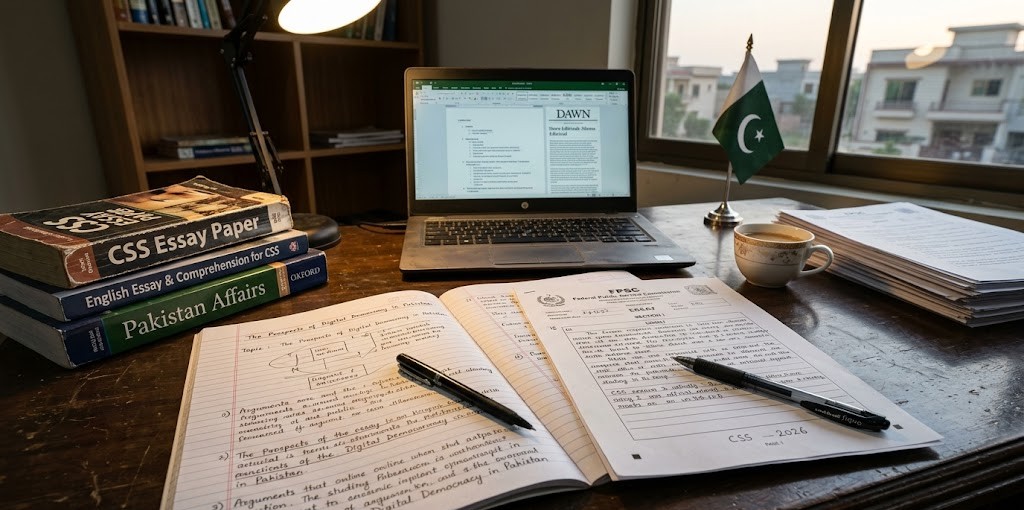
The Mistake: Writing a generic essay. If the topic is "The Prospect of Digital Democracy in Pakistan," many candidates write everything they know about "Democracy" or "Internet issues," ignoring the specific link between the two.
The Pro Fix: Use the Deconstruction Technique. Break the topic into its variables.
Example: For the topic "Global Warming: Fact or Fiction?", you cannot just write about the causes and effects of climate change. You must explicitly argue for the "Fact" side while acknowledging the "Fiction" (skepticism) side to fulfill the prompt's demand.
2. The Absence of a Definitive Thesis Statement
A CSS essay without a Thesis Statement is like a body without a soul. It is the most important sentence in your entire 2,500-word attempt.
The Mistake: Being vague. "Global warming is a big problem for the world and we should stop it." This is a statement of fact, not a thesis.
The Pro Fix: A thesis must be an arguable claim that sets the direction.
Example: "While global warming is often dismissed by skeptics as a natural cycle, the overwhelming empirical evidence of anthropogenic climate change necessitates a radical shift in global energy policy to prevent ecological collapse."
Pro Tip: Place this at the end of your introductory paragraph so it acts as a bridge to your body paragraphs.
3. Structural Incoherence in the Outline
The Outline is the examiner’s first impression. If your outline is messy, the examiner assumes your mind is messy.
The Mistake: Lack of Parallelism.
Bad Outline:
Poverty is rising.
Impact on the economy.
How to solve poverty?
The Pro Fix: Use consistent grammatical structures.
Pro Outline:
The Rising Menace of Poverty in Pakistan.
The Socio-Economic Implications of Widespread Destitution.
Strategic Interventions for Poverty Alleviation.
The Result: This looks academic, organized, and professional.
4. The "Silo" Effect (Lack of Transitions)
A high-scoring essay flows like a river. In contrast, failing essays often read like a collection of disconnected Wikipedia entries.
The Mistake: Starting new paragraphs abruptly without linking them to the previous point.
The Pro Fix: Use Connective Tissue. Every paragraph should start with a transitional hook.
Example: Instead of just starting a paragraph on "Solutions," start with: "Building upon the structural causes mentioned above, the resolution of this crisis requires a multi-pronged policy approach..."
Key Words: Furthermore, Conversely, In light of the aforementioned, Paradoxically.
5. Prioritizing "Big Words" Over Clear Logic
There is a common myth that you need the vocabulary of a Victorian poet to pass the CSS. In reality, the examiner values clarity and precision.
The Mistake: Using complex words incorrectly. Using "plethora" when "many" would suffice, or misusing words like "equivocal" to sound smart. This disrupts the "readability" of your essay.
The Pro Fix: Follow the 70/30 Rule. 70% of your language should be clear, direct, and functional. 30% can be sophisticated academic vocabulary used to add nuance.
Example: Instead of saying "The bad situation of the economy is very sad," say "The prevailing economic volatility is deeply concerning for regional stability."
6. Weak Conclusion: The "Fizzle Out"
Many candidates run out of time and end their essay with a single, rushed sentence. This leaves the examiner with a bad taste.
The Mistake: Just summarizing the points or introducing brand-new information in the final paragraph.
The Pro Fix: The conclusion should provide a synthesis and a "Way Forward."
The "Pro" Structure: Restate the thesis (in different words) + Summarize main arguments + End with a powerful, optimistic closing thought or a relevant quote.
Example: "Ultimately, the challenge is great, but the potential for reform is greater. As Quaid-e-Azam noted, 'With faith, discipline, and selfless devotion to duty, there is nothing nothing worthwhile that you cannot achieve.'"
Comments (0)
No comments yet. Be the first to comment!