Pak Imtehan
Staff Report
Winter gas load management plan exposes the cost of Pakistan's LNG gap
Staff Report | Opinion
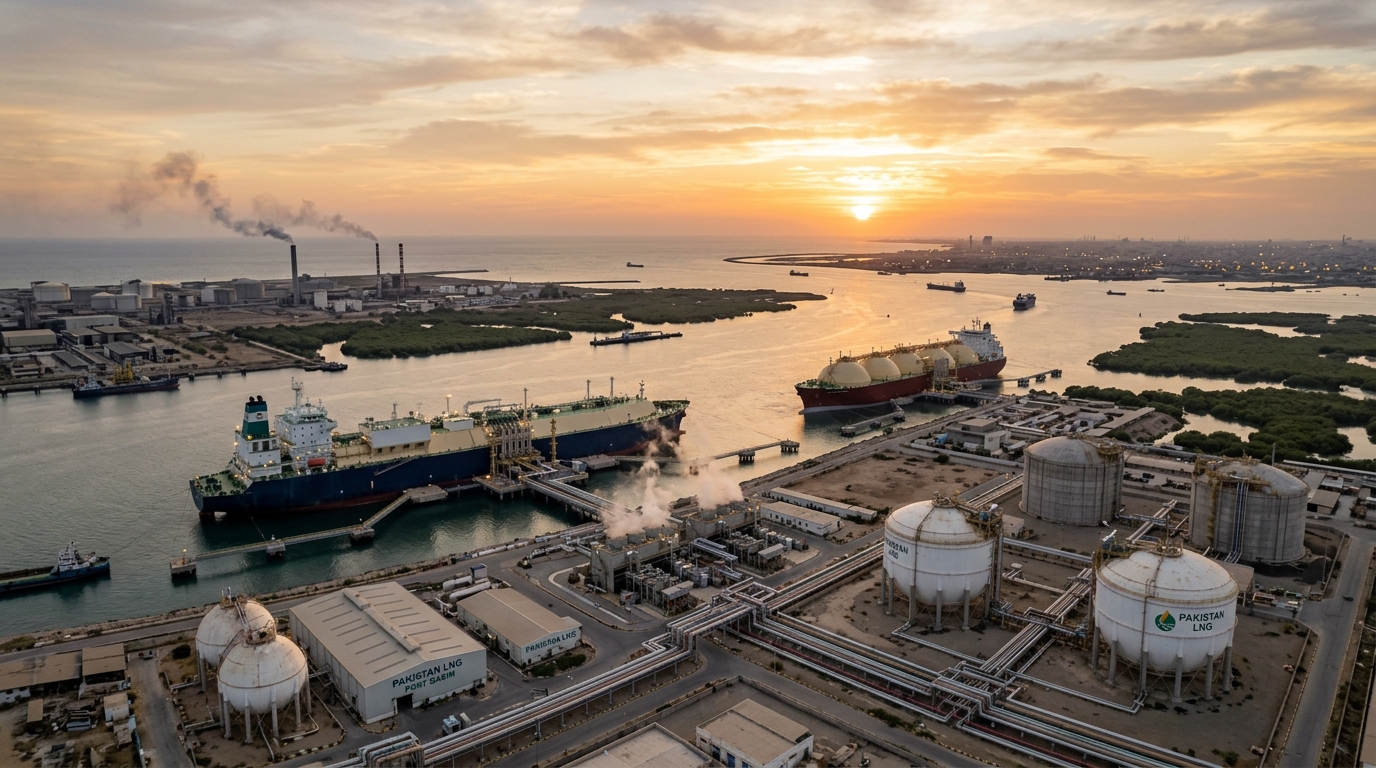
Prime Minister Shehbaz Sharif on Tuesday directed his government to finalise a comprehensive winter gas load management plan, and the details reported on Wednesday show why the order matters. Gas companies and the Petroleum Division asked for 22 cargoes of imported liquefied natural gas (LNG) to cover December to February. The task force handling procurement has committed to between 10 and 12, and only on a best-effort basis. The winter gas load management plan is therefore less a routine seasonal exercise than a formal recognition that supply will fall well short of what the utilities say they need. The central question is whether that shortfall can be shared out fairly and openly before the cold arrives, rather than improvised once it does.
The meeting in Islamabad brought together Federal Minister for Finance and Revenue Muhammad Aurangzeb, Federal Minister for Petroleum and Natural Resources Ali Pervaiz Malik and Federal Minister for Economic Affairs Ahad Khan Cheema, among others. Its decisions set out a clear order of priority. Domestic consumers are to receive locally produced gas first, while regasified liquefied natural gas (RLNG) is to go mainly to power generation and industry. The prime minister also ordered a wide public awareness campaign encouraging households to adopt alternative sources of energy, along with steps to keep gas flowing without interruption from reserves in the northern areas. A proposal for bank financing of electric appliances for water and space heating is under consideration.
The cause of the shortfall lies largely outside Pakistan. Renewed hostilities in the Middle East, linked to the conflict between the United States and Iran, have disrupted two of the main routes for the region's energy trade, the Strait of Hormuz and the Bab al-Mandab. Fuel prices have risen as a result. For an importing country, the difficulty is both physical and financial. Each spot cargo is estimated to cost about $100 million, and purchases on that scale require the approval of the Ministry of Finance and the State Bank of Pakistan. Each cargo carries roughly 100 million cubic feet of gas. When the number of cargoes is cut in half, the margin available to the gas system becomes very thin.
The arithmetic of the gap deserves close attention. The task force, led by Lieutenant General Zafar Iqbal, has offered roughly half of the cargoes requested. Reports citing official sources suggest the realistic figure may be only seven or eight. If that lower estimate holds, the country would receive about a third of the LNG its gas companies sought for the three coldest months. At the reported price of about $100 million a cargo, the 14 cargoes separating 22 from eight would cost in the region of $1.4 billion. Part of the shortfall is therefore a decision about scarce foreign exchange, as well as a consequence of disrupted shipping lanes. Both pressures point in the same direction.
A strong case can be made for the order of priority the government has chosen. Households in several regions rely on piped gas for heating, cooking and hot water, and a winter shortage affects their daily lives directly. Reserving local gas for domestic users protects the group with the fewest immediate alternatives. Directing imported gas to power plants and factories, in turn, links the most expensive fuel to the sectors that generate output and income. Timing also counts in the plan's favour. Setting out the framework in early October gives distribution companies, industrial users and families several weeks to prepare, which is far preferable to sudden cuts announced in the middle of a cold spell.
The same design, however, carries risks that deserve equal weight. If imported gas is the residual supply and imported gas is what is being cut, the burden of the shortfall falls by design on power generation and industry. Less gas for power plants can mean a shift to other fuels or reduced generation capacity, depending on what alternatives are available. Less gas for factories can mean lower output and, in labour-intensive sectors, fewer shifts. There is also a tension inside the plan itself. Encouraging households to move to electric water and space heating would add to winter electricity demand at the same time as gas for power generation is being rationed. The two measures need to be planned together rather than separately.
The wider pattern is one of exposure to events that no single government in Islamabad can control. Pakistan's import arrangements depend on shipping routes that run through two narrow maritime passages, and both are now affected by conflict. The decision to plan early reflects an understanding of that exposure. What remains less clear is whether the plan rests on a single forecast or on several scenarios. A schedule built for 10 to 12 cargoes would look very different from one built for seven or eight. Energy planning under uncertainty works best when it states its assumptions openly and sets out in advance what happens if the more pessimistic case materialises.
The real-world costs will be spread unevenly. For households, the awareness campaign will only be as effective as the alternatives are affordable. Bank financing for electric heaters may help salaried families with access to formal credit, but it is less likely to reach low-income households outside the banking system. For the treasury, each additional cargo means a further call on foreign exchange that requires approval from both the finance ministry and the central bank. For industry, the main cost is uncertainty. Firms that cannot know in October how much gas they will receive in January may defer orders, reduce production plans or turn to more expensive fuels on their own account.
A constructive way forward begins with transparency. The government could publish the winter plan in full, including the number of cargoes it has secured each month and the rules it will follow if deliveries fall short. Clear criteria for curtailing industrial supply would allow firms to plan, and would reduce suspicion that decisions are made case by case. The heating appliance financing scheme should be finalised quickly, with a design that reaches lower-income families rather than only existing bank customers. Coordination between the Petroleum Division and the power sector matters just as much, so that savings in household gas do not simply reappear as extra pressure on an electricity grid that is itself short of gas.
The winter gas load management plan is, in the end, a test of whether scarcity can be managed by rules rather than by emergency. The order of priority announced on Tuesday is defensible, and the decision to act in early October is sensible. Its credibility will depend on what follows. The points to watch over the coming weeks are the final number of LNG cargoes the task force secures, the approvals required from the finance ministry and the State Bank, the publication of detailed supply schedules, and the launch of the heating appliance scheme. Developments in the Strait of Hormuz and the Bab al-Mandab will shape every one of those outcomes, and with them the success of the winter gas load management plan.
Comments (0)
No comments yet. Be the first to comment!