Pak Imtehan
Analysis
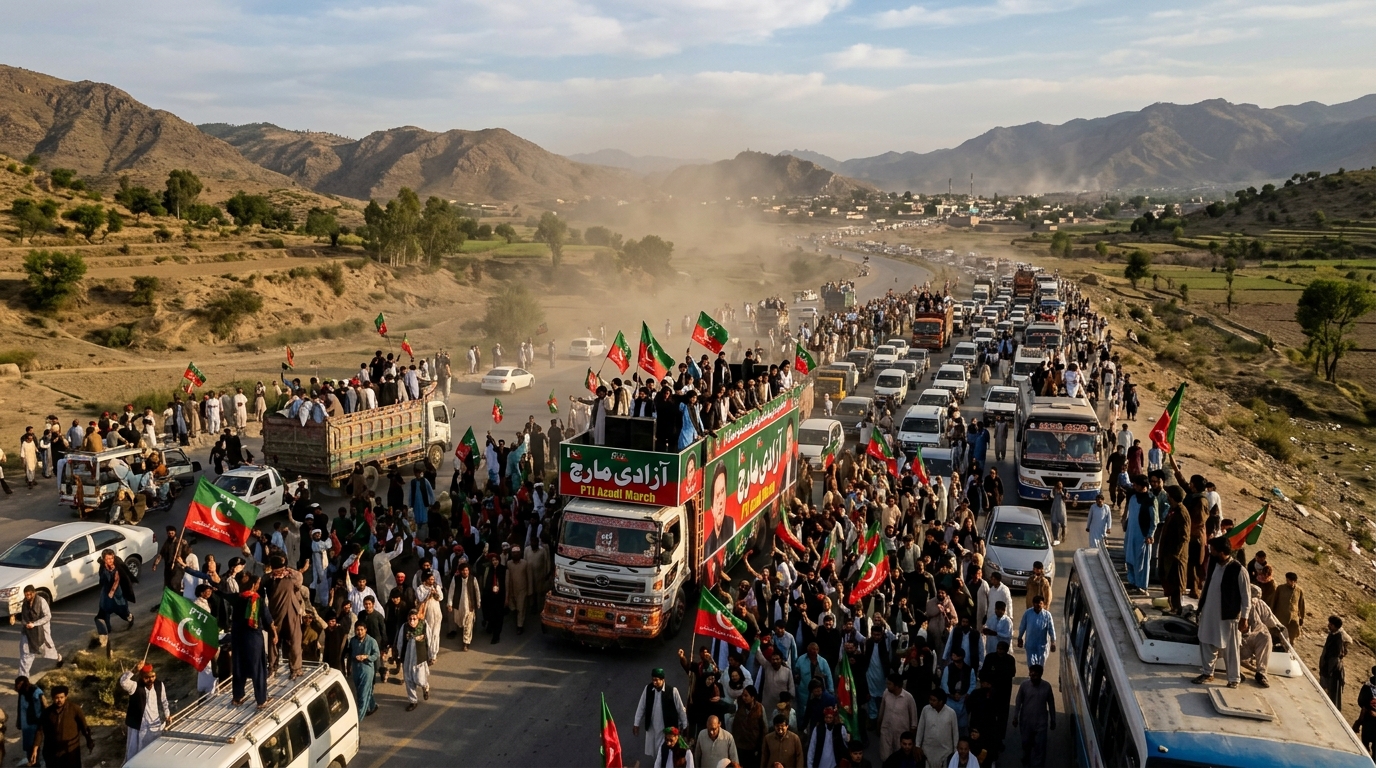
The Punjab government on Tuesday prohibited gatherings of five or more people across the province for 10 days. The Home Department's notification refers to a "serious and imminent threat to public peace" from militant organisations and hostile intelligence agencies. Such warnings deserve to be taken seriously. The timing of the order, however, is difficult to separate from politics. A day earlier, the PTI long march, led by Khyber Pakhtunkhwa Chief Minister Sohail Afridi, had reached Kohat on its way to Islamabad. The province that the march must cross has now closed its public spaces for the period in which the convoy is expected to arrive. The central difficulty is that both the march and the ban are substitutes for a negotiated settlement, and neither is capable of producing one.
The order took effect on 6 October under Section 144(6) of the Code of Criminal Procedure, 1898. According to the provincial government, threat alerts point to possible suicide attacks, vehicle-borne explosive devices and targeted killings at large public gatherings. Weddings, funeral prayers, burials, worship in mosques, court proceedings and officially permitted government activity are exempt. A previous Section 144 order, imposed on 23 September for 13 days, lapsed only on 5 October, leaving a gap of barely a day before the new one began. The PTI long march, meanwhile, is scheduled to pass through Peshawar on Wednesday and to assemble at Khairabad, near Attock on the Punjab border, on Thursday, 8 October. The new restrictions therefore cover precisely the march's most sensitive phase.
The immediate origins of the confrontation lie in the failure of talks between the federal government and the Pakistan Tehreek-e-Insaf (PTI) at the weekend. Two issues proved decisive: counterterrorism policy in Khyber Pakhtunkhwa and access to the party's imprisoned founder, former prime minister Imran Khan. The government agreed to restore family and lawyer visits to Mr Khan but declined to include that commitment in a formal agreement. Interior Minister Mohsin Naqvi has placed the blame on Mr Afridi, saying the chief minister altered the party's position after earlier rounds had brought both sides close to agreement. The march left Lakki Marwat on Sunday. Its principal demand is Mr Khan's release, set out alongside seven demands that include dialogue involving the prime minister and opposition leaders.
The case behind the PTI long march rests on two arguments that merit fair consideration. The first concerns the rights of a detained political leader. The party demands "full legal, medical and visitation rights" for Mr Khan and his wife, Bushra Bibi. Access to family and counsel is a basic expectation in any constitutional order, and the government's willingness to restore visits implicitly concedes the principle. The second argument concerns security policy. The provincial government opposes federal counterterrorism operations affecting Khyber Pakhtunkhwa, the province that has borne a heavy share of the cost of militancy. Former federal minister Asad Umar argued on Tuesday that force alone should not determine strategy, urging the parties to "resolve the issue on the basis of the jirga's declaration". A province exposed to violence has a reasonable claim to influence the response.
The federal government's position is also grounded in legitimate concerns. The Centre has said it will not permit gatherings in Islamabad, has announced restrictions on the march entering the capital and has discussed closing routes between Khyber Pakhtunkhwa and Punjab. Khyber Pakhtunkhwa Governor Faisal Karim Kundi said on Tuesday that the march would not be allowed beyond Attock, adding that the party "did not have the capacity" to proceed further. He also alleged that Mr Afridi acts on the instructions of PTI leader Murad Saeed. Beyond these political exchanges lies a more substantial point. A state that holds credible intelligence about threats to large crowds is obliged to act on it. The difficulty is that restrictions timed to coincide with a protest invite doubt, and doubt erodes the credibility of genuine warnings.
The episode reflects a broader pattern in which extraordinary powers are becoming routine instruments of administration. Section 144 was designed as a temporary measure against specific and immediate dangers. Two consecutive orders in Punjab now span most of the past fortnight and the coming ten days. When emergency restrictions become the ordinary condition of public life, citizens lose the ability to distinguish a real threat from an inconvenient demonstration, and the state loses a valuable means of communicating danger. The opposition's conduct raises a parallel concern. A serving chief minister is leading a march against the federal capital, and Mr Afridi has spoken of a "T20 match" beginning on 8 October. Framing a dispute between federation and province as a contest lowers the threshold for escalation on both sides.
The costs of the standoff are borne largely by citizens rather than by the principal actors. Closure of the main routes between Khyber Pakhtunkhwa and Punjab would disrupt travel, trade and transport between the two provinces. Police and security personnel assigned to contain political convoys are unavailable for the counterterrorism duties that the Punjab notification itself describes as urgent. The dispute also unfolds before an international audience. United Nations Secretary-General Antonio Guterres arrived in Pakistan on Tuesday for a three-day visit lasting until 8 October, the same day on which the marchers intend to reach Khairabad. A capital sealed against domestic protest during such a visit sends an unhelpful signal about the country's political stability and its capacity to manage dissent through institutions.
A workable settlement remains within reach, since the principal elements are already on the table. The federal government has accepted in principle that family and lawyer visits to Mr Khan should resume. Placing that commitment in writing, and making it public, would cost little and would remove the most persuasive element of the PTI's grievance. The PTI, for its part, could halt at Khairabad rather than enter Punjab, and return the counterterrorism dispute to a formal forum, using the jirga's declaration cited by Mr Umar as a basis for discussion. The Punjab government could narrow its order to specific locations and periods, and explain its threat assessment as fully as security allows. None of these steps requires either side to abandon its core position.
The PTI long march has become a test of whether political disputes in Pakistan can still be resolved through negotiation rather than through confrontation on highways. The coming 48 hours will indicate the direction of travel. The key markers are whether the convoy moves through Peshawar on Wednesday as planned, whether it is stopped at Attock on Thursday, and whether the federal government and the PTI resume the talks that broke down at the weekend. The manner in which Punjab enforces its 10-day ban, and whether the order is withdrawn early should the threat recede, will also be significant. If each side seeks victory on the road, the PTI long march is likely to end without a settlement. The opening for agreement is narrow, but it has not yet closed.
Comments (0)
No comments yet. Be the first to comment!