Pak Imtehan
Competitive Exams Prep App (CSS-IR)
The transition from a unipolar moment to a fragmented, multipolar reality has outpaced the institutional frameworks designed to manage global competition. As the United States and China navigate an increasingly narrow corridor of strategic coexistence, the Thucydides Trap, a term popularized by Graham Allison to describe the structural stress when a rising power threatens to displace a ruling one, has evolved. In its 2.0 iteration, the risk is no longer just a binary clash between two titans; it is the collapse of the systemic floor provided by Hegemonic Stability Theory in an era where power is diffused, yet interdependence remains weaponized.
The current global order is defined by a paradox: the more the international system becomes multipolar in its distribution of material capabilities, the more bipolar it becomes in its ideological and technological alignment. This friction is not merely a byproduct of personality-driven politics or temporary trade disputes. It is a fundamental realignment of how power is generated and protected in the 21st century.
The Erosion of the Hegemonic Floor
For much of the post-Cold War era, the international system operated under the assumption that a single hegemon, the United States, would provide the public goods necessary for global stability. These included the protection of sea lanes, the maintenance of a reserve currency, and the enforcement of liberal norms. According to Hegemonic Stability Theory, a dominant power reduces the transaction costs of international cooperation by acting as a lender of last resort and a security guarantor.
That floor is now buckling. The rise of China is not a standard case of a peer competitor emerging within a stable system. Instead, China is developing a parallel architecture, spanning the Belt and Road Initiative (BRI) to the BRICS+ expansion, that offers an alternative to the Washington Consensus. This creates a dual-track international order where the incentives for cooperation are consistently undermined by the strategic necessity of decoupling.
The danger of Thucydides Trap 2.0 lies in the fact that neither power can fully provide the stability the world requires, yet neither is willing to yield the influence necessary to let the other lead. "The preeminent danger in the years ahead is that a cooling of relations between the two most consequential powers on earth will lead to a systemic freeze, where collective action on global threats becomes impossible," notes Kevin Rudd, former Prime Minister of Australia. This systemic freeze is the hallmark of a world that is multipolar in theory but paralyzed in practice.
Weaponized Interdependence and the End of the "Long Peace"
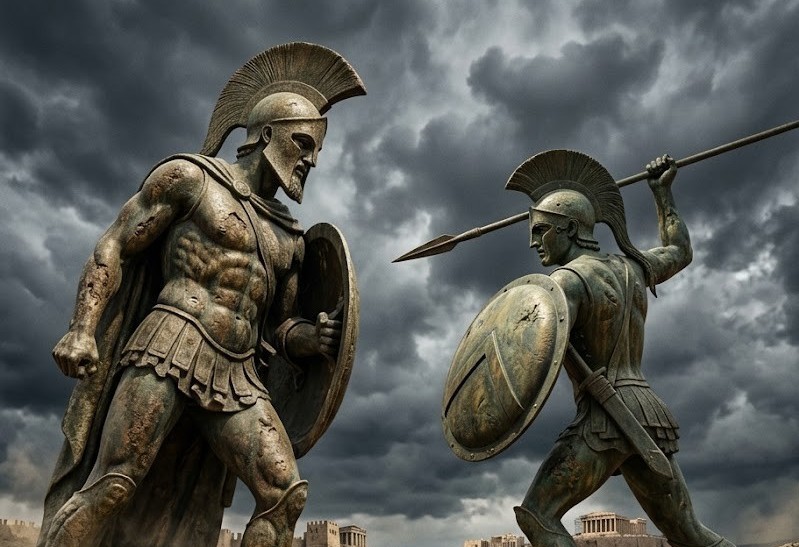
In the original Thucydides Trap, the fear was primarily military: the Spartan apprehension of growing Athenian walls and naval reach. In the modern context, the walls are digital and the navy is the global supply chain. The integration that was once thought to be a safeguard against war, the liberal idea of commercial peace, has become a primary theater of conflict.
We are witnessing the rise of weaponized interdependence, where states leverage their positions within global networks such as finance, data, and energy to coerce rivals. This transforms the global economy from a site of mutual gain into a zero-sum battlefield. When the U.S. restricts high-end semiconductor exports or China dominates the processing of critical minerals, they are not just protecting domestic industries; they are engaging in preemptive containment.
This shift suggests that multipolarity without a shared regulatory framework leads to a fragmented global commons. Unlike the Cold War, where the two blocs were largely economically isolated from one another, the U.S. and China are joined at the hip. Forcing a separation causes phantom limb pains throughout the global South, as middle powers are pressured to choose sides in a technological and financial schism they did not ask for.
The Middle Power Agency and Systemic Instability
One of the most significant departures from the classic Thucydides model is the role of middle powers. In a bipolar world, smaller states are often relegated to the status of satellites. In the current multipolar landscape, states like India, Brazil, Turkey, and Indonesia are acting as swing states. They do not seek to replace the hegemon, but they are increasingly unwilling to support a status quo that they perceive as biased toward Western interests.
This agency adds a layer of volatility to the U.S.-China rivalry. The diffusion of power to regional actors means that local conflicts in the South China Sea, Eastern Europe, or the Middle East can no longer be easily dampened by a single global policeman. Instead, these conflicts become proxies for broader systemic competition. The result is a world where security dilemmas are nested; a move by a regional power to secure its borders can trigger a cascade of reactions from the superpowers, leading to an escalatory spiral that neither Washington nor Beijing intended.
The failure of hegemonic stability is most visible in the inability of the United Nations Security Council or the World Trade Organization to mediate these disputes. When the arbiter of the rules is also a lead contestant in the game, the legitimacy of the rules themselves begins to evaporate.
The Tech-Polarity Shift
The 2.0 version of the trap is also defined by the race for Artificial Intelligence and quantum computing. In the 20th century, power was measured in steel, oil, and nuclear warheads. Today, it is measured in compute and data sovereignty. This Tech-Polarity creates a winner-take-all incentive structure that makes the Thucydides Trap even more difficult to avoid.
If one side achieves a decisive breakthrough in AI-driven military logistics or autonomous weaponry, the traditional balance of power becomes obsolete overnight. This reality encourages maximum pressure and minimum transparency. Because software is harder to monitor than a missile silo, the trust gap between the competing powers widens. The absence of a hotline for cyber and AI escalations means that a technical glitch or a misunderstood algorithm could be the modern equivalent of the Sirenian incident that sparks a broader conflagration.
Beyond Stability: The Risk of a "Leaderless" World
The most likely outcome of the current trajectory is not a clean handoff of power from the U.S. to China, nor is it a settled multipolar balance. It is a period of prolonged systemic vacuum. As Robert Gilpin argued in his work on war and change, systems become unstable when the cost of maintaining the status quo exceeds the benefits for the hegemon, while the cost of changing the system appears low to the challenger.
Today, both sides feel the burden. The United States is grappling with domestic polarization and intervention fatigue, making the cost of global leadership increasingly unpalatable to its electorate. China, meanwhile, faces demographic decline and a slowing economy, which may create a peaking power syndrome, a scenario where a rising state becomes more aggressive because it fears its window of opportunity is closing.
"The world is entering a period of geopolitical 'poly-crisis,' where overlapping tensions in trade, security, and climate are occurring in the absence of a credible global coordinator," a recent IMF report suggested. This lack of coordination is the primary threat of the 2.0 era. In a multipolar world, responsibility is often everyone’s in theory and no one’s in practice.
The Path to Strategic Managed Competition
Avoiding the catastrophic fulfillment of Thucydides’ prophecy requires a departure from the victory or defeat mindset of the 20th century. In a multipolar world, victory is defined by the preservation of the system itself, not the elimination of the rival.
Redefining Red Lines: Both powers must move beyond vague rhetoric toward concrete, narrow definitions of national security. When everything from social media apps to electric vehicle batteries is labeled a national security threat, the space for diplomacy disappears.
Institutional Pluralism: The West must accept that the 1945 institutional framework is no longer sufficient. Rather than viewing the BRICS+ or the Asian Infrastructure Investment Bank (AIIB) as purely adversarial, there must be a move toward inter-institutional cooperation.
The Role of Minilateralism: Since broad multilateralism is currently paralyzed, minilateral groups like the Quad or various P-3 configurations will lead the way. However, these must be designed as building blocks for regional stability rather than exclusive clubs for containment.
The Thucydides Trap 2.0 is not an inevitability, but it is the default path of the current international system. The faltering of hegemonic stability does not mean a world without order; it means a world where order must be negotiated daily rather than imposed from above. The transition from a world governed by a single hegemon to one managed by a precarious balance of many is the most dangerous journey a global civilization can take. Success depends on recognizing that in a deeply integrated world, the trap is not just for the two powers at the top, but for the entire global architecture they built.
Comments (0)
No comments yet. Be the first to comment!