Pak Imtehan
History
What Really Happened at the Munich Agreement
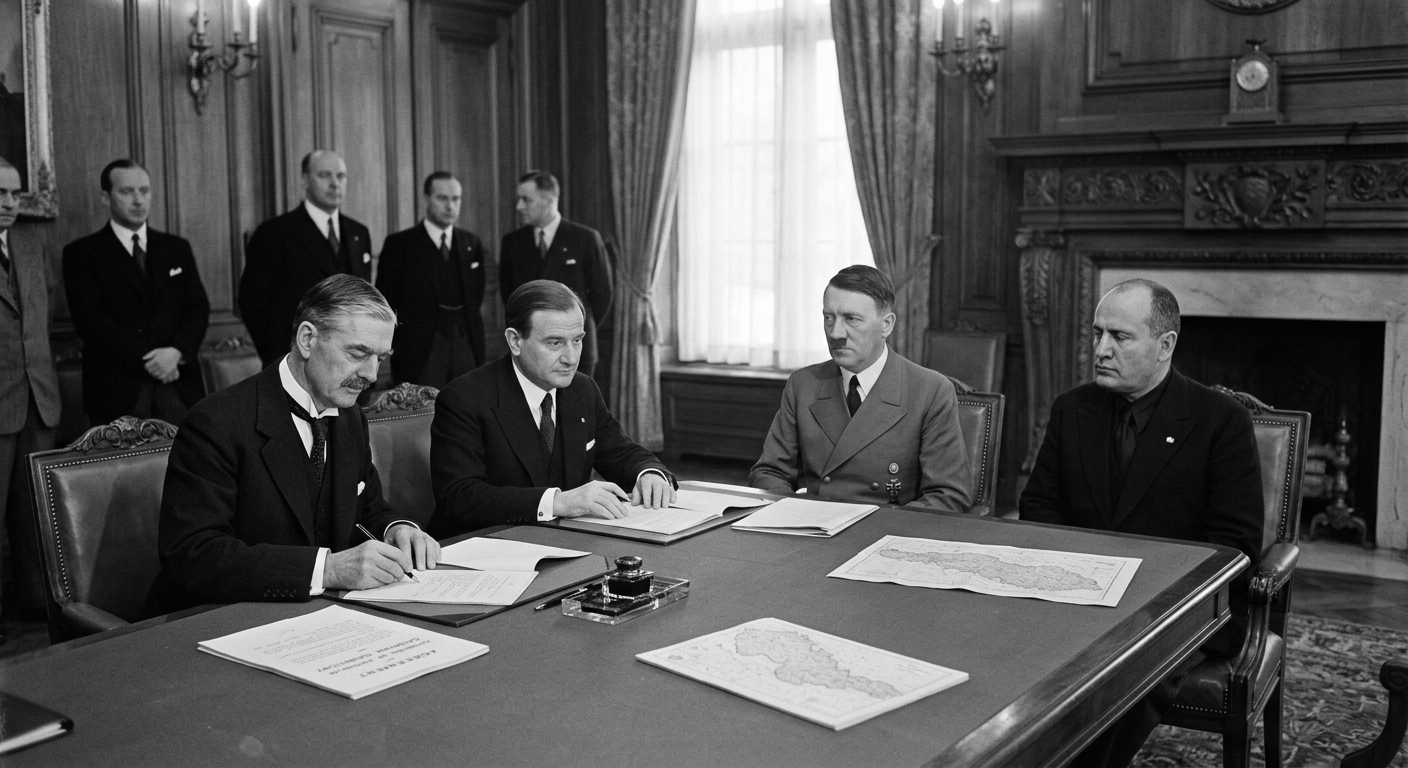
Shortly after 1.30 in the morning on 30 September 1938, four men signed a document in a stone building on the Königsplatz in Munich. Neville Chamberlain of Britain, Édouard Daladier of France, Benito Mussolini of Italy and Adolf Hitler had decided the fate of a fifth country. That country, Czechoslovakia, had no seat at the table. Its two diplomats had spent the evening waiting for news, and they learned the terms only when the British handed them a copy after the signing.
The Munich Agreement is usually remembered through one phrase, “peace for our time”, and one image: Chamberlain on an airfield waving a piece of paper. The real story is longer and more complicated. It runs through a spring of rising tension, three meetings between Chamberlain and Hitler in two weeks, a continent preparing for war, and a final conference that lasted less than a day. Six months later, the agreement was in ruins.
A Country Built on a Fault Line
Czechoslovakia was created in 1918 from the wreckage of the Austro-Hungarian Empire. By the 1930s it was the only working democracy left in central Europe, with a strong economy, the famous Škoda armaments works and a well-equipped army. Its western border regions, which Germans called the Sudetenland, were protected by mountains and a line of modern fortifications.
Those border regions were also home to about three million German speakers. Germans made up close to a quarter of the population of the young state, and many resented living under Czech rule, particularly after the Great Depression hit the industrial Sudeten towns hard.
In 1933, a former gymnastics teacher named Konrad Henlein founded what became the Sudeten German Party. By 1935 it was one of the largest parties in the country. Henlein presented himself as a campaigner for minority rights, but he was increasingly guided by Berlin. In March 1938, Hitler told him to keep making demands the Czechoslovak government could never accept.
The Spring of 1938
Germany annexed Austria in the Anschluss of March 1938. On a map, Czechoslovakia now looked like a head inside the jaws of a German wolf, surrounded on three sides.
On 24 April, Henlein announced the Karlsbad Programme, eight demands that included full autonomy for the German regions. President Edvard Beneš and his government offered concessions, and each time the demands rose again.
In May, rumours spread that German troops were moving toward the border. The Czechoslovak government ordered a partial mobilisation. Britain and France issued warnings to Berlin, and the May Crisis passed. Abroad, Hitler appeared to have backed down. In private, he was furious. On 30 May 1938, he signed a revised directive for Fall Grün (Case Green), the plan to invade Czechoslovakia, stating that it was his “unalterable decision to smash Czechoslovakia by military action in the near future.” The attack was set for no later than 1 October 1938.
A Mediator From London
Britain had no treaty with Czechoslovakia. France did, and the Soviet Union had promised help on the condition that France acted first. If Germany attacked and France honoured its word, Britain would almost certainly be drawn into a European war. Chamberlain, Prime Minister since 1937, was determined to stop that from happening.
In August, the British government sent Lord Runciman, a former cabinet minister, to Prague as a mediator in what became known as the Runciman Mission. It produced no settlement. Under strong British pressure, Beneš eventually offered the Sudeten Germans almost everything in the Karlsbad Programme. The Sudeten leaders broke off talks anyway.
On 12 September, Hitler gave a furious closing speech at the Nazi Party rally in Nuremberg, attacking the Czechoslovak government and Beneš personally. Riots broke out in the Sudetenland, the Czechoslovak authorities declared martial law, and Henlein fled to Germany. War seemed days away.
Three Flights to Germany
Berchtesgaden, 15 September. Chamberlain, then 69 years old, flew to Germany to meet Hitler at the Berghof, his mountain retreat in the Bavarian Alps. Hitler demanded that the Sudetenland join Germany and threatened war if it did not. At one point, Chamberlain asked why he had come at all if Hitler had already decided to use force. Hitler calmed down, and Chamberlain went home agreeing in principle that the German areas could be transferred.
Back in London, Chamberlain and the French leaders drew up a joint plan. Czechoslovakia would hand over every district where Germans made up more than half of the population, and in return Britain and France would guarantee what remained of the country. Prague first refused. Britain and France then told Beneš that if he rejected the plan, Czechoslovakia would be held responsible for any war, and France would not come to its aid. The government gave way on 21 September, and it resigned the next day.
Bad Godesberg, 22 September. Chamberlain flew back to Germany, expecting to settle the details. Instead, Hitler said the plan was no longer enough. He now wanted German troops to occupy the territory immediately, and he supported fresh claims by Poland and Hungary. In the early hours of 24 September, he handed over the Godesberg Memorandum, which demanded that the territory be evacuated within days. Chamberlain was angry, and this time even his own cabinet resisted.
A Continent Gets Ready for War
The last days of September felt like the eve of war. Czechoslovakia ordered a general mobilisation and manned its border fortifications. France called up reservists. In London, trenches were dug in the parks and gas masks were handed out to the public, and the Royal Navy was mobilised.
On 26 September, in a speech at the Sportpalast in Berlin, Hitler declared that the Sudetenland was the last territorial claim he had to make in Europe, and gave Beneš a choice between peace and war.
The next evening, Chamberlain spoke to the nation by radio. His words would later be quoted against him for decades: “How horrible, fantastic, incredible it is that we should be digging trenches and trying on gas masks here because of a quarrel in a far-away country between people of whom we know nothing.”
Behind the scenes, Britain asked Mussolini to intervene. On 28 September, Mussolini persuaded Hitler to hold off for 24 hours and agree to a meeting of the four powers. Chamberlain received the news while speaking in the House of Commons, and the chamber broke into cheers.
Munich, 29 September
The conference met in the Führerbau, Hitler’s new party building in Munich. There were four leaders, their advisers and interpreters, and no agenda in the usual sense. Mussolini presented a proposal as an Italian compromise. It was very close to Hitler’s own Godesberg demands.
Two groups were missing. Czechoslovakia, the country being divided, was not invited. Its diplomats, Vojt?ch Mastný and Hubert Masa?ík, had been sent to Munich as observers and were kept away from the talks. The Soviet Union, an ally of both France and Czechoslovakia, was also left out completely.
The four leaders signed the agreement at around 1.30 in the morning on 30 September, though the document is dated 29 September. Chamberlain then called in Mastný and handed him the terms. When Mastný said he would take them back to his government for an answer, he was told that no answer was expected.
The main terms were:
German troops would occupy the Sudetenland in four stages, starting on 1 October and finishing by 10 October 1938.
An international commission would decide the final borders and hold plebiscites in doubtful areas. In practice, the plebiscites never took place, and the commission accepted German demands.
The claims of Poland and Hungary on Czechoslovak territory would be settled later.
Britain and France would guarantee the new borders of Czechoslovakia against unprovoked aggression.
Czechoslovakia was left with two choices: fight Germany alone, or accept. On 30 September, the government in Prague accepted.
The Piece of Paper
Later that morning, Chamberlain met Hitler privately at his Munich apartment and asked him to sign a short joint declaration. It stated that the two countries regarded the agreement and their 1935 Anglo-German Naval Agreement as symbolic of their desire never to go to war with one another again. Hitler signed it with little hesitation.
That afternoon, Chamberlain landed at Heston Aerodrome near London and held up the declaration for the cameras. Later, from a window in Downing Street, he told the crowd: “I believe it is peace for our time.” Huge crowds cheered him. In Paris, Daladier had expected to face anger on his return and was greeted with cheers as well.
What Czechoslovakia Lost
For Czechoslovakia, Munich was a disaster. The historic Czech lands of Bohemia, Moravia and Silesia lost about 38 percent of their area. With the territory went its mountain fortifications, which had taken years to build, and a large share of the country’s industry, including about 70 percent of its iron and steel production and around 70 percent of its electric power.
Other neighbours moved quickly. Poland sent an ultimatum on the night of 30 September and occupied the Zaolzie area around Teschen on 2 October. On 2 November 1938, the First Vienna Award, decided by Germany and Italy, gave Hungary nearly 12,000 square kilometres of southern Slovakia and Subcarpathian Ruthenia.
Beneš resigned as president on 5 October and went into exile. A smaller, defenceless state remained, now heavily dependent on Germany.
The Argument in London
Not everyone in Britain cheered. Duff Cooper, the First Lord of the Admiralty, resigned from the cabinet on 3 October. Two days later, Winston Churchill rose in the House of Commons and said: “We have sustained a total and unmitigated defeat, and France has suffered even more than we have.” He warned that Munich was only the first sip of a bitter cup that would be offered year after year.
On 6 October, the Commons approved the government’s policy by 366 votes to 144. Churchill and a group of Conservative critics abstained.
Six Months Later
The agreement’s promises did not last. In March 1939, Germany encouraged Slovak leaders to break away, and the Slovak State declared independence on 14 March. That night, the elderly Czech president, Emil Hácha, was summoned to Berlin. He was told that German troops had orders to advance, and Hermann Göring threatened to bomb Prague from the air. In the early hours of 15 March, Hácha signed a statement placing the Czech people under German “protection”.
The same day, German troops entered Prague. The rest of the Czech lands became the Protectorate of Bohemia and Moravia. Hitler had now taken territory where almost no Germans lived, and his claim to be uniting German people was exposed. The Anglo-French guarantee for Czechoslovakia was never honoured.
Chamberlain’s government changed course. At the end of March 1939, Britain and France guaranteed Poland’s independence. When Germany invaded Poland on 1 September 1939, they declared war two days later.
Was Munich a Mistake or a Pause?
Historians have argued over Munich ever since.
Critics argue that 1938 was the best moment to stop Hitler. Czechoslovakia had a modern army behind strong fortifications, France had the largest army in western Europe, and Germany was not ready for a long war. Some German generals were so alarmed at the prospect of war that a group around Colonel Hans Oster planned to arrest Hitler if he ordered an invasion, in what became known as the Oster conspiracy. The plotters hoped for a firm British stand, and when it did not come, their plan collapsed. Munich also handed Germany Czech fortifications, factories and weapons, and it convinced Hitler that Britain and France would always back down. It persuaded Stalin of the same thing, which helps explain why he chose to sign the Molotov-Ribbentrop Pact with Hitler in August 1939.
Defenders argue that Chamberlain had few good options. Britain’s air defences, including radar and modern fighter aircraft, were not ready in 1938. The British Dominions, such as Canada, Australia and South Africa, were unwilling to go to war over the Sudetenland. Public opinion in Britain and France feared another war on the scale of 1914 to 1918, and France had no plan to attack Germany in order to save its ally. In this view, the year after Munich gave Britain time to rearm and made clear to the world that Hitler, not the Western powers, was responsible when war came.
Both arguments hold some truth. Britain did use the following year to rearm. Germany also used it, and it gained more from the Czech arms industry than Britain gained in time. Most historians today see Munich less as a single act of weakness than as the end point of a policy of appeasement that had been allowing German expansion since 1935.
What is beyond dispute is what happened to the people who were not in the room. Czechoslovakia was divided by four powers in one night and occupied six months later. The Munich Agreement entered the language of international politics as a warning: a peace bought at someone else’s expense rarely lasts.
Also Read: https://pakimtehan.com/blog/history-explained/why-the-league-of-nations-failed
Comments (0)
No comments yet. Be the first to comment!