Pak Imtehan
History
How the Cold War Began
In October 1945, two months after atomic bombs destroyed Hiroshima and Nagasaki, the British writer George Orwell published a short essay called "You and the Atomic Bomb". In it, he imagined a future in which a few great powers, each armed with weapons that could wipe out millions of people in seconds, would face one another in a permanent state of "cold war": no real peace, and no open fighting either.
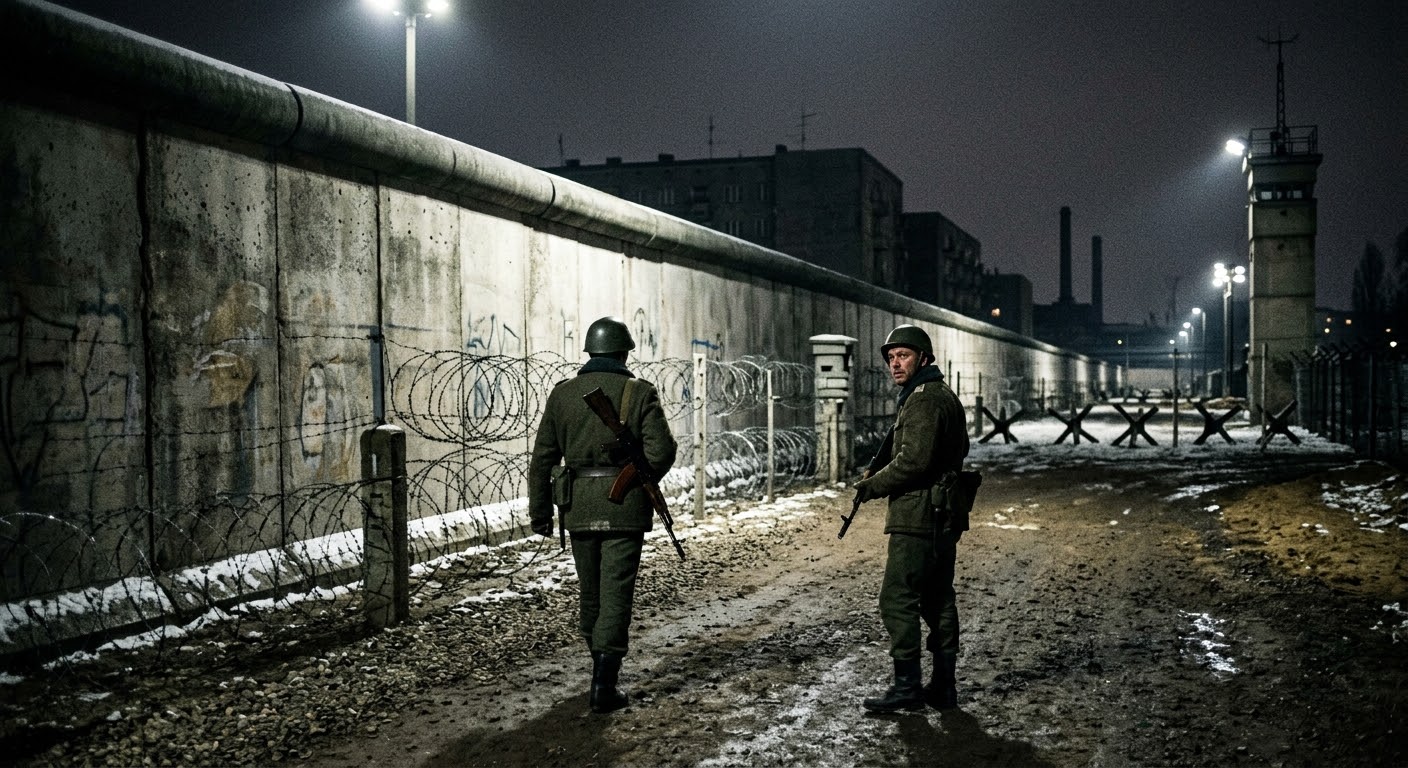
Within five years, his description had become reality. The United States and the Soviet Union, allies in the defeat of Nazi Germany, had become rivals dividing the world between them. Europe was split by a fortified line, Germany was divided into two states, both superpowers had the atomic bomb, and war was being fought in Korea. The story of how this happened runs year by year from 1945 to 1950.
Two Allies Who Never Trusted Each Other
On 25 April 1945, American and Soviet soldiers met on the River Elbe near the German town of Torgau, cutting Nazi Germany in two. Photographs of the meeting, known as Elbe Day, show soldiers shaking hands and embracing. It was the high point of the wartime alliance.
That alliance had always been a partnership of necessity. The United States was a capitalist democracy built on private property, free markets and elections. The Soviet Union was a one-party communist state led by Joseph Stalin, whose ideology taught that capitalism and communism were bound to clash. Distrust ran deep on both sides. Western powers had sent troops to intervene in the Russian Civil War after 1917. The Soviet Union had signed a pact with Hitler in 1939. During the war, Stalin repeatedly complained that Britain and the United States delayed opening a second front in France until 1944, while the Red Army carried the heaviest fighting.
The two countries also came out of the war in very different conditions. The Soviet Union had lost an estimated 27 million people, and much of its western territory lay in ruins. The United States had lost around 400,000 service members, its own territory was untouched, and its economy had grown enormously. Each side's experience of the war shaped what it wanted from the peace.
1945: Agreements With Different Meanings
The leaders of the "Big Three" met twice in 1945 to plan the post-war world.
At the Yalta Conference in the Crimea, from 4 to 11 February 1945, Franklin Roosevelt, Winston Churchill and Stalin agreed that Germany would be divided into zones of occupation, that the Soviet Union would join the war against Japan, and that the countries freed from Nazi rule would hold free elections. The central dispute was Poland. Britain and the United States expected a democratic Polish government. Stalin, whose country had been invaded through Poland twice in thirty years, was determined to have a friendly government there, and the Red Army was already in control of the country.
Roosevelt died on 12 April 1945. His successor, Harry S. Truman, had little experience in foreign affairs and took a sharper tone with the Soviets from his first weeks in office.
At the Potsdam Conference near Berlin, from 17 July to 2 August 1945, the leaders confirmed the division of Germany and Berlin into four zones run by the United States, the Soviet Union, Britain and France. On 24 July, Truman told Stalin that the United States had a new weapon of unusual destructive force. Stalin showed little reaction. Soviet intelligence had already learned of the American atomic programme through its spies.
Two weeks later, the United States dropped atomic bombs on Hiroshima on 6 August and Nagasaki on 9 August 1945. Japan surrendered, the war ended, and the world entered the nuclear age with one country holding the bomb.
1946: Words That Defined the Conflict
Stalin's speech, February 1946. On 9 February 1946, Stalin gave an election speech in Moscow in which he argued that the capitalist system made future wars likely and called for rapid industrial and military growth. Many in Washington read it as a warning that cooperation was over.
The Long Telegram, February 1946. Two weeks later, on 22 February 1946, the American diplomat George F. Kennan sent an analysis of Soviet behaviour from the US embassy in Moscow. At a little over 5,000 words, the Long Telegram was the longest diplomatic telegram in the history of the State Department up to that point. Kennan argued that Soviet hostility came from deep insecurity and from the needs of the regime itself, that Moscow would push outward wherever it met no resistance, and that it would back down when faced with firm strength. The telegram was read widely in Washington and shaped American thinking for years.
The Iron Curtain, March 1946. On 5 March 1946, Churchill, now out of office, spoke at Westminster College in Fulton, Missouri, with Truman sitting on the stage. He declared: "From Stettin in the Baltic to Trieste in the Adriatic, an iron curtain has descended across the Continent." The phrase became the most famous image of the divided Europe. Stalin compared Churchill to Hitler and accused him of calling for war against the Soviet Union.
Crises on the southern edge. That year, tension also grew in the Middle East. In the Iran crisis of 1946, Soviet troops stayed in northern Iran beyond the agreed withdrawal date and supported separatist governments there. They left after strong pressure from the United States and the new United Nations. In the Turkish Straits crisis, Moscow pressed Turkey for joint control of the straits linking the Black Sea to the Mediterranean. The United States sent naval forces to the eastern Mediterranean, and the Soviets eventually dropped the demand.
Moscow produced its own view of the other side. In September 1946, the Soviet ambassador in Washington, Nikolai Novikov, sent a report to Moscow arguing that the United States was seeking world domination and preparing for a future war against the Soviet Union.
1947: The Year the Lines Were Drawn
The Truman Doctrine. In early 1947, Britain told the United States it could no longer afford to support the government of Greece, which was fighting communist guerrillas in the Greek Civil War, or to keep up its aid to Turkey. On 12 March 1947, Truman asked Congress for help for both countries. He declared: "I believe that it must be the policy of the United States to support free peoples who are resisting attempted subjugation by armed minorities or by outside pressures." Congress approved around 400 million dollars in aid. The Truman Doctrine turned support for Greece and Turkey into a general principle of opposing the spread of communism.
A name for the conflict. On 16 April 1947, the American financier Bernard Baruch told an audience in South Carolina: "Let us not be deceived: we are today in the midst of a cold war." Later that year, the journalist Walter Lippmann published a book called The Cold War, and the term entered everyday use.
The Marshall Plan. Western Europe was still in ruins in 1947, and the winter of 1946 to 1947 had been one of the harshest on record. American leaders feared that poverty and hunger would help communist parties, which were strong in France and Italy, win power. On 5 June 1947, Secretary of State George C. Marshall proposed a large programme of economic aid for Europe in a speech at Harvard University.
The offer was open to the Soviet Union and Eastern Europe. Soviet Foreign Minister Vyacheslav Molotov attended talks in Paris and then walked out, rejecting the plan's conditions as American interference in national economies. Moscow pressed Poland and Czechoslovakia to stay away. Truman signed the Marshall Plan into law on 3 April 1948, and the United States provided about 13.3 billion dollars to Western European countries over the following years. The largest shares went to Britain, France and West Germany. The Soviets answered with their own programme for Eastern Europe, which later developed into Comecon.
Containment. In July 1947, Kennan published an article titled "The Sources of Soviet Conduct" in the journal Foreign Affairs, signed only "X". It called for a "long-term, patient but firm and vigilant containment of Russian expansive tendencies." Containment became the guiding idea of American policy for the next four decades.
The Soviet response. In September 1947, Moscow brought together communist parties from across Europe to form the Cominform, an organisation to coordinate their policies. Soviet official Andrei Zhdanov announced that the world was now divided into two camps: an "imperialist" camp led by the United States, and an "anti-imperialist" camp led by the Soviet Union. Both superpowers were now describing the world in the same divided terms.
1948: Prague and Berlin
The fall of Czechoslovakia. Czechoslovakia was the last country in Eastern Europe with a coalition government that included non-communist parties. In February 1948, the communists took full control in what became known as the 1948 Czechoslovak coup d'état. Ten years after the Munich Agreement, Czechoslovakia had again lost its independence, this time to Soviet influence. The coup alarmed Western Europe and helped push the Marshall Plan through Congress.
The Berlin Blockade. Berlin lay deep inside the Soviet zone of Germany, but the city itself was divided among the four occupying powers. In June 1948, the Western powers introduced a new currency, the Deutsche Mark, in their zones to revive the German economy. Stalin saw this as a step toward a separate West German state.
On 24 June 1948, Soviet forces cut all road, rail and canal routes into West Berlin. More than two million people in the western sectors faced the loss of food and fuel. The Western powers did not try to break the blockade by force. Instead, they supplied the city by air.
The Berlin Airlift lasted almost a year. American and British aircraft flew more than 278,000 flights and delivered about 2.3 million tons of supplies, around two thirds of it coal. On a single day in April 1949, crews delivered nearly 13,000 tons in 1,383 flights. The operation cost 101 lives, mostly in accidents. On 12 May 1949, the Soviets lifted the Berlin Blockade. It was a major defeat for Stalin and a powerful symbol of Western resolve.
1949: Alliances, Two Germanys and a Second Bomb
The events of 1948 convinced Western Europe that it needed American military protection. On 4 April 1949, twelve countries, including the United States, Canada, Britain and France, signed the North Atlantic Treaty in Washington, creating NATO. Its members agreed that an armed attack against one would be considered an attack against them all. For the United States, it was the first peacetime military alliance with Europe in its history.
Germany's division became formal. The Federal Republic of Germany, or West Germany, was founded in May 1949. The German Democratic Republic, or East Germany, followed in October 1949.
Two other events that year changed the balance of power. On 29 August 1949, the Soviet Union tested its first atomic bomb, known in the West as RDS-1, years earlier than American experts had expected. The American nuclear monopoly was over. On 1 October 1949, Mao Zedong proclaimed the People's Republic of China after the communists won the Chinese Civil War. The most populous country in the world was now communist.
1950: The Cold War Turns Global
In April 1950, a secret American policy paper known as NSC 68 described the Soviet Union as a threat to the free world and called for a huge increase in American military spending.
On 25 June 1950, North Korean forces, backed by Stalin, invaded South Korea. The United States led a United Nations force to defend the South, and China later entered the war on the North Korean side. The Korean War showed that the Cold War was no longer limited to Europe. It had become a worldwide struggle, and it would last until the collapse of the Soviet Union in 1991.
Who Started It? The Historians' Debate
Historians have argued about responsibility for the Cold War since it began. Their views fall broadly into three schools.
The orthodox view, common in the West in the 1940s and 1950s, placed the blame mainly on Stalin. In this interpretation, Soviet expansion into Eastern Europe, broken promises at Yalta and communist ideology forced the United States to respond.
The revisionist view gained ground in the 1960s, during the Vietnam War. Historians such as William Appleman Williams argued that the United States shared much of the responsibility. They pointed to American economic interests in open markets, the use of atomic power as a diplomatic weapon and a failure to understand the Soviet need for security after two invasions from the west.
The post-revisionist view, associated with historians such as John Lewis Gaddis, sees the conflict as the result of mutual misunderstanding. Each side read the other's defensive moves as aggressive and responded in ways that confirmed the other's fears. After Soviet archives opened in the 1990s, Gaddis and others placed renewed weight on Stalin's personal role and his ideological outlook.
Most historians now agree on several points. The two powers had fundamentally different political and economic systems, and each believed its own system should shape the post-war world. The end of the war removed the common enemy that had held them together. Germany and Eastern Europe were left in a power vacuum that both sides wanted to fill. The atomic bomb added a new level of fear. In that setting, every move by one side, whether a speech, an aid programme or a blockade, was read by the other as proof of hostile intent.
The handshake on the Elbe in April 1945 lasted only a few years. By 1950, the soldiers who had met there belonged to two rival military blocs, each armed with atomic weapons, facing each other across a divided Germany. The world Orwell had imagined in 1945 had arrived.
Also Need: https://pakimtehan.com/blog/history-explained/why-germany-lost-world-war-two
Comments (0)
No comments yet. Be the first to comment!