Pak Imtehan
Analysis
US arms sale to UAE: Trump's Gulf strategy equips partners for a war that diplomacy has yet to end
Staff Report | Opinion
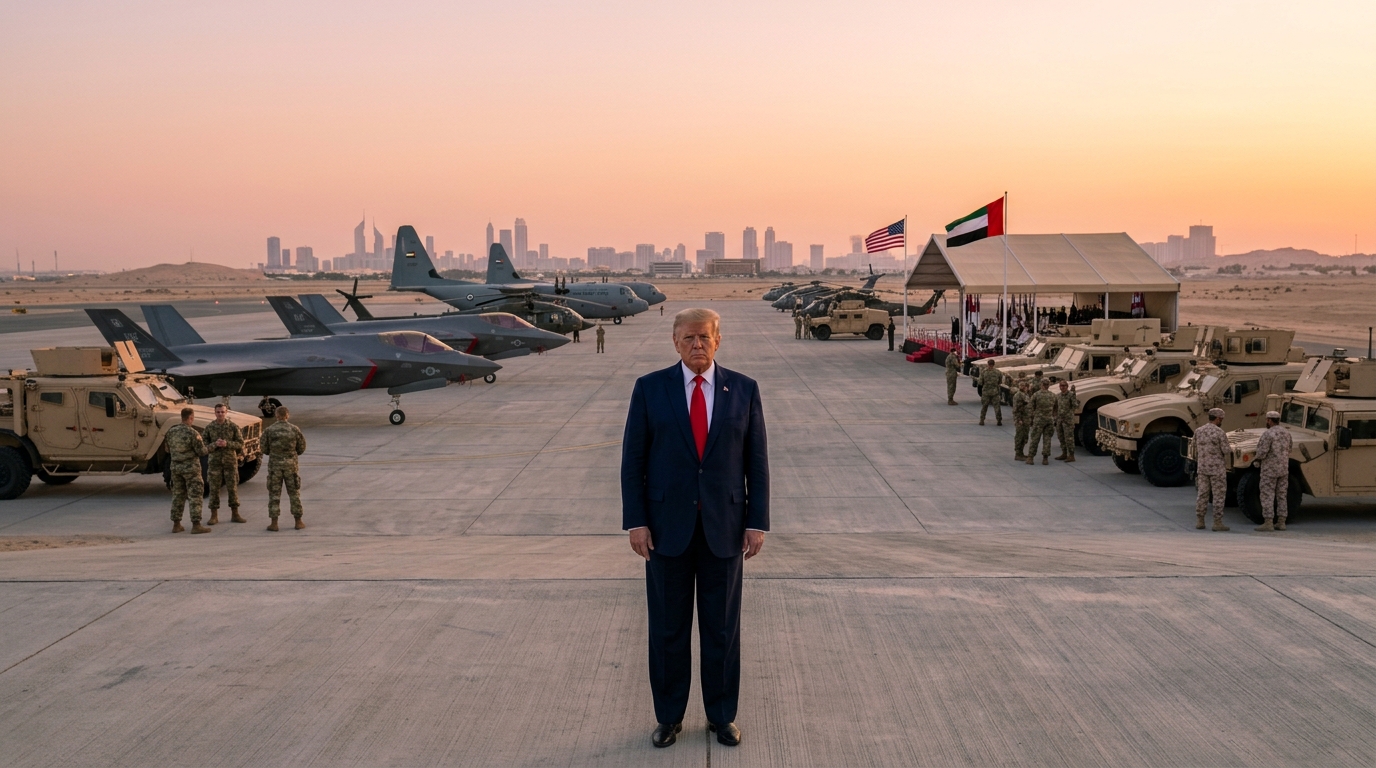
The Trump administration has approved a $1 billion sale of precision rocket guidance kits to the United Arab Emirates, alongside $400 million in Patriot missile repair services for Kuwait. The approvals, announced by the State Department in Washington on Monday and reported in the region on Tuesday, arrive as Gulf states continue to face drone and missile attacks linked to the war with Iran. The US arms sale to UAE is a technical package rather than a headline-grabbing deal, yet it reveals a coherent strategic logic. Washington is equipping its partners to defend themselves more cheaply and more independently. That approach has clear merits. Its limitation is that better defence against attacks does not, by itself, bring the conflict that produces them any closer to an end.
The details of the package explain its purpose. The UAE is to receive up to 10,000 guidance sections for the Advanced Precision Kill Weapon System (APKWS), which converts unguided rockets into precision munitions. The system can be used to intercept drones, reducing reliance on far more expensive interceptor missiles. On the headline figures, the sale works out at roughly $100,000 per guidance section. The State Department said the sale would "improve the United Arab Emirates' capability to meet current and future threats" and would "support the foreign policy and national security objectives of the United States". The separate Kuwaiti package covers the repair and return of Patriot missiles, which Kuwait would use "to strengthen its homeland defence".
The approvals must be read against the course of the war. The conflict began in late February 2026 with strikes on Iran. A memorandum of understanding in June produced a pause, but Iranian attacks on vessels in the Strait of Hormuz led to the resumption of United States military operations in September. Negotiations remain stalled. Throughout this period Gulf states have been exposed to repeated Iranian drone and missile attacks. The pressure has intensified this week. Saudi Arabia reported attacks on two airports near the Yemeni border on Tuesday, and the Houthi movement claimed further strikes on Saudi targets. In such conditions, the immediate demand among Gulf governments is for affordable means of stopping large numbers of relatively cheap aerial threats.
The case for the US arms sale to UAE, and for the Trump administration's wider approach, is grounded in cost and in burden-sharing. Drones are inexpensive to build and launch, while sophisticated interceptor missiles are costly and limited in supply. A defence that relies on expensive missiles to destroy cheap drones is unsustainable over a long campaign. Guided rockets narrow that gap. The policy also reflects the principle that partners should carry a larger share of their own defence, reducing the need for direct deployment of United States forces. Supplying maintenance for existing Patriot systems in Kuwait follows the same reasoning. It keeps established air defences operational without new large-scale commitments, and it strengthens the confidence of partners whose territory and infrastructure have already come under fire.
The counter-argument concerns what arms sales cannot achieve. Each improvement in defensive capability may encourage adversaries to increase the volume or sophistication of their attacks, producing a cycle in which both sides invest more without either gaining a decisive advantage. More weapons in a region already at war also raise the risk of escalation through miscalculation, particularly in crowded airspace and shipping lanes. There is, in addition, a question of priorities. Military support is visible and quick to deliver, whereas diplomacy is slow and uncertain. When negotiations are stalled, there is a temptation to treat procurement as a substitute for a political strategy. The experience of the June pause, which collapsed within months, suggests that durable security requires a settlement rather than a better shield.
The economic context helps explain why Washington and its Gulf partners are focused on keeping energy flowing. Oil prices have hovered around $100 a barrel this week. Gulf oil exports, excluding Iran, recovered in September to more than 81 per cent of their pre-war levels, and Group of Seven (G7) governments announced on Friday the release of 100 million barrels of crude and diesel from emergency stocks. Protecting refineries, ports and airports from drone attack is therefore central to stabilising world energy markets. Effective air defence in the Gulf has consequences well beyond the region, for importers and consumers who have absorbed sharply higher fuel costs since the war began. In that sense, the arms package serves an economic purpose as well as a military one.
For Pakistan, the implications are both direct and indirect. On Monday, Pakistan and Türkiye agreed with Saudi Arabia to provide military forces and capabilities and to ensure their rapid deployment to the kingdom, the first activation of the defence pact signed in August. Pakistan is therefore no longer an observer of Gulf security but a participant in it. The direction of American policy, including which partners receive which capabilities, will shape the environment in which any Pakistani deployment operates. The economic link is equally important. Sustained fuel prices weigh on household budgets in Pakistan, where protests over fuel levies are already being organised. A Gulf in which energy infrastructure is better protected serves Pakistan's interests, but so would a diplomatic settlement that removes the threat altogether.
The broader pattern is one in which the Gulf is becoming more heavily armed while the political framework for managing conflict remains weak. Three tankers were struck by unidentified projectiles in the Strait of Hormuz over the weekend, which illustrates how quickly incidents can occur in a crowded waterway. Each new weapons transfer strengthens individual states, but regional security depends on mechanisms that allow adversaries to communicate, de-escalate and verify commitments. None of these features prominently in the current approach. The danger is that the region settles into a prolonged condition of armed confrontation, in which defensive capabilities improve steadily while the underlying dispute remains untouched, and in which a single serious incident could still trigger a wider war.
A more balanced strategy would pair defensive support with renewed diplomatic effort. The United States could link continued arms transfers to a parallel push to revive talks on the Strait of Hormuz and a broader cessation of hostilities, building on the June memorandum rather than abandoning it. Gulf partners receiving new capabilities could commit to transparency on their use and to regional channels for preventing incidents at sea and in the air. Pakistan and Türkiye, as new partners in Gulf defence, could use their standing to support de-escalation alongside their defence commitments. Lawmakers in Washington could also ask how each package fits within a strategy for ending the conflict rather than merely managing it.
The US arms sale to UAE, and the accompanying Kuwaiti package, show how the Trump administration intends to manage a dangerous Gulf: by strengthening partners and spreading the cost of defence. That approach answers the immediate threat from drones and missiles with some efficiency. It does not answer the question of how the war ends. Several signals will indicate the direction of policy in the coming weeks. These include whether further arms approvals for Gulf partners follow, whether talks on the Strait of Hormuz resume, and how attacks on Gulf infrastructure evolve. If the US arms sale to UAE is followed by a serious diplomatic initiative, it may be remembered as part of a coherent strategy. If not, it will mark another step in a costly stalemate.
Comments (0)
No comments yet. Be the first to comment!