Pak Imtehan
Staff Report
EU-China trade talks in Beijing test whether Europe can rebalance trade without a trade war
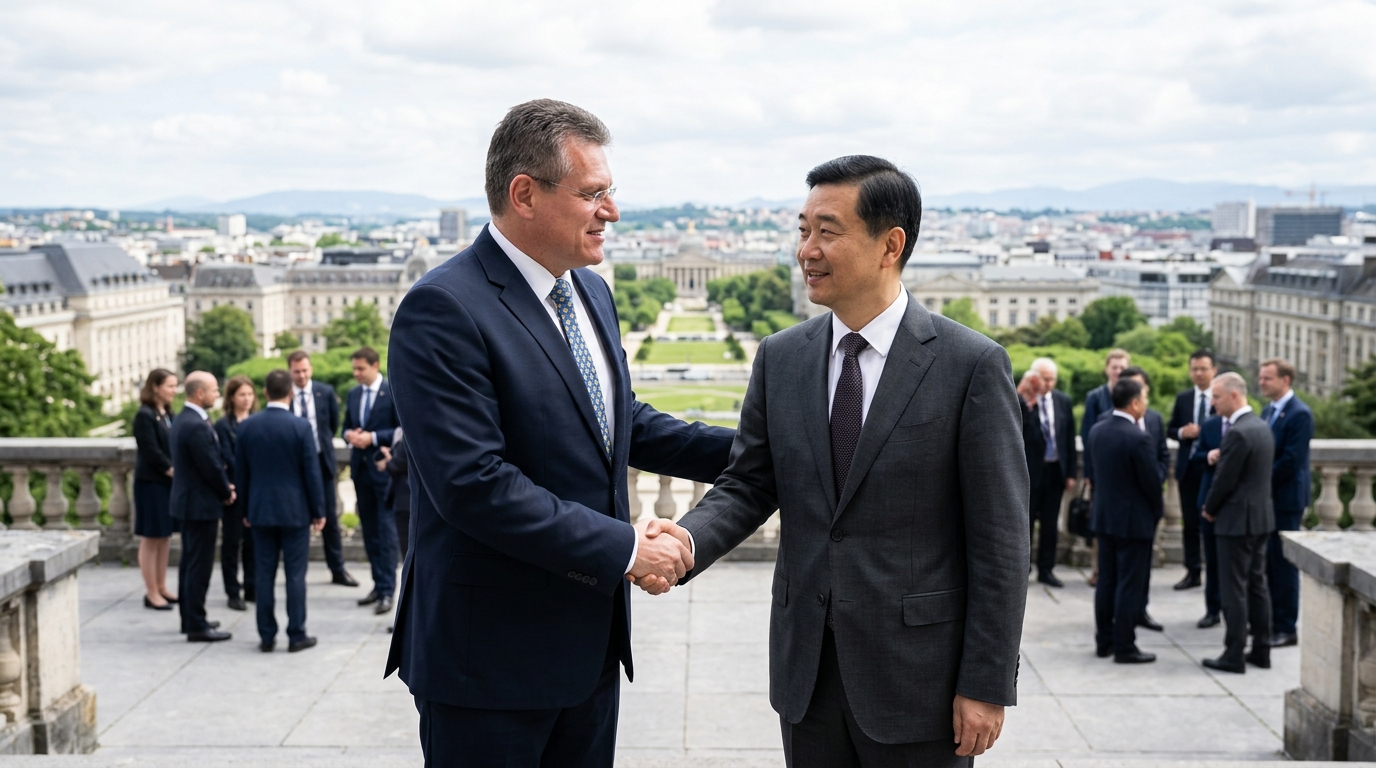
Two days of EU-China trade talks open in Beijing on Thursday, and they arrive at a tense moment for the world's trading system. European Trade Commissioner Maros Sefcovic is meeting Chinese Commerce Minister Wang Wentao for the second session of the EU-China Trade and Investment Council, which the two men co-chair. Brussels wants concrete commitments on a trade imbalance that runs at roughly €1 billion a day in China's favour. Beijing, for its part, has warned against what it calls protectionism. The evidence suggests that both sides want to avoid open conflict. The harder question is whether a settlement can come before Europe acquires new tools that would make confrontation easier to start.
The timetable explains the urgency. Sefcovic has said he wants "tangible results by October", and the talks are expected to run through Friday. EU leaders then meet in Brussels next week, with trade with China high on their agenda. A good outcome in Beijing would give the European Commission something to present at that summit. A poor one would strengthen the hand of governments pressing for tougher action. Brussels has set out three broad aims for the talks. It wants to slow surges of Chinese imports in strategic sectors, raise European exports to China, and secure more dependable access to critical raw materials. Each of these touches a sensitive point in Beijing's economic model.
The most immediate test concerns hybrid cars. The European Union hopes to manage some Chinese exports through voluntary limits, with hybrid vehicles shipped to the bloc as the leading example. Beijing has made clear that it firmly opposes import quotas. The difference matters. A voluntary restraint arrangement would let China set the pace of its own exports and save face. A quota imposed by Brussels would be a unilateral restriction that Beijing would almost certainly treat as hostile. The car sector is a natural first case, since it already has a recent history of dispute between the two sides. Success there could become a template for other industries.
That recent history is instructive. When the bloc and Beijing clashed over electric vehicles, China responded with measures against European brandy and pork. The episode showed how quickly a dispute in one industry can spread to farmers and food producers elsewhere. It also showed the limits of trade defence measures taken one product at a time. Those measures can take months to prepare and can still be met with swift retaliation. This experience shapes the present EU-China trade talks. Europe appears to want a broader framework that limits surges before they happen, rather than a series of separate cases that each invite a fresh round of counter-measures.
Rare earths add a second layer of pressure. China introduced restrictions on exports of rare earths last year, and these minerals are essential to European manufacturing. The EU now wants a clear system of export licensing for rare earths and related materials, so that companies can plan supply with some certainty. Here the balance of leverage favours Beijing. Europe can threaten tariffs or quotas on Chinese goods, but China can respond by slowing supplies that European factories cannot easily replace. That asymmetry helps explain why Brussels has approached the talks with caution, even as its rhetoric has hardened. Any agreement on licensing would be as valuable to European industry as a deal on cars.
Behind the negotiators stands a sharper political argument inside Europe. French President Emmanuel Macron and German Chancellor Friedrich Merz have urged the EU to prepare a "credible instrument" that could be used quickly against economic pressure. The proposed tool would not name any single country. It would let the European Commission respond to trade aggression within days rather than months. Some governments want a European equivalent of Section 301. That United States law is used to investigate and retaliate against unfair trade practices. China's commerce ministry has urged Paris and Berlin to avoid "protectionist" steps and warned that they could suffer the consequences. The proposal is therefore both a negotiating signal and a source of risk.
The strongest case on each side deserves a fair statement. From the European perspective, a persistent deficit of this size reflects more than consumer choice. Brussels points to surges in strategic sectors, and many in the bloc blame unfair trade practices. A faster response tool, on this view, is simply a way to make existing trade defences effective. From Beijing's perspective, the same deficit reflects the competitiveness of Chinese manufacturing and European demand for its goods. Beijing describes such concerns as protectionism aimed at restricting China. The more defensible reading is that both claims contain truth. That is why a managed compromise is more plausible than either full victory or a complete breakdown.
The wider consequences of the EU-China trade talks reach well beyond Europe and China. A shift by the EU towards quotas or rapid-response restrictions would add to a global trend. Large economies increasingly use trade policy as an instrument of strategy. For producers in third countries, including Pakistan, such shifts carry two possible effects. Goods blocked from Europe may be redirected to other markets, increasing competition for local manufacturers. At the same time, European buyers seeking to reduce reliance on a single supplier may look for alternative sources. Which effect dominates would depend on the sectors involved and on the terms of any deal. Policymakers in Islamabad and elsewhere in the region have reason to follow the outcome closely.
A constructive way forward is visible in the outline of the talks themselves. A limited agreement on hybrid cars, paired with transparent licensing for rare earths, would let each side claim progress. Neither would have to surrender its core position. Such a deal could include agreed review dates, so that neither side feels locked into terms that later prove unfair. Europe could keep its proposed instrument in reserve, using it as a backstop rather than a first resort. China could treat voluntary export restraint in one sector as a way to protect its wider access to the European market. Small, verifiable steps of this kind are more likely to hold than a sweeping settlement.
The EU-China trade talks will not resolve a structural imbalance in two days, and neither side has suggested that they will. What they can do is set the direction for the next phase. Three signals will matter most. The first is whether Beijing accepts any form of restraint on hybrid exports. The second is whether the two sides agree on clearer rules for rare earth licences. The third is how EU leaders treat the proposed rapid-response instrument at next week's summit in Brussels. If the outcome of the EU-China trade talks is modest but concrete, managed competition remains possible. If the talks fail, the instruments of confrontation are already being prepared.
Comments (0)
No comments yet. Be the first to comment!