Pak Imtehan
Geopolitics Analyst
What Is Geopolitics? A Beginner's Guide
Why does the price of petrol in Lahore, Lagos or London go up when two countries start fighting thousands of kilometres away? Why do superpowers compete for influence over small nations most people cannot find on a map? Why has Russia worried about its western border for centuries, whoever was in power in Moscow?
All three questions have the same answer: geopolitics.
It sounds like a heavy academic subject, but the core idea is simple. Once you understand it, you will start to see it behind almost every major headline.
The Simple Definition
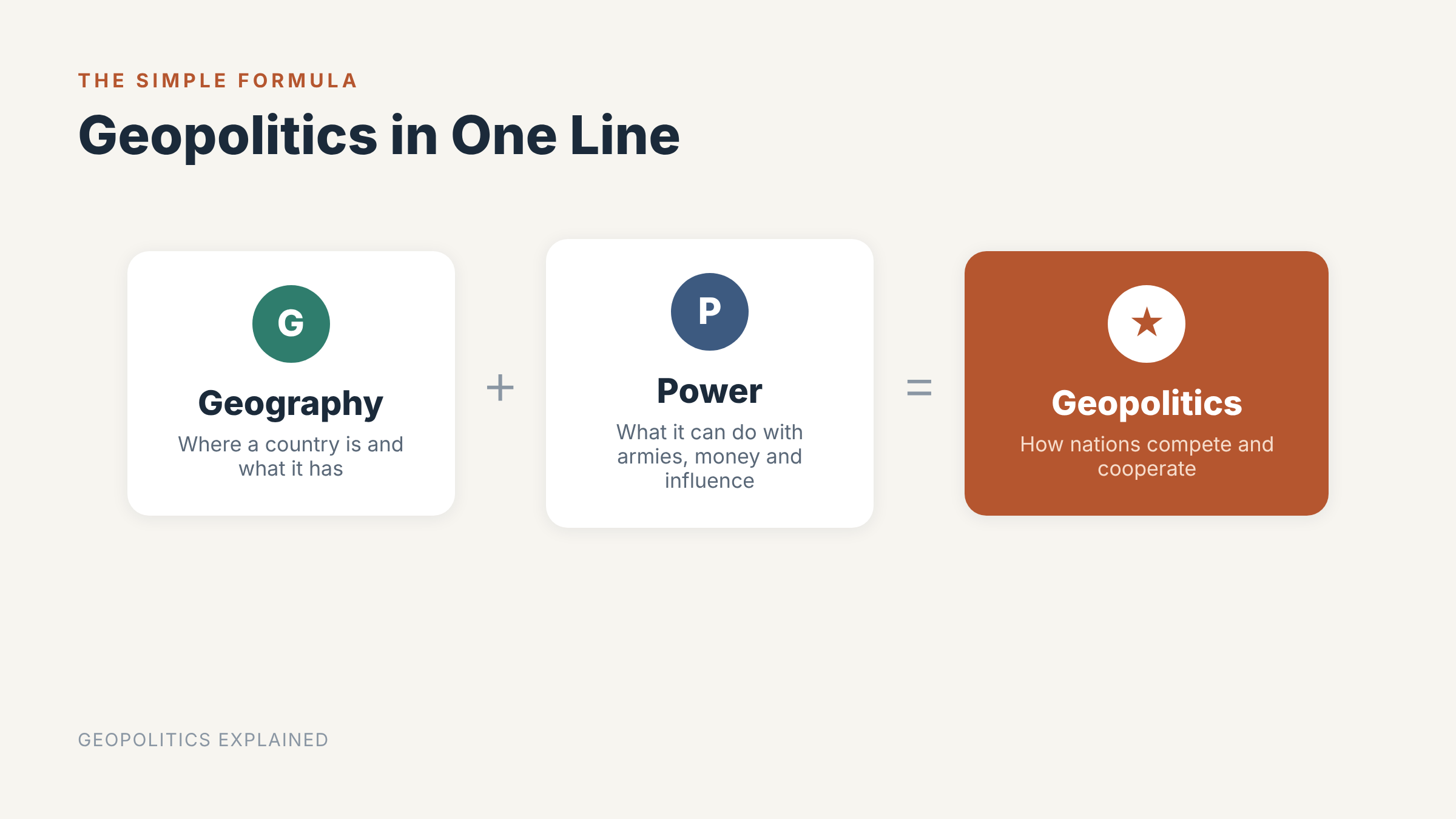
Geopolitics is the study of how geography shapes power and politics between nations.
Split the word in two and the meaning is clear:
Geo means earth, land or territory
Politics means power: who gets what, when and how
Together, geopolitics asks one central question: how does a country's place on the map shape what it can do, what it fears and what it wants?
A country's location, borders, mountains, rivers, coastlines, climate and natural resources are not just background facts. They decide whether it is easy to invade or hard to reach, rich in oil or dependent on imports, connected to the world by sea or locked inside a continent. These facts push leaders towards certain choices again and again.
Where the Idea Came From
People have thought about geography and power for thousands of years. Ancient generals and emperors knew that rivers, passes and mountains decided wars. The modern study of geopolitics, though, began in the late nineteenth century.
Rudolf Kjellén, a Swedish political scientist, coined the term "geopolitics" in 1899. He saw the state almost as a living body that needed territory and resources to survive.
Alfred Thayer Mahan, an American naval officer, argued in 1890 in The Influence of Sea Power upon History that the nations controlling the seas would control world trade, and with it world power. His ideas shaped the navies of the United States, Britain, Germany and Japan.
Halford Mackinder, a British geographer, offered the opposite view in 1904. He argued that the real centre of world power was the huge landmass of Eurasia, which he called the "Heartland." His famous warning was: "Who rules East Europe commands the Heartland; who rules the Heartland commands the World-Island; who rules the World-Island commands the world."
In the 1930s, Nazi Germany twisted geopolitical ideas to justify conquering land in Eastern Europe. After the Second World War, the word became unpopular in the West for decades. It returned in the 1970s, when American statesman Henry Kissinger used it to describe great-power strategy during the Cold War. Today it is used everywhere, from university classrooms to government security plans.
Why Geography Matters So Much
The most important idea in geopolitics is this: a country can change its government, its laws and its economy, but it cannot change its location.
Mountains, seas and borders stay in place for thousands of years. Because of this, countries often follow similar strategies across centuries, even under very different rulers. Consider four examples:
Britain is an island. The English Channel protected it from invasion, so instead of spending heavily on a large land army, Britain built the world's most powerful navy. That navy allowed it to build a global empire.
Russia sits on vast, flat plains with almost no natural barriers in the west. Napoleon invaded in 1812 and Hitler in 1941, both marching across that open land. This history explains why Russian leaders, from the Tsars to the Soviets to today, have tried to control or influence the countries along their borders.
Switzerland is surrounded by the Alps. Its mountains make it very difficult to invade, which has helped it stay neutral for centuries while wars raged around it.
Afghanistan is landlocked, mountainous and divided by rugged terrain. The British Empire, the Soviet Union and the United States all found it easy to enter but almost impossible to control. That is why it is often called the "Graveyard of Empires."
The same planet produces very different fears and ambitions depending on where a nation stands.
The Building Blocks of Geopolitics
When experts study a country's geopolitical position, they usually look at a few key factors:
Location: Is the country at a crossroads of trade, or isolated? Does it border powerful neighbours or friendly ones?
Terrain: Mountains and deserts can protect a country. Open plains can expose it.
Access to the sea: Countries with warm-water ports can trade and project naval power. Landlocked countries depend on their neighbours.
Natural resources: Oil, gas, water, minerals and fertile land give countries wealth and leverage. Lacking them creates dependence.
Population: A large, young population can drive economic and military strength. A shrinking one can limit it.
Chokepoints: Narrow sea passages such as the Strait of Hormuz, the Strait of Malacca, the Suez Canal and the Panama Canal carry huge shares of world trade. Whoever controls or threatens them gains great influence.
A country's leaders cannot escape these facts. They can only manage them well or badly.
The World as a Chessboard
The easiest way to picture geopolitics is as a giant game of chess.
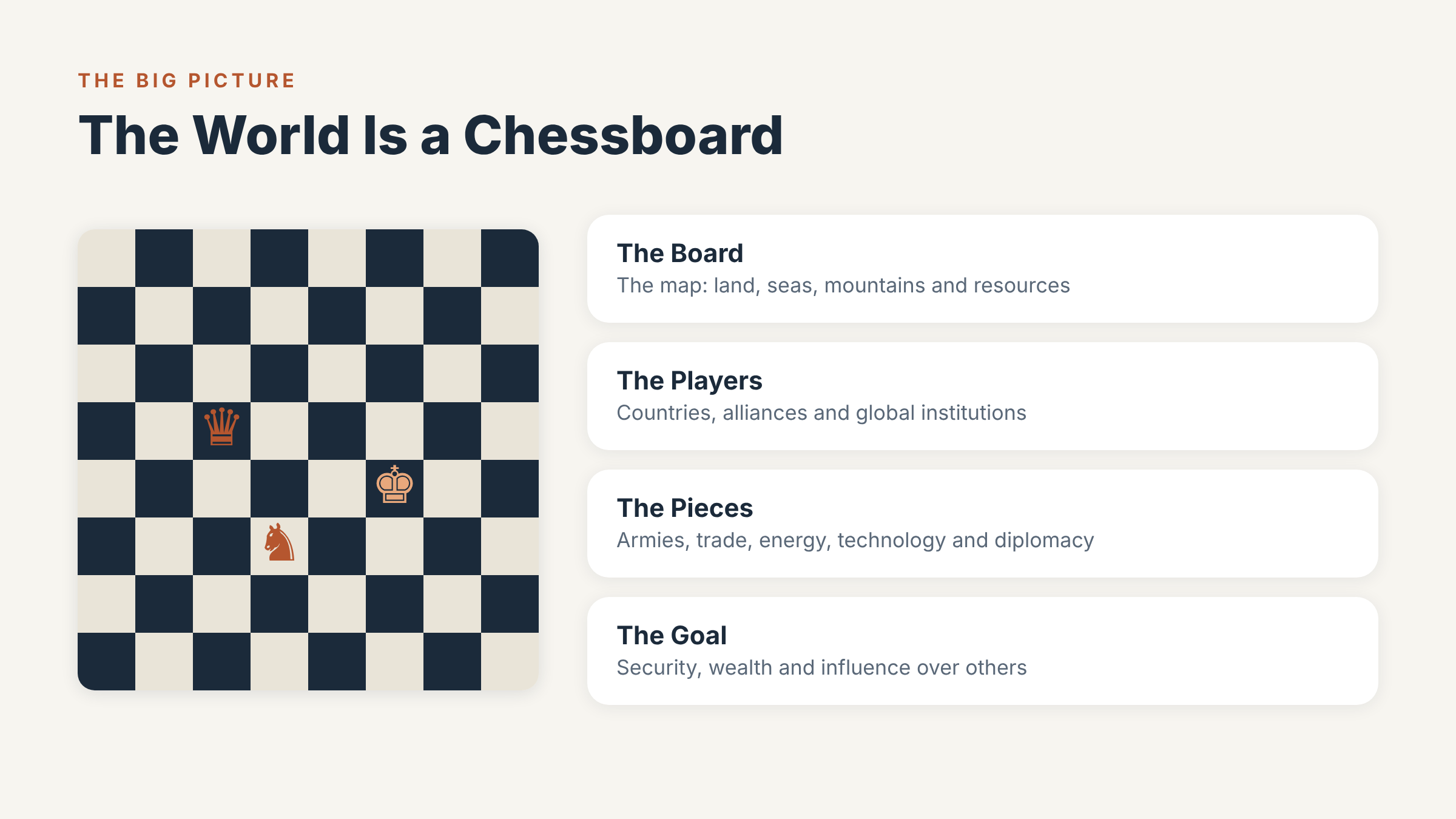
There are important differences from real chess. In geopolitics, many players move at the same time, alliances shift, the rules are often unclear, and the game never truly ends. A move made today can shape events for decades. For example, borders drawn by European powers in Africa and the Middle East more than a century ago still fuel disputes today.
How Geopolitics Touches Daily Life
Geopolitics is not only about presidents, generals and summits. It reaches ordinary people every day.
Fuel prices: Roughly one-fifth of the world's oil passes through the narrow Strait of Hormuz between Iran and Oman. Whenever tensions rise there, oil prices jump, and petrol becomes more expensive in countries far away.
Food prices: Before 2022, Russia and Ukraine together supplied close to 30 percent of the world's wheat exports. When war broke out, bread and flour prices rose in countries from Egypt to Pakistan to Lebanon.
Technology: The rivalry between the United States and China over advanced computer chips affects which phones, laptops and apps reach your market, and what they cost.
Jobs and investment: Large infrastructure projects, such as the China-Pakistan Economic Corridor connecting western China to the Arabian Sea port of Gwadar, are driven by geopolitical goals as much as economic ones.
When you follow geopolitics, you are learning why your own world works the way it does.
The Main Players
Three types of actors shape geopolitics today:
States (countries): Still the most important players. The United States, China and Russia have the greatest global reach, while regional powers such as India, Turkey, Iran, Saudi Arabia and Brazil shape events in their own neighbourhoods.
Alliances and organisations: Groups such as NATO, the European Union, the Shanghai Cooperation Organisation and BRICS (Brazil, Russia, India, China, South Africa and newer members) allow countries to combine their strength or coordinate their interests.
Non-state actors: Multinational companies, technology giants, armed groups and even financial markets can influence events without being countries themselves.
Geopolitics vs Everyday News
News tells you what happened. Geopolitics explains why it happened and what might come next.
A news report might say: "China held naval exercises near Taiwan." A geopolitical reading asks deeper questions. Why is Taiwan's location so important to China's access to the Pacific Ocean? Why does the United States care about an island so far from its own shores? Why do Japan and South Korea watch nervously? Seen this way, a single headline becomes part of a much larger story about power, security and the future of a whole region.
How to Think Like a Geopolitics Expert
Whenever you see a world crisis in the news, ask these four questions:
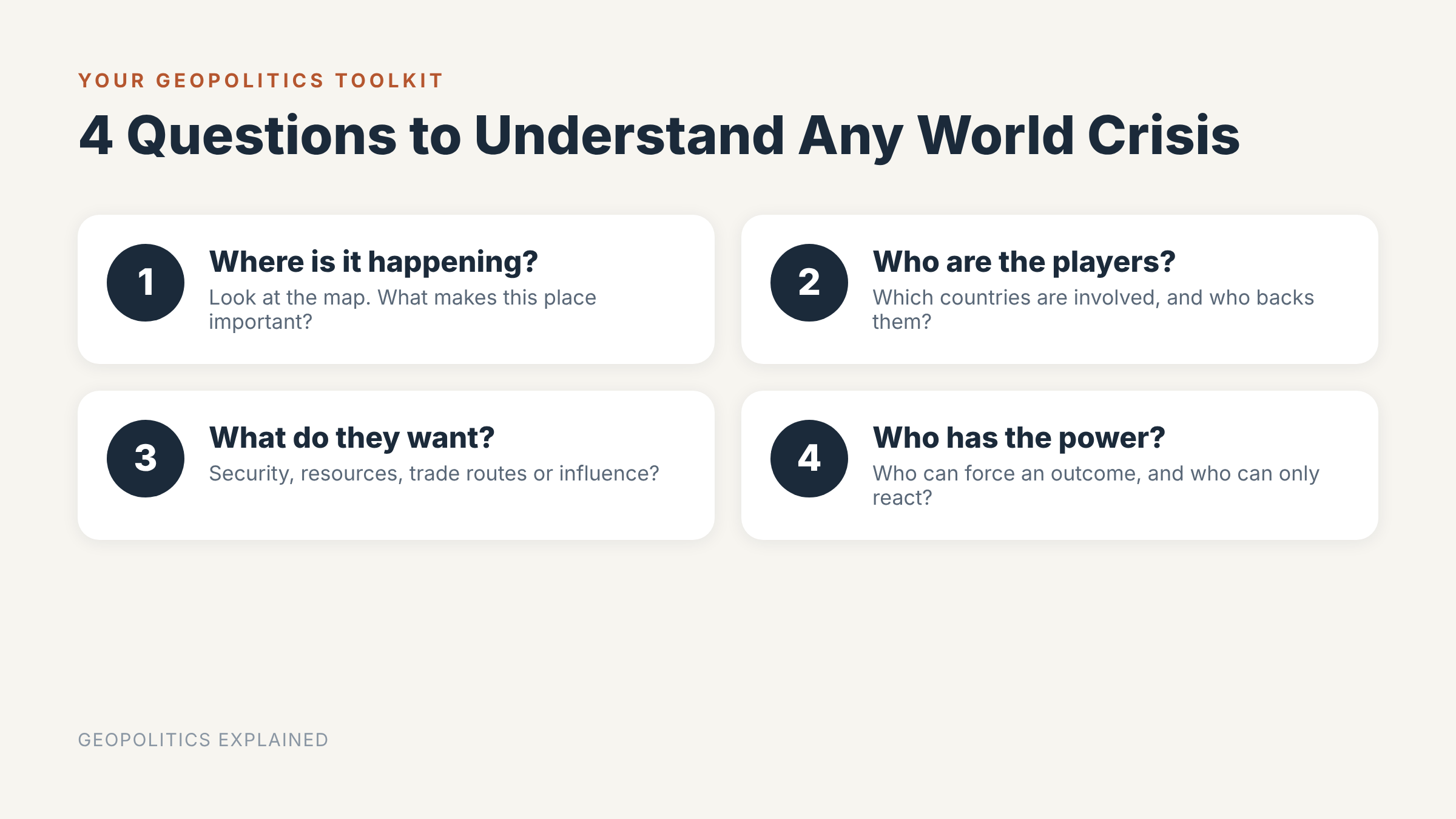
Use these questions on any headline, from a border clash to an oil price spike, and you will start to notice patterns that most readers miss.
The Bottom Line
Geopolitics is not about memorising capitals, dates or treaties. It is about understanding why nations behave the way they do.
Countries act out of fear, ambition and necessity, and much of that is shaped by the ground beneath their feet. Leaders come and go, but mountains, seas and borders remain.
Keep one idea in mind: geography sets the stage, power decides the moves, and national interests write the script. Once you see the world this way, the news stops looking like a stream of random events and starts to look like a story you can follow.
Comments (0)
No comments yet. Be the first to comment!