Pak Imtehan
Geopolitical Analyst
In The Prince, written in 1513, the Florentine diplomat Niccolò Machiavelli advised rulers that “it is much safer to be feared than loved, if one cannot be both.” For centuries, that judgement summarised how most statesmen understood power. Armies, fleets and treasuries decided the fate of nations, and influence was measured in the capacity to compel.
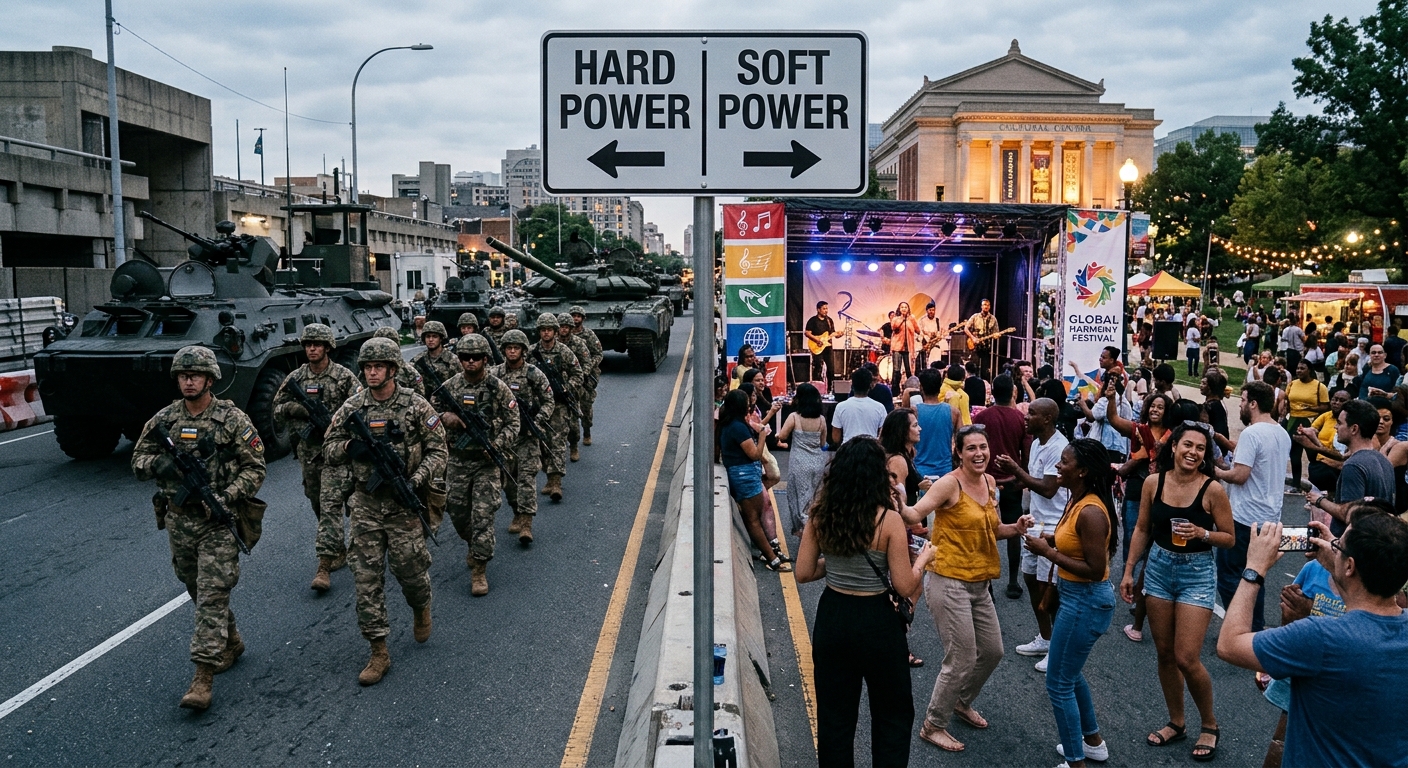
Nearly five hundred years later, the American scholar Joseph Nye offered a different answer to Machiavelli’s dilemma. In his book Bound to Lead (1990), and later in Soft Power: The Means to Success in World Politics (2004), Nye argued that a country can also get what it wants because others admire its values, imitate its example and aspire to its level of prosperity and openness. He called this capacity soft power, and defined it as “the ability to get what you want through attraction rather than coercion or payments.”
The distinction between being feared and being admired, between compelling others and persuading them, now sits at the centre of how scholars and governments think about influence in world politics.
Two Ways of Shaping the Behaviour of Others
All power in international relations is ultimately about changing the behaviour of other actors. Nye identified three broad ways of doing so:
Threats: the use or threat of force, or of economic punishment, to make others act against their own preferences.
Payments: offering rewards, such as aid, investment or trade access, in exchange for desired behaviour.
Attraction: shaping what others want, so that they choose to act in ways that suit you without needing to be compelled or paid.
The first two are forms of hard power. The third is soft power. Nye described these as points along a spectrum, ranging from command power, which forces or buys compliance, to co-optive power, which shapes preferences and sets the agenda.
Hard Power: Compulsion and Inducement
Military Power
Military force remains the most direct form of hard power. It can be used to defend territory, deter adversaries, coerce rivals or overthrow hostile governments. Its forms range from open war to more limited instruments:
Deterrence: discouraging an attack by threatening unacceptable retaliation, as nuclear weapons have done since 1945.
Coercive diplomacy: using limited force or the threat of force to persuade an adversary to change course. During the Cuban Missile Crisis of October 1962, the United States imposed a naval “quarantine” around Cuba, backed by the threat of escalation, until the Soviet Union agreed to withdraw its missiles.
Gunboat diplomacy: the display of naval power to force concessions. In 1853, American warships under Commodore Matthew Perry sailed into Tokyo Bay, and the following year Japan signed the Treaty of Kanagawa, ending more than two centuries of near-total isolation.
Direct military action: in 1991, a United States-led coalition expelled Iraqi forces from Kuwait under the authority of the United Nations Security Council.
Economic Power
Economic instruments can be as powerful as weapons, and in an interdependent world they are often used more frequently.
Sanctions and punishment: governments restrict trade, freeze assets or cut off access to financial systems in order to change another state’s behaviour. After Russia’s full-scale invasion of Ukraine in February 2022, Western governments froze an estimated 300 billion US dollars of Russian central bank reserves and imposed extensive restrictions on trade and finance.
Inducements and rewards: states also use economic power positively. Between 1948 and 1952, the Marshall Plan provided around 13 billion US dollars for the reconstruction of Western Europe, a sum equivalent to well over 150 billion dollars today. It helped rebuild European economies, strengthened American influence and limited the appeal of communism. More recently, China’s Belt and Road Initiative, announced by President Xi Jinping in 2013, has financed ports, railways, roads and power plants across Asia, Africa, Europe and Latin America, extending Chinese economic influence on a vast scale.
The Limits of Hard Power
Hard power can produce quick and visible results, but its record is mixed.
Military superiority does not guarantee success. The United States possessed overwhelming military strength in Vietnam and in Afghanistan, yet withdrew from both without achieving its central political goals. The withdrawal from Afghanistan in August 2021 ended a twenty-year intervention.
Force carries heavy costs. Wars consume enormous resources, cause great human suffering and often create new enemies.
Sanctions frequently fall short. Major studies of economic sanctions, including the work of Gary Hufbauer and his colleagues, have found that only around one-third of sanctions episodes achieved even partial success. Targeted governments often adapt, find alternative partners or pass the costs on to their populations.
Coercion can damage reputation. The use of force that others see as illegitimate can weaken a country’s international standing for years.
Soft Power: The Power of Attraction
The Three Sources of Soft Power
According to Nye, a country’s soft power rests on three main resources:
Culture: when its films, music, literature, food, sport and way of life are attractive to others.
Political values: when it lives up to the values it promotes, both at home and abroad.
Foreign policy: when its actions are seen as legitimate and having moral authority.
The third point is often misunderstood. Soft power does not come only from popular culture. A country that is admired for its films but whose foreign policy is widely seen as unjust may find its overall attraction severely limited.
How States Build Soft Power
Governments invest heavily in institutions designed to cultivate attraction and understanding abroad:
Broadcasting: the BBC World Service, founded in 1932, broadcasts in dozens of languages and has long been one of Britain’s most influential international voices.
Cultural institutes: the Alliance Française (founded in 1883), the British Council (1934), the Goethe-Institut (1951) and China’s Confucius Institutes (from 2004) promote language learning and cultural exchange.
Education: scholarship programmes such as the American Fulbright Program, established in 1946, have brought future leaders, scholars and officials from across the world to study abroad. Many return home with lasting personal and professional ties.
International events: hosting the Olympic Games or the FIFA World Cup allows countries to present themselves to a global audience. Qatar’s hosting of the 2022 World Cup was a clear attempt to raise its international profile.
Soft Power in Action
The Korean Wave. Few countries have expanded their cultural influence as rapidly as South Korea. Known as Hallyu, or the Korean Wave, the global spread of Korean television dramas, films, music and fashion has transformed international perceptions of the country. In 2018, the band BTS addressed the United Nations General Assembly as part of a youth campaign, and in 2020 the film Parasite became the first non-English-language film to win the Academy Award for Best Picture.
Turkish television drama. Türkiye has become one of the world’s largest exporters of television series. Historical dramas have built large audiences across the Middle East, Central Asia, the Balkans and South Asia. In 2020, Pakistan Television began broadcasting an Urdu-dubbed version of Dirilis: Ertugrul, which attracted enormous audiences and deepened popular affection for Türkiye in Pakistan.
Disaster relief. Soft power can also grow out of humanitarian action. After the Indian Ocean tsunami of December 2004, the American military delivered large-scale relief to affected areas of Indonesia, and opinion surveys afterwards recorded a marked improvement in Indonesian attitudes towards the United States. A similar pattern followed the 8 October 2005 earthquake in northern Pakistan, when American and allied helicopters, including heavy-lift Chinooks, carried supplies to remote mountain areas. In both cases, military hardware served the purposes of attraction rather than coercion.
The Limits of Soft Power
Soft power has its own weaknesses:
It works slowly. Attraction builds over years or decades and rarely produces immediate results in a crisis.
Governments do not fully control it. Much of a country’s cultural appeal comes from private artists, companies, universities and citizens.
It can be lost quickly. Actions that contradict a country’s stated values can damage its reputation. The images of prisoner abuse at Abu Ghraib prison in Iraq, published in 2004, severely harmed the international image of the United States.
Attraction does not always change policy. A government may enjoy the music or films of another country while still opposing its foreign policy.
Measuring Soft Power
Because soft power is intangible, measuring it is difficult. Several indices attempt to do so:
The Soft Power 30, published by the consultancy Portland between 2015 and 2019, ranked countries using data on government, culture, education, digital engagement, enterprise and international engagement, combined with polling.
The Global Soft Power Index, published annually by Brand Finance since 2020, surveys public perceptions in many countries. In recent editions, the United States, China and the United Kingdom have occupied the leading positions.
Such rankings are useful for comparison, but they should be read with caution. Perceptions shift rapidly, and attraction among one audience may coexist with hostility among another.
Beyond the Binary: Smart Power and Sharp Power
Smart Power
Few governments rely on hard or soft power alone. The term smart power describes the ability to combine both effectively, choosing the right tool for each situation. It was popularised by the American analyst Suzanne Nossel in an article in Foreign Affairs in 2004 and later adopted by Nye. In 2009, Hillary Clinton, then nominated as US Secretary of State, used the term to describe her approach to American diplomacy.
The relationship between the two forms of power is often complementary:
Hard power can support soft power. Disaster relief delivered by military forces, as in Indonesia in 2004 and Pakistan in 2005, can generate goodwill.
Soft power can support hard power. Countries that are widely admired find it easier to build coalitions and gain international support for their policies.
Hard power can undermine soft power. Military action seen as illegitimate can erode attraction for years.
Sharp Power
In 2017, a report published by the National Endowment for Democracy, written by Christopher Walker and Jessica Ludwig, introduced the term sharp power. It describes efforts by states to manipulate, censor or distort information in other societies, through disinformation campaigns, covert influence over media and pressure on universities and publishers. Unlike soft power, which relies on genuine attraction, sharp power seeks to penetrate and manipulate the information environment of other countries.
Pakistan’s Hard and Soft Power
Pakistan possesses significant resources of both kinds, though they are unevenly developed.
Hard power resources:
A nuclear deterrent, established with the tests of 28 May 1998
One of the largest and most experienced armed forces in the world
A strategic location near the Strait of Hormuz and at the junction of several regions
Partnerships with China, the Gulf states and Türkiye that strengthen its strategic position
Soft power resources:
Cricket: Pakistan’s victory in the 1992 Cricket World Cup under Imran Khan remains one of the most celebrated moments in the sport and gave the country global recognition.
Music: the work of Nusrat Fateh Ali Khan brought Sufi qawwali to international audiences, and Coke Studio Pakistan, launched in 2008, has reached millions of listeners worldwide. Its song Pasoori (2022) became one of the most streamed South Asian songs internationally.
The diaspora: millions of Pakistanis living abroad act as cultural ambassadors and sent a record of around 38 billion US dollars in remittances in the fiscal year 2024 to 2025.
United Nations peacekeeping: Pakistan has been among the largest contributors of troops to UN peacekeeping missions for decades, building a reputation for international service.
Religious and cultural heritage: sites such as Taxila, Mohenjo-daro and the shrines of Sufi saints draw visitors and scholarly interest from around the world.
Challenges:
International media coverage has often focused on security concerns, which has limited the country’s global image.
Investment in cultural diplomacy, tourism promotion and international education has been modest compared with many other states of similar size.
The gap between Pakistan’s hard power and its soft power potential suggests considerable room for growth through sustained investment in culture, education, tourism, sport and public diplomacy.
Why the Distinction Matters
Understanding the difference between hard and soft power helps explain several features of contemporary world politics:
Why powerful states sometimes fail: military and economic strength cannot guarantee outcomes if others see their use as illegitimate.
Why smaller states can gain influence: countries such as Norway, Switzerland, Qatar and South Korea have built international standing far beyond their military size through diplomacy, culture and reputation.
Why competition increasingly takes place over ideas and narratives: in an age of social media and global communication, the struggle to shape perceptions has become as important as the struggle for territory or markets.
Conclusion
Machiavelli argued that it is safer to be feared than loved. Joseph Nye’s contribution was to show that, in the modern world, being admired can also be a powerful source of influence. Hard power, through military force and economic pressure, allows states to compel or induce others. Soft power, through culture, values and legitimate policies, allows them to attract others and shape what they want.
Neither form is sufficient on its own. Hard power without legitimacy breeds resistance, while soft power without strength may be admired but ignored. The most effective states combine both, using force and payment where necessary and attraction wherever possible. In this sense, the old question of whether it is better to be feared or loved has a modern answer: the most powerful countries seek to be respected for their strength and admired for their example at the same time.
Frequently Asked Questions
What is the difference between hard power and soft power?
Hard power is the ability to influence others through coercion or payment, using military force, economic sanctions or financial rewards. Soft power is the ability to influence others through attraction, based on a country’s culture, political values and foreign policies.
Who coined the term soft power?
The American political scientist Joseph Nye introduced the concept in his 1990 book Bound to Lead and developed it further in Soft Power: The Means to Success in World Politics (2004).
What are the three sources of soft power?
According to Joseph Nye, soft power comes from a country’s culture, its political values when it lives up to them, and its foreign policies when they are seen as legitimate and having moral authority.
What are examples of hard power?
Examples include military intervention, such as the 1991 Gulf War; coercive diplomacy, such as the naval quarantine during the Cuban Missile Crisis; economic sanctions, such as those imposed on Russia after 2022; and economic inducements, such as the Marshall Plan.
What are examples of soft power?
Examples include the global appeal of American films and universities, the Korean Wave of music and television, the BBC World Service, cultural institutes such as the British Council and Goethe-Institut, scholarship programmes such as the Fulbright Program, and hosting events such as the Olympic Games or the FIFA World Cup.
What is smart power?
Smart power is the ability to combine hard and soft power effectively, choosing the most suitable tools for each situation. The term was popularised by Suzanne Nossel in 2004 and later used by Joseph Nye and US Secretary of State Hillary Clinton.
What is sharp power?
Sharp power refers to efforts by states to manipulate or distort information and public opinion in other countries through censorship, disinformation and covert influence. The term was introduced in a 2017 report by the National Endowment for Democracy.
Which country has the most soft power?
In recent editions of the Brand Finance Global Soft Power Index, the United States has ranked first, followed by China and the United Kingdom. Rankings vary by index and change over time.
Is soft power more effective than hard power?
Neither is always more effective. Hard power can produce quick results but often carries high costs and can damage reputation. Soft power is slower and harder to control but can create lasting influence. Most successful states combine both.
Can hard power create soft power?
Yes. Humanitarian operations carried out by military forces, such as American relief efforts after the 2004 Indian Ocean tsunami and the 2005 earthquake in Pakistan, improved perceptions of the United States in the affected countries.
What are Pakistan’s sources of soft power?
Pakistan’s soft power sources include cricket, Sufi music and qawwali, Coke Studio Pakistan, its large overseas diaspora, its contributions to United Nations peacekeeping and its rich historical and religious heritage, including sites such as Taxila and Mohenjo-daro.
Also Read: https://pakimtehan.com/blog/geopolitics/superpowers-great-powers-and-middle-powers-explained
Comments (0)
No comments yet. Be the first to comment!