Pak Imtehan App
CSS Current Affairs Notes
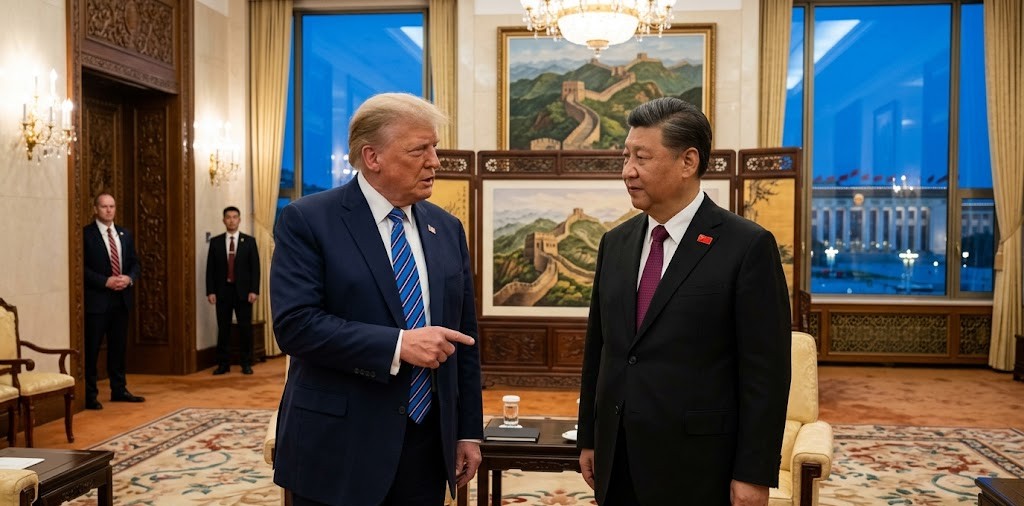
The May 14–15, 2026, summit in Beijing between Presidents Donald Trump and Xi Jinping operates as a high-stakes compliance check on the 2025 Busan Truce. This meeting serves to formalize a mercenary détente rather than a lasting peace. The geopolitical landscape is constrained: a costly US military involvement in Iran has depleted the Treasury and strained the Pentagon, handing Beijing significant energy leverage while the Strait of Hormuz remains a contested choke point.
Trump’s "deal-maker" rhetoric masks a structural reality defined by a new "Board of Trade" mechanism. This body aims to ringfence non-sensitive commerce from a deepening tech-security chasm. Friction remains intense over an $11 billion Taiwan arms package and China’s 2025 export ban on rare earth permanent magnets. This summit represents a tactical retreat for both sides. Xi needs to stabilize a cooling Chinese economy, while Trump must curb inflation and energy costs before the 2026 US Midterm elections.
Key Takeaways
The Busan Baseline: Reaffirmation of the 10% "Fentanyl Tariff" floor, preventing a return to the 145% duty peak of early 2025.
Military Overstretch: The $200 billion cost of the Iran conflict has forced Washington to seek Chinese diplomatic help in reopening global oil routes.
Magnet Diplomacy: Beijing refuses to lift its ban on rare earth permanent magnets for military use, a direct counter to the $11 billion US-Taiwan defense sale.
Commercial Sanctuaries: A new bilateral "Board of Trade" oversees $30 billion in non-sensitive commerce to protect supply chains for firms like Tesla and Nvidia.
Midterm Priority: The White House is prioritizing a reduction in $5.00+ per gallon gas prices over ideological decoupling.
The Beijing Checkpoint: A Mercenary Peace
BEIJING — The Great Hall of the People saw little more than a cold exchange of interests this week. As President Donald Trump arrived in the Chinese capital, the theater of handshakes could not hide the math of the 2025 Busan Truce. This meeting is a performance of "stabilized hostility."
In 2025, the relationship nearly fractured. Following the "Liberation Day" tariffs of April 2, which pushed US duties on Chinese imports to 145%, global markets went into freefall. The subsequent Busan Truce in October 2025 reset those rates to a 10% baseline. That rate is contingent on Beijing’s suppression of fentanyl precursors. This summit is the first audit of whether that floor holds.
Hard Power and the Iran Shadow
Washington’s leverage in Beijing is limited by the geography of conflict. The war with Iran has become a fiscal quagmire. With the Pentagon confirming costs of $29 billion in the last month alone, and total war expenditures exceeding $200 billion, Defense Secretary Pete Hegseth is managing a readiness deficit.
The closure of the Strait of Hormuz on March 4, 2026, turned China into an essential energy intermediary. Brent Crude has spiked above $120 per barrel. While the US produces significant shale, the resulting 30% jump in domestic gas prices is a political toxin. China, as the top buyer of Iranian oil, holds the keys to de-escalation. Every day the Strait remains closed, the White House loses political capital. The deal in Beijing is priced in barrels.
The "Big Three" Friction Points
1. Taiwan and the Tech Red Line
The immediate flashpoint is the $11 billion arms package for Taipei. The sale includes M109A7 howitzers and ATACMS missiles. Beijing’s response is the 2025 Permanent Magnet Ban.
By blocking exports of neodymium-iron-boron (NdFeB) and samarium-cobalt magnets to military end-users, China has targeted the US defense industrial base. These magnets are vital for F-35 actuators and the very missiles being shipped to Taiwan. During the talks, Secretary of State Marco Rubio pushed for a "carve-out" for commercial aerospace, but the Chinese Ministry of Commerce remains firm. The red line has moved from the Taiwan Strait to the molecular level of manufacturing.
2. The Board of Trade: Musk, Huang, and the CEO Caucus
To prevent total decoupling, the summit introduced the "Board of Trade" (BoT) mechanism. This body, lobbied for by Elon Musk and Jensen Huang, seeks to isolate $30 billion in non-sensitive sectors from the security crackdown.
The BoT allows for case-by-case reviews of advanced semiconductors, moving away from the 2025 "presumption of denial." In exchange, China agreed to increase purchases of Boeing aircraft and US soybeans, returning to the "Phase One" playbook. However, the definition of "sensitive" remains a moving target as AI capabilities blur the lines between civilian and military use.
3. Energy and the 10% Floor
Economic stability in 2026 rests on the 10% "fentanyl duty." Trump’s strategy of linking drug interdiction to trade tariffs has resulted in a 15% reduction in precursor shipments from Chinese ports. In Beijing, the President signaled he will hold the 10% rate steady through the year, provided Beijing uses its influence to stabilize global LNG market
The Personality Gap: Deals vs. Doctrines
The summit highlights the tension within the US delegation. On one side is Trump, who views Xi as a peer and prefers personalized, high-stakes gambles. On the other are Marco Rubio and Pete Hegseth, the architects of institutional China-skepticism.
Rubio has pushed for hard decoupling in biotech and quantum sectors. Hegseth remains focused on Pacific military overmatch. Trump appears more interested in the "Big Win," a headline-grabbing commitment from Xi to purchase hundreds of billions in US energy. This "Good Cop, Bad Cop" routine is transparent. The Chinese leadership knows a personal promise from the President can often override the policy papers of his cabinet.
Conclusion: Managed Competition or Borrowed Time?
The May 2026 summit did not end the rivalry. It formalized the rules of engagement. By establishing the Board of Trade and reaffirming the Busan Truce, both sides avoided an economic collapse during a period of energy instability.
Structural issues: Taiwan’s defense, the rare earth chokehold, and the AI race remain. For Trump, the summit is a pivot toward domestic needs; a way to lower the "inflation tax" before November. For Xi, it is a strategic pause, allowing China to manage its property crisis without the weight of a 145% tariff wall. This summit achieved managed competition by default. It bought the world another six months of predictability. But with the Busan Truce set to expire in late 2026, and the Iran war continuing, this stability is fragile.
Comments (0)
No comments yet. Be the first to comment!