Pak Imtehan
Competitive Exams Prep App (CSS, PMS)
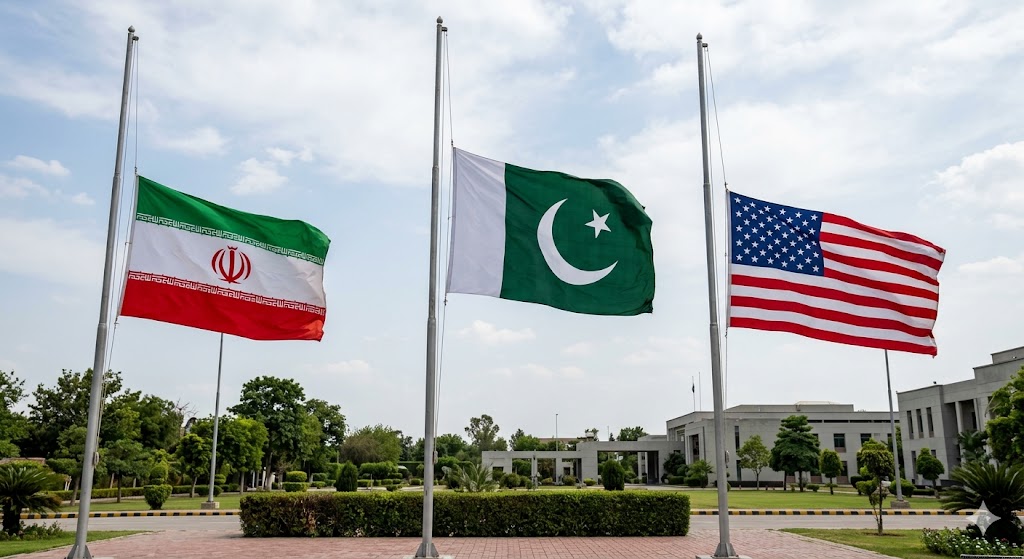
The structural integrity of Pakistan’s foreign policy is currently facing its most rigorous stress test since the 1979 Iranian Revolution. As the Middle East slides toward a systemic reconfiguration driven by the collapse of the JCPOA, the proliferation of drone warfare, and the sharpening of the Riyadh-Tehran-Tel Aviv triangle, Islamabad finds itself trapped in a geographic and fiscal vise. Pakistan shares a nearly 900-kilometer border with Iran, yet its economic survival remains tethered to the US-led financial architecture and the security subsidies of Gulf monarchies. Unlike the Cold War era, where "alignment" was a binary choice, the current friction between Washington and Tehran demands that Pakistan master a form of strategic polycentrism. The challenge is no longer merely avoiding a side but ensuring that its proximity to one does not trigger a catastrophic security or economic reprisal from the other.
The Geography of Constraint and the Myth of Choice
For Pakistan, neutrality is not a moral preference but a geographical imperative. The Sistan-Baluchestan border region functions as a sensitive barometer for domestic stability; any escalation between the US and Iran risks turning this frontier into a theater of proxy kinetic action. Pakistan’s internal security remains fragile, particularly with the resurgence of the Balochistan Liberation Army (BLA) and other separatist elements that often exploit the porous nature of the Iranian border.
A direct conflict or intensified US sanctions regime against Iran complicates Pakistan’s internal security calculus. If Islamabad aligns too closely with Washington’s "maximum pressure" tactics, it risks Tehran withdrawing its tacit cooperation on border management, potentially allowing militants a freer hand. Conversely, defying US primary and secondary sanctions to pursue projects like the Iran-Pakistan (IP) gas pipeline invites the wrath of the US Treasury, threatening Pakistan’s access to IMF tranches and the SWIFT banking system. Consequently, Pakistan’s "neutrality" is actually a defensive posture designed to prevent the spillover of a neighbor’s revolution and a superpower’s retribution.
The Economic Asymmetry: IMF Mandates vs. Energy Needs
The divergence between Pakistan’s energy requirements and its sovereign debt obligations creates a policy paralysis. The Iran-Pakistan gas pipeline, a project conceived as a "Peace Pipeline," has become a monument to the limitations of Pakistani sovereignty. Tehran has completed its portion, but Islamabad remains frozen by the threat of US sanctions.
This deadlock reflects a deeper systemic issue: Pakistan’s energy security is hostage to the dollar-denominated global financial system. While Iran offers a shortcut to alleviating Pakistan’s chronic "circular debt" in the power sector through cheap natural gas, the opportunity cost, losing the support of the US within the IMF board is deemed too high. As noted by the late strategist Zbigniew Brzezinski, “a nation that cannot manage its own geography is doomed to be the playground of others,” a reality that manifests in Pakistan’s inability to finalize bilateral trade agreements with Iran without seeking a "comfort letter" from Washington. This economic asymmetry ensures that Pakistan’s mediation efforts are often perceived as a search for a waiver rather than a genuine pursuit of regional peace.
The Mediation Gambit: Credibility in a Polarized Environment
Pakistan has frequently offered itself as a bridge between Tehran and Washington (and by extension, Riyadh). This role as a regional mediator is often presented as a diplomatic virtue, but it is primarily a pre-emptive strategy to prevent a conflict that would necessitate an impossible choice. When Islamabad mediates, it is not acting out of a surplus of influence, but out of a deficit of options.
To be a successful mediator, a state requires "leverage parity," the ability to offer something to both sides. Pakistan’s leverage with Iran lies in its role as a Sunni-majority nuclear power that refuses to join anti-Shia military coalitions. Its leverage with the US lies in its geographical necessity for counter-terrorism operations and Afghan stability. However, as the US shifts its focus toward the Indo-Pacific, the "Pakistan card" in Washington’s deck has lost its premium value. This devaluation of Pakistan’s strategic rent makes its mediation offers appear more like pleas for restraint than the maneuvers of a regional powerbroker.
Sectarian Cohesion as a National Security Variable
The US-Iran conflict is never purely external for Pakistan; it is deeply domestic. With a significant Shia minority (roughly 15-20% of the population), any perceived Pakistani involvement in a US-led kinetic action against Iran could ignite internal sectarian fractures. The state’s memory of the 1980s and 90s, where Saudi-Iranian proxy wars were fought on the streets of Karachi and Lahore, remains a haunting precedent.
Islamabad’s refusal to join the Saudi-led intervention in Yemen in 2015 was the defining moment of its modern neutrality. By choosing a "neutral" path, the Pakistani parliament recognized that the military’s external deployment is inextricably linked to internal social cohesion. In this context, neutrality is a tool for domestic peacekeeping. Any shift toward the US-CENTCOM orbit regarding Iran would require a level of domestic political consensus that currently does not exist in Pakistan’s fractured civilian-military landscape.
The China Factor: A New Shield for Pakistani Neutrality
The entry of China as a major diplomatic actor in the Middle East, evidenced by the 2023 Iran-Saudi rapprochement brokered in Beijing has provided Pakistan with a new layer of maneuverability. Previously, Pakistan had to balance the US and Iran in a vacuum; now, it can align its neutrality with the broader Eurasian integration project.
As China invests heavily in both the China-Pakistan Economic Corridor (CPEC) and a 25-year strategic partnership with Iran, it is in Beijing’s interest to see a stable Iran-Pakistan border. This provides Islamabad with a "Great Power" umbrella to resist US pressure. If the US demands further isolation of Iran, Pakistan can point to its obligations under the CPEC framework to maintain regional connectivity. However, this shift risks relegating Pakistan to a secondary orbit of Chinese influence, where its neutrality is no longer managed by Islamabad, but outsourced to Beijing’s regional vision.
The Nuclear Dimension and the Threshold of Escalation
Pakistan’s status as the only nuclear-armed Muslim state adds a layer of unspoken tension to its relationship with both the US and Iran. For Washington, a primary concern is the potential for nuclear technology proliferation, a ghost from the A.Q. Khan era that continues to haunt bilateral ties. For Tehran, Pakistan’s nuclear umbrella is a source of both envy and security; a nuclear-armed neighbor that remains neutral is a far better prospect than one that is a formal US treaty ally.
The strategic implication here is that Pakistan cannot afford to let the US-Iran conflict reach a nuclear threshold. Any discussion of "tactical nuclear weapons" or strikes on Iranian nuclear facilities would trigger a massive reassessment of Pakistan’s own "Full Spectrum Deterrence" doctrine. As Henry Kissinger observed, “The conventional army loses if it does not win. The guerrilla wins if he does not lose,” and in the context of the Middle East, Pakistan views Iran as the ultimate "state-level guerrilla." Islamabad knows that a protracted conflict would destabilize the region’s nuclear psychology, making the maintenance of its own deterrent far more complex and scrutinized.
Border Militancy and the 'Two-Front' Anxiety
Pakistan’s traditional security focus has been its eastern border with India and its northwestern border with Afghanistan. A hostile Iran would create a "third front," an unbearable burden for a military already overextended by domestic counter-insurgency and the permanent standoff with New Delhi.
The recent exchange of missile strikes between Iran and Pakistan in early 2024 served as a clarifying moment. It demonstrated that neutrality is not a passivity; it must be enforced. The swift de-escalation followed by a restoration of diplomatic ties showed that both states recognize they are "reluctant neighbors" who cannot afford a divorce. For Pakistan, the incident proved that while it will not participate in a US-led campaign against Iran, it will also not allow Iran to outsource its security problems to Pakistani soil. This "armed neutrality" is the new baseline for the relationship.
Forward-Looking Implications: The Twilight of Non-Alignment
The era of "balanced" foreign policy is evolving into an era of "transactional survival." Pakistan’s ability to navigate the US-Iran conflict will depend less on its diplomatic rhetoric and more on its ability to diversify its economy away from total dollar-dependency.
If Pakistan succeeds in maintaining this balance, it becomes the essential "buffer state" that prevents a total regional conflagration. If it fails, it risks becoming a fragmented territory where the US and Iran settle their scores through proxies, much like the fate of Lebanon or Iraq. The long-term consequence for Pakistan is a forced closeness with the SCO (Shanghai Cooperation Organisation) as a means to balance out Western pressure. This is not a pivot of choice, but a pivot of necessity.
Strategic Observations for Policy Planning
The future of Pakistan’s neutrality will be defined by three critical variables:
The Waiver Economy: Pakistan’s diplomatic success will be measured by its ability to secure specific "national interest waivers" from the US for energy trade with Iran, arguing that a stable Pakistani economy is a prerequisite for US regional interests.
Intelligence Decoupling: Islamabad will likely seek to maintain deep intelligence sharing with the US on Afghanistan/ISIS-K while simultaneously establishing a "redline" protocol with Iran’s IRGC to prevent border skirmishes.
The Gwadar-Chabahar Nexus: Rather than seeing the Iranian port of Chabahar as a rival to Gwadar, Pakistan’s policy must shift toward a "twinning" model. Integration of these ports would make the cost of conflict too high for both Tehran and Islamabad, creating a commercial interdependence that acts as a hedge against external military pressure.
In the final analysis, Pakistan is not a mediator by choice, but by the sheer weight of its circumstances. Its "neutrality" is a high-wire act performed without a safety net, where the goal is not to reach the other side, but simply to stay on the wire. The forward-looking implication is clear: Pakistan’s relevance in the 21st century will not be defined by who it allies with, but by how effectively it refuses to be an enemy of anyone.
Comments (0)
No comments yet. Be the first to comment!