Pak Imtehan
CSS Mentor
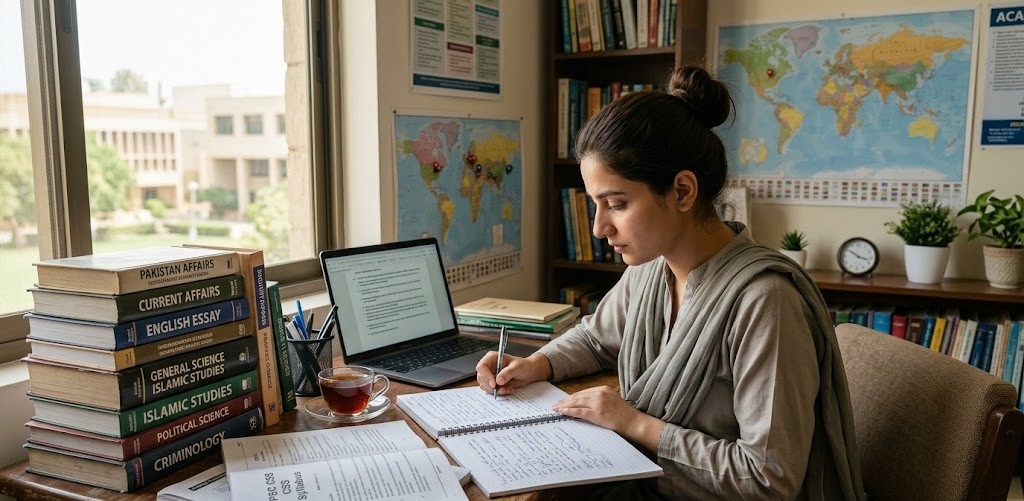
Starting your Central Superior Services (CSS) journey can feel overwhelming when you are looking at a massive syllabus from a absolute baseline of zero. However, clearing Pakistan’s most prestigious competitive exam isn't about studying harder, it is about studying smarter.
This step-by-step roadmap breaks down exactly how to build your preparation from scratch with total clarity.
Step 1: Decode the Eligibility Criteria First
Before buying a single book, make sure you meet the basic requirements set by the Federal Public Service Commission (FPSC).
Degree Requirement: You need at least a Bachelor’s degree (14 years of education) in any discipline.
Minimum Marks: A minimum of a 2nd Division or a 2.5 CGPA is required. If you have a 3rd division, you can still apply only if you obtained a higher division in your Master's degree.
Age Limit: You must be between 21 and 30 years old on the cutoff date (usually January 1st of the exam year). Government servants, disabled candidates, and recognized scheduled castes get a 2-year relaxation (up to 32 years).
Step 2: Master the CSS Exam Structure & Format
The CSS exam is divided into four distinct phases. You must clear the written portion before moving forward.
[Written Exam] --> [Medical Test] --> [Psychological Assessment] --> [Viva Voce / Interview]
The Written Examination (1200 Total Marks)
The written exam consists of 12 distinct subjects, split evenly between compulsory and optional papers. Each paper is worth 100 marks.
1. Compulsory Subjects (600 Marks)
You have no choice here; everyone takes these six papers. The passing mark is 40%.
English Essay (100 Marks)
English (Précis and Composition) (100 Marks)
General Science & Ability (100 Marks)
Current Affairs (100 Marks)
Pakistan Affairs (100 Marks)
Islamic Studies (or Comparative Study of Major Religions for non-Muslims) (100 Marks)
2. Optional Subjects (600 Marks)
You select subjects totaling 600 marks from the official FPSC groups. The passing mark is 33%. You can choose 100-mark or 200-mark subjects based on your background or interest (e.g., International Relations, Criminology, Gender Studies, Political Science).
Step 3: Start with the "Big Three" Foundations
When starting from zero, do not try to study all 12 subjects at once. This causes instant burnout. Instead, spend your first 4 to 6 weeks mastering the core pillars of CSS.
1. The English Language Foundation
English is the primary reason for a low passing ratio in written exams. Focus heavily on:
Grammar & Sentence Structure: Master basic tenses, active/passive voice, and punctuation.
Reading Habits: Read an editorial daily from reputable news outlets like Dawn or The Economist. Write down a summary of what you read to build comprehension.
2. Analytical Reading (The FPSC Syllabus)
Download the official syllabus from the FPSC website. Read through it like a map. Look at the specific topics listed for Pakistan Affairs and Current Affairs. Your goal is to understand what the exam expects you to know.
3. Basic Mapping & Geography
Get a world map. Learn the locations of major global regions, oceans, straits, and global powers. Knowing where places like the Taiwan Strait or the Middle East are located will instantly make Current Affairs easier to comprehend.
Step 4: Create a Realistic Beginner’s Study Plan
A successful CSS strategy relies on a consistent, repeatable routine. Treat your preparation like a professional job.
Phase 1: Months 1–2 (The Groundwork)
Daily Routine: 3 to 4 hours of study.
Focus: 1 hour of English grammar/vocabulary, 1 hour of reading opinion editorials, and 1 to 2 hours of foundational reading (e.g., General Science or basic Pakistan History).
Phase 2: Months 3–6 (Subject Completion)
Daily Routine: 5 to 6 hours of study.
Focus: Pick two subjects at a time (one compulsory, one optional). Complete their syllabus line-by-line, make concise notes, and move to the next pair.
Phase 3: Months 7–8 (Past Papers & Revision)
Daily Routine: 6+ hours.
Focus: Stop reading new books. Solve past papers from the last 5 to 10 years under strict exam timers. Have an expert check your answers to correct your mistakes.
Step 5: How to Select High-Scoring Optional Subjects
Choosing optionals is a critical strategic decision. Do not pick a subject simply because someone tells you it is "high-scoring." Use this reliable three-step filter instead:
Academic Background: If you have a degree in International Relations, Political Science, or Computer Science, consider choosing it because you already understand the core terminology.
Syllabus Overlap: Choose subjects that complement each other. For example, International Relations overlaps heavily with Current Affairs, while Criminology offers a concise, highly structured syllabus that is straightforward to cover.
Personal Interest: You will be reading these topics for months. Pick subjects that genuinely interest you so your study sessions remain engaging.
Pro-Tip for Absolute Beginners
CSS does not test how many facts you can memorize. It tests your ability to analyze a problem and present a balanced, logical solution on paper. Start small, master your English expression, and build your knowledge base step-by-step. Every single CSS officer started exactly where you are standing right now: at zero.
For complete, high-yielding CSS notes, comprehensive Factbooks, solved past papers, and practice MCQs, download the Pak Imtehan App today to accelerate your competitive exam preparation.
Comments (0)
No comments yet. Be the first to comment!