Pak Imtehan
Competitive Exams App (Available on Playstore/Appstore)
Title: Trump & Pakistan
Writer: Touqir Hussain (former ambassador; adjunct professor, Georgetown University)
Published in: Dawn
Date of publication: 20 October 2026
Warm Words, Thin Substance: Reading the Real State of Pakistan-US Relations
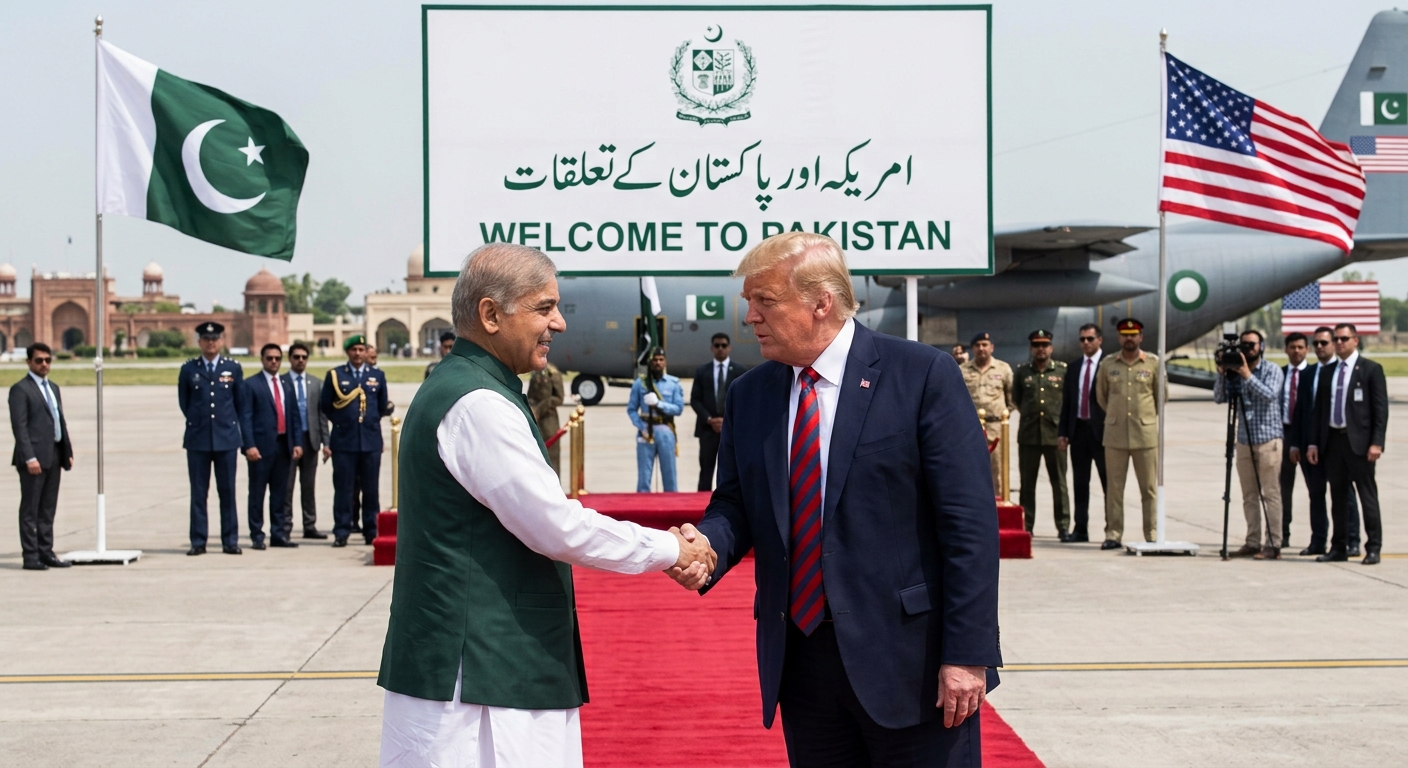
Anyone trying to judge Pakistan’s relationship with the United States today has to read between the lines, much as a student reads a difficult poem. The surface is pleasant. American leaders have praised Pakistan’s leadership in generous terms, and the tone in Washington is friendlier than it has been for years. But American politicians are famous for exaggeration, and praise is cheap. The more useful question is what lies underneath: whether there is a real strategic partnership, or simply a good mood that may not last.
1. Better, but Not Deeper
Compared with the previous US administration, relations have clearly improved. The best description is that they have been elevated, but not upgraded. Visits are friendlier, statements warmer, and Pakistan’s image in Washington stronger. Yet the basic structure of the relationship has not changed in any lasting way.
Part of the reason has little to do with Pakistan. The current US administration runs an experimental foreign policy. It is reassessing its approach to China and Russia, rebalancing ties with old allies, and placing less emphasis on the long-standing American goal of global primacy, without abandoning it entirely. It favours unilateral action, the use of military force and economic pressure, using tariffs as a tool for both trade and geopolitical bargaining. In this shifting environment, Pakistan has found openings. It has been, in effect, an incidental beneficiary: helped by changes in American thinking that were not designed with Pakistan in mind.
2. What Washington Actually Wants
Behind the friendly words sit hard interests. Pakistan matters to the United States for reasons of geography and power. It is a populous nuclear-armed state sitting at the meeting point of South Asia, Iran, the Arabian Peninsula, Central Asia, Russia and China. Few countries occupy such a position. Washington also sees Pakistan’s defence capability as relevant to regional stability, and, less openly, as a form of leverage over India.
There is also concrete business. The administration has approved a $686 million upgrade and sustainment package for Pakistan’s F-16 fleet. A separate $488 million foreign military sales contract awarded to the American firm Northrop Grumman for radar engineering support covers 21 countries, Pakistan among them. Cooperation is developing in energy, information technology, crypto, agriculture, renewable energy and critical minerals, with Pakistan presented as a potential source of minerals. The United States also remains Pakistan’s largest export market.
Two older interests continue. Washington needs Pakistan’s help against transnational terrorist groups, and that cooperation goes on. It also worries about the risk of conflict between Pakistan and India, two nuclear powers, and will keep playing the role of crisis manager whenever tensions rise.
3. The Missing Strategic Layer
For all this activity, something important is absent. A real strategic partnership shows itself through sustained high-level engagement across government. Here the signals are weak. Senior American diplomats, including the Secretary of State, the deputy secretary and the under-secretaries, have not visited Pakistan. The Secretary of State, known for hawkish views on China and warmth towards India, has spoken in favour of a strategic relationship, but little has followed. There is no real sign of a strategic relationship, despite occasional talk of one.
This suggests that two tracks may be running in Washington at once. One is the president’s personalised diplomacy, built on rapport and dealmaking. The other is a more traditional foreign policy establishment, which may quietly limit how far ties with Pakistan can go.
4. Pakistan Seen Through Other Lenses
A deeper question is whether Washington views Pakistan on its own terms at all. American policy towards Pakistan may be shaped by its policy towards India, which in turn is shaped by its policy towards China. Senior US officials continue to describe China as the biggest economic and military threat facing the United States. If that view drives everything else, Pakistan’s value rises and falls with Washington’s needs in the wider contest with Beijing.
This creates a delicate position. The United States wants to limit China’s influence in Pakistan, but pushing Pakistan too hard would backfire. Alienating Pakistan would shut the door on American influence there altogether. That gives Islamabad some room, but also exposes it to pressure from both sides.
5. Will It Last?
The honest assessment is modest. The current administration has not done anything extraordinary for Pakistan that it would fear losing. Much of the president’s freelance style of foreign policy may end when his term ends, and the impact on Pakistan could then be small.
There is, however, a reason for continued engagement that does not depend on any individual leader. American wars in the Middle East, fought alongside Israel, have weakened US standing in the region. That gives Washington a lasting reason to stay engaged with Pakistan, which has expanded its own diplomatic profile in the Middle East.
6. The Right Balance for Islamabad
The conclusion follows naturally. Pakistan should neither overestimate nor dismiss the current warmth. Personal rapport between leaders can open doors, but it rarely builds lasting structures. Pakistan’s real assets are permanent: its location, its size and its role in regional security.
The relationship with the United States is necessary but not indispensable. Keeping it that way, valuable without becoming a dependence, is the best way for Pakistan to protect its strategic autonomy while dealing with Washington, Beijing and its neighbours on its own terms.
Exam Essentials
1. Key Facts and Figures
Pakistan-US ties described as “elevated, but not upgraded” compared with the previous US administration
$686 million US-approved upgrade and sustainment package for Pakistan’s F-16 fleet
$488 million foreign military sales contract to Northrop Grumman for radar support covering 21 countries, including Pakistan
Areas of cooperation: energy, IT, crypto, agriculture, renewable energy, critical minerals
The United States is Pakistan’s largest export destination
No visits to Pakistan by the US Secretary of State, deputy secretary or under-secretaries
Senior US officials describe China as the biggest economic and military threat
2. Key Terms
Strategic partnership: a long-term relationship based on shared interests and sustained cooperation
Transactional diplomacy: relations driven by immediate deals rather than lasting commitments
Personalised diplomacy: foreign policy driven by personal rapport between leaders
Global primacy: a state’s aim of remaining the leading world power
Leverage: using one relationship to gain advantage in another
Strategic autonomy: a state’s ability to make foreign policy choices independently
Foreign military sales: government-to-government arms transfers
Crisis management: diplomatic intervention to prevent conflicts from escalating
3. Related Subjects
Pakistan’s Foreign Policy: relations with the US, China and India
International Relations: great-power rivalry, alliances, balance of power
US Foreign Policy: unilateralism, tariffs, China containment
South Asian Security: Pakistan-India tensions, nuclear deterrence
Current Affairs: Middle East conflicts and regional diplomacy
4. Useful Arguments
Warm rhetoric is not the same as a strategic relationship.
Pakistan’s geography and nuclear status give it lasting relevance in US policy.
US policy towards Pakistan is often shaped by its China and India policies.
Personal diplomacy rarely survives a change of leadership.
Pressuring Pakistan too hard would push it further towards China.
Balanced relations with major powers protect strategic autonomy.
5. Probable Questions
Critically evaluate the current state of Pakistan-US relations. Is there a genuine strategic partnership?
“US policy towards Pakistan is a function of its China and India policies.” Discuss.
How can Pakistan preserve its strategic autonomy amid US-China rivalry?
6. One Quotable Line
“Compliments open doors, but only shared interests keep them open.”
For CSS Pakistan Affairs Complete Notes & Solved Past Papers, download the Pak Imtehan app on the Google Play Store or App Store — subscriptions start from Rs. 600/month!
Comments (0)
No comments yet. Be the first to comment!