Pak Imtehan CSS, PMS App
CSS App
Title: 'China Model' Fallacies
Writer: Shahid Mehmood
Published in: Dawn
Date of publication: 2 October 2026
1. The Search for a Ready-Made Solution
Pakistan's economy has been stuck in stagflation since 2022. Stagflation is the combination of slow growth and high inflation, a painful condition because rising prices erode incomes while the economy fails to create enough jobs. Over more than four years, average GDP growth has barely exceeded population growth, which means income per person has hardly improved.
During this period, a series of supposed quick fixes was announced, including the Special Investment Facilitation Council (SIFC), a body set up to fast-track foreign investment; claims of $6 trillion in mineral wealth; corporate farming; cryptocurrency; and earning geopolitical rents, meaning financial benefits drawn from strategic alliances. None delivered the promised transformation. The latest idea circulating in governance circles is the "China model".
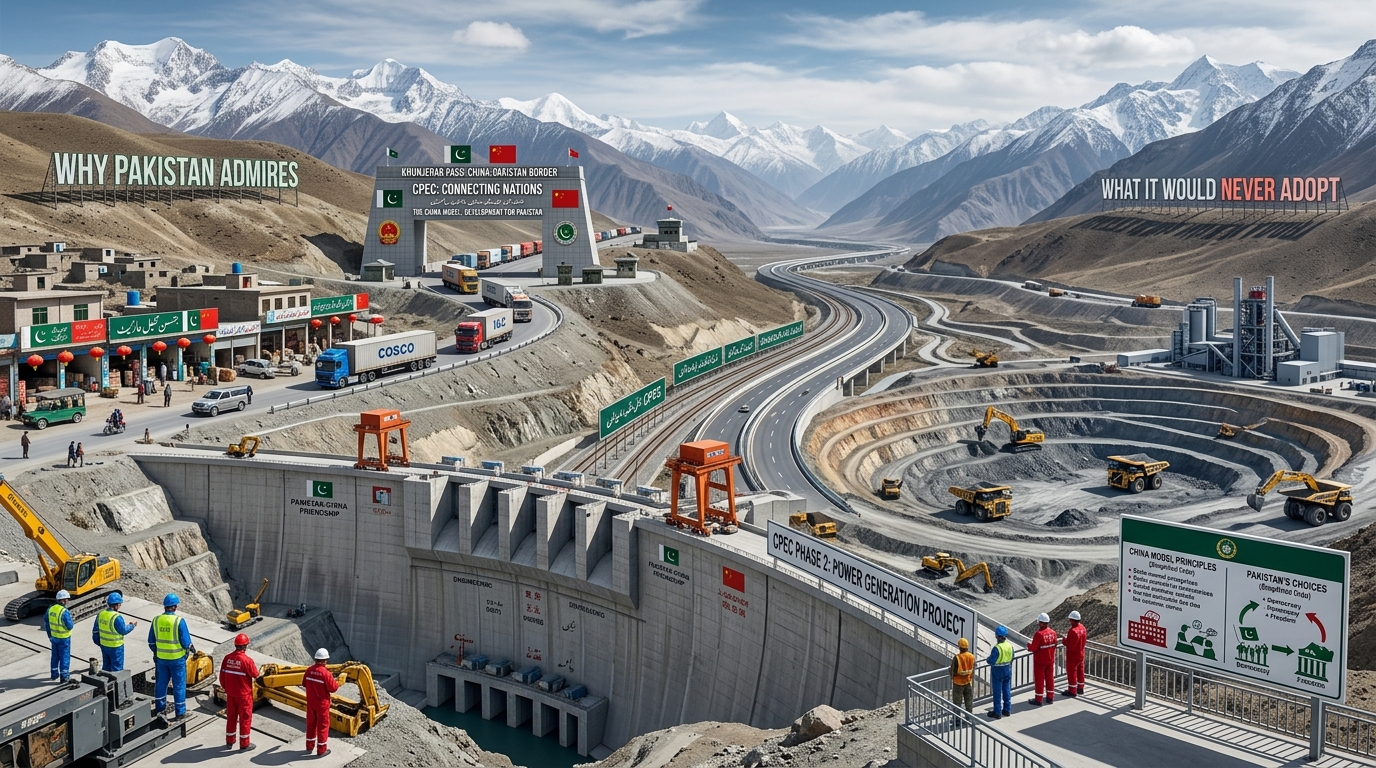
The way this model is commonly imagined in Pakistan is simple: an all-powerful centre that issues economic commands through long-term plans, drives growth through heavy state intervention, and leaves little role for local government. The core argument is that this picture is almost entirely wrong, and that the real Chinese system is one Pakistan's ruling elite would never accept.
2. The Electric Vehicle Story: Private Firms and Local Initiative
A recent research paper by Fengming Lu and Xiao Ma, titled "The rise of China's electric vehicle industry", challenges the popular myth. China is now the world's leading producer of electric vehicles (EVs), but the firms behind this success did not follow a central script.
Leading EV makers such as BYD and NIO are private companies that received no state grants at all.
Government research money went instead to state-owned enterprises (SOEs), companies owned and run by the state.
The successful private firms grew in cities that the central planners had not selected for EV development.
The explanation lies at the local level. Mayors of the cities left out of the official plan partnered with entrepreneurs and built the industry themselves. Their success undercut the favoured SOEs, yet the central government did not intervene to stop them. This single case overturns the idea of a centre that controls every decision and tolerates no local authority.
3. A Competitive Local System and Merit-Based Promotion
China's local tier of government is highly developed and fiercely competitive. Officials rise to senior positions in the ruling party mainly through their performance in local posts, such as raising growth or attracting industry. Family connections alone cannot secure a top position.
Pakistan's political culture works differently. Senior party positions are frequently inherited by the children and relatives of party heads. Where promotion depends on lineage rather than results, officials have little reason to deliver economic performance.
4. Tolerating Creative Destruction
The EV case also shows China's willingness to accept "creative destruction", a concept developed by the economist Joseph Schumpeter. It describes how new, competitive firms replace older and weaker ones, so that progress comes partly through the failure of the inefficient. This is a core feature of capitalism, not socialism or communism.
In the EV race, private competitors left SOEs far behind, and the centre allowed this decline to happen. Competition has become so intense that it has triggered price wars, and some firms are expected to collapse. One county reportedly lost 6.6 billion yuan on a carmaker it had backed. The Chinese state accepted these losses as the price of a dynamic industry rather than shielding favoured companies.
5. Planning Through Debate, Not Decree
The common view of Chinese long-term plans as orders imposed from above is also misleading. These plans draw on the advice of leading experts and are discussed at length before adoption.
A clear example came after the collapse of the Soviet Union. Between October and December 1991, in a series of discussions known as the "eleven half-days", Chinese policymakers examined why the Soviet economy had failed and how China could avoid the same fate. These debates fed into preparations for the 14th Party Congress. The outcome was the "modern enterprise system", approved in November 1993, built on four principles:
Clear property rights
Clearly defined rights and responsibilities
Separation of government from business enterprises
Scientific management
This reform marked a turning point in China's path to prosperity, and it emerged from careful deliberation rather than command.
6. One of the Most Decentralised Systems in the World
China is arguably among the most decentralised governance systems in the world. More than 80 per cent of public expenditure takes place at the local level, and mayors enjoy wide independence in fiscal and administrative decisions. In technical terms, this is fiscal decentralisation: spending power lies largely with local governments, which are closest to local needs.
The centre remains powerful, but its power works through firm red lines rather than micromanagement. A key red line is that wealthy interests must not capture the state and bend policy in their own favour against the public interest. For this reason, members of the ruling party are banned from holding golf club memberships, a measure aimed at limiting cosy links between officials and business elites. Corruption is punished severely, in some cases with the death penalty.
7. The Pakistani Contrast: A State Captured by Capital
The underlying philosophy in China is to encourage capital and growth while preventing capital from turning against the public good. Pakistan follows the reverse pattern. Big capital shapes policy through tax exemptions and public-sector contracts worth trillions of rupees. This is known as elite capture: a narrow group bends state decisions to its own benefit.
The sugar industry is a familiar example. Influential mill owners who sit in the legislature are able to influence regulations and policies in their favour. This is not an argument against business or investment. It is an argument for regulating the harmful spillovers of concentrated economic power. Severe punishment for corruption, as practised in China, is also rarely seen in Pakistan.
8. Implications and the Way Forward
China's rise was a long, difficult and untidy process that began with the reform and opening-up of 1978, not the product of a single wise ruler issuing commands. Its real ingredients were local autonomy, merit-based promotion, tolerance of competition and failure, careful policy debate, and firm limits on the power of wealth.
Adopting such a system would require Pakistan's elite to give up centralised control and the rents, meaning unearned income gained through privilege, that it collects through that control. This explains why the "China model" is praised in policy circles but is unlikely to be implemented.
Empower local governments with real fiscal and administrative authority.
Link promotion to performance rather than family ties.
Allow inefficient firms, including state enterprises, to fail.
Build policy through expert debate before implementation.
Prevent business interests from writing their own rules, and enforce accountability for corruption.
The real lesson from China is not centralisation but discipline: a state that facilitates growth while refusing to be owned by the powerful.
Exam Essentials
1. Key Facts and Figures
Pakistan: stagflation since 2022; average GDP growth barely above population growth
Research paper: "The rise of China's electric vehicle industry" by Fengming Lu and Xiao Ma
BYD and NIO: private EV firms that received no state grants
6.6 billion yuan: reported loss of one Chinese county on a carmaker it backed
October to December 1991: the "eleven half-days" debates after the Soviet collapse
November 1993: approval of the modern enterprise system
More than 80 per cent of China's public expenditure occurs at the local level
1978: start of China's reform and opening-up
2. Key Terms
Stagflation: slow economic growth combined with high inflation
State-owned enterprise (SOE): a company owned and controlled by the government
Creative destruction: the replacement of weaker firms by more innovative competitors
Fiscal decentralisation: transfer of spending and revenue powers to local governments
Elite capture: control of public policy by a small, powerful group for its own benefit
Rent-seeking: earning income through privilege or influence rather than productive activity
Modern enterprise system: China's 1993 framework separating government from business
3. Related Subjects
Economics: development models, growth theory, stagflation
Governance and Public Policy: decentralisation, local government, accountability
Comparative Politics: China's governance system, meritocracy
Pakistan Affairs: economic crises, elite capture, policy reform
International Relations: China's rise and the end of the Soviet Union
4. Useful Arguments
China's growth came from local initiative and private competition, not only central command.
Decentralisation brings decision-making closer to local needs and builds accountability.
Merit-based promotion creates incentives for officials to deliver results.
A state that protects inefficient firms blocks innovation.
Borrowed development models fail when the political will to adopt their hard parts is absent.
Economic reform in Pakistan depends on freeing policy from the influence of entrenched interests.
5. Probable Questions
What lessons can Pakistan draw from China's development experience, and what obstacles prevent their adoption?
"Decentralisation is the hidden engine of China's economic rise." Discuss.
Elite capture is the central barrier to economic reform in Pakistan. Critically examine.
6. One Quotable Line
"China did not grow by commanding everything from the centre; it grew by letting local initiative compete while refusing to let wealth command the state."
Comments (0)
No comments yet. Be the first to comment!