CSS PMS App
Pak Imtehan
Title: Fragile Cryosphere
Writer: Naseer Memon
Published in: Dawn
Date of publication: 1 October 2026
1. Background: A Quiet Monsoon, Not a Safe One
Pakistan's 2026 monsoon passed through the plains without a major disaster, unlike the catastrophic floods of the previous year. That relief is incomplete. The northern highlands of Gilgit-Baltistan (GB) and Chitral were still hit by floods, and a far larger disaster in neighbouring Nepal showed what the same mountains can do.
The issue concerns the cryosphere: all the parts of the Earth's surface where water exists in frozen form, including glaciers, snow cover, ice sheets and permanently frozen ground. In South Asia, the cryosphere is both a source of life and a source of danger. It stores the water that feeds the region's great rivers. As it warms and is disturbed by human activity, it also releases sudden floods, landslides and debris flows. The central argument is simple: Pakistan faces the same mountain hazards as Nepal and should treat the Nepal tragedy as an early warning.
2. What Happened in Nepal
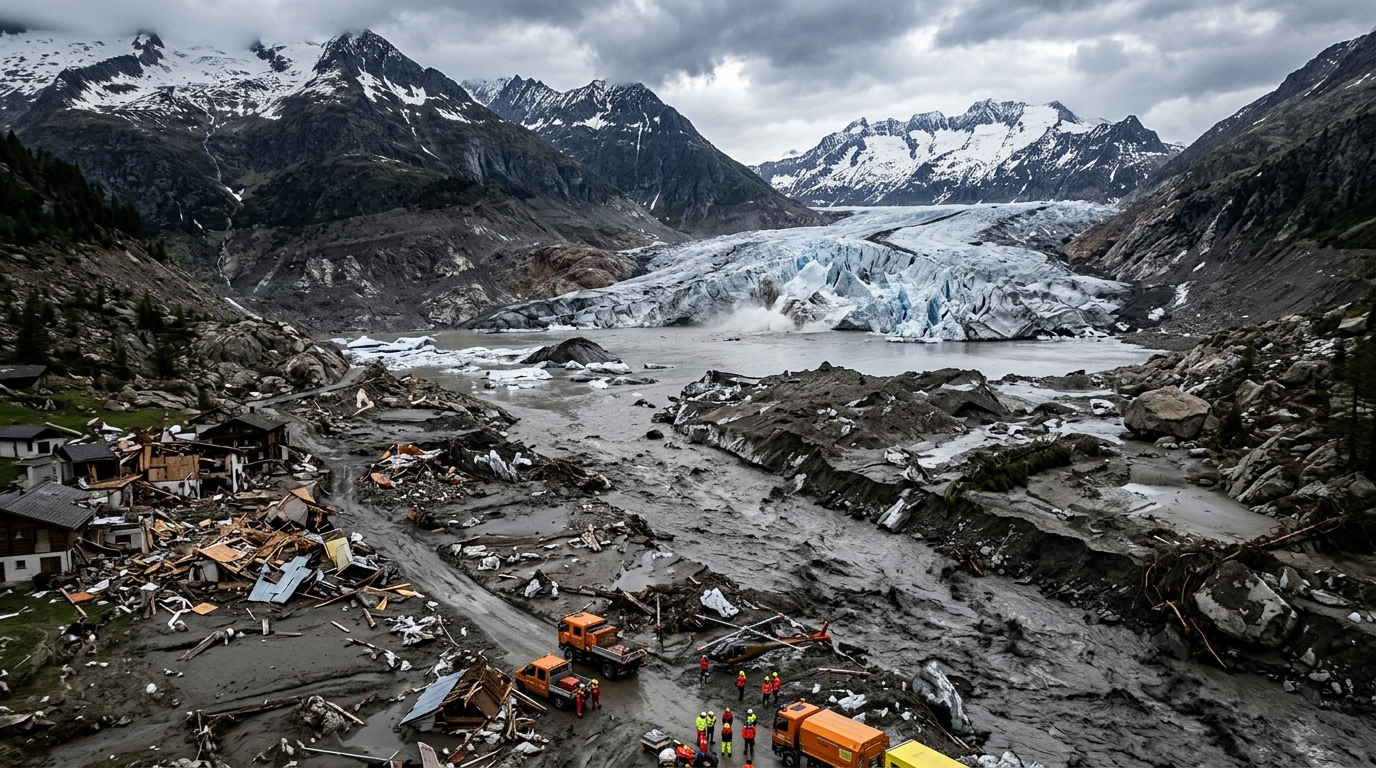
In August 2026, Nepal suffered one of the worst disasters in its history. A huge mass of glacial ice and rock broke away and slid down a Himalayan slope near the Langtang region. Within about thirty minutes, the falling material produced a surge of water up to nine metres high in the Bhote Koshi and Trishuli river system. More than 1,400 people died, and thousands more were reported missing.
A nine-metre surge is roughly the height of a three-storey building. Moving down a narrow mountain valley, such a wave destroys almost everything in its path, and thirty minutes gives downstream communities very little time to escape.
About a month later, after days of heavy rain, a large section of mountainside collapsed into the swollen Kali Gandaki River. Soil, rock and debris poured into the water, and the resulting floods and landslides killed at least two dozen people. The two events show that mountain disasters often arrive in chains: one collapse weakens slopes and swells rivers, and the next heavy rainfall triggers another.
3. The Hindu Kush-Himalaya: Water Tower and Hazard Zone
Nepal and Pakistan are linked by geography. Pakistan, China, India, Nepal and Bhutan all lie along the Hindu Kush-Himalaya (HKH) mountain system. The HKH is often called the "Third Pole" because it holds the largest concentration of ice and glaciers outside the Arctic and Antarctic.
These mountains are known as the "water towers of Asia". They feed 10 major river systems and support the livelihoods of more than two billion people. Yet the same ice and steep slopes that provide water also generate hydro-climatic disasters, meaning disasters caused by the interaction of water and climate, such as flash floods, glacial lake outbursts and landslides.
Pakistan is directly exposed because the Indus and its tributaries draw their water from the Hindu Kush, Karakoram and western Himalaya, among the most fragile mountain ranges in the world. The flash floods that strike GB and Khyber Pakhtunkhwa (KP) almost every year are smaller versions of the Nepal disaster, driven by the same forces.
4. The Growing Threat of Glacial Lakes
When glaciers retreat, meltwater often collects in lakes held back by moraines, which are loose ridges of rock and soil left behind by the moving ice. Such natural dams are weak. If they give way, the lake can empty in minutes, producing a glacial lake outburst flood (GLOF).
In its August 2026 update, the Space and Upper Atmosphere Research Commission (Suparco), Pakistan's national space agency, which uses satellite imagery to monitor such hazards, identified 131 potentially dangerous glacial lakes (PDGLs), most of them in GB and KP. More alarming, the number of unfrozen PDGLs rose from 40 to 105 within a single month because of higher temperatures. A frozen lake is relatively stable; an unfrozen one can burst, so this sharp rise means the number of active threats more than doubled in weeks.
These findings match the assessment of the International Centre for Integrated Mountain Development (ICIMOD), a regional intergovernmental body working on the HKH. ICIMOD identified 25,614 glacial lakes across the region's major river basins and warned in particular about moraine-dammed lakes near retreating glaciers.
5. Not Only Climate Change: The Human Hand
It would be easy to blame everything on climate change, but human activity is making natural processes far more dangerous. The health of the cryosphere depends on forests, vegetation and soil stability. Trees hold soil in place and slow the movement of water. When forests are cut, slopes are exposed, runoff from rain and glacial melt increases, and floods become faster, more violent and heavier with debris.
The data on forest loss is striking:
Chitral lost about 9,288 acres of forest between 1992 and 2009, according to an ICIMOD-supported study.
The annual rate of deforestation rose from 0.14 per cent (1992 to 2000) to 0.54 per cent (2000 to 2009), meaning the pace of loss nearly quadrupled.
In GB, forest cover has fallen to 615,798 acres, only 3.57 per cent of the total area, leaving most slopes with little natural protection.
6. Population Pressure and Settlement in Danger Zones
Population growth adds a further layer of risk. GB's population rose from about 881,000 in the 1998 census to roughly 1.5 million in 2023, an increase of around 70 per cent in 25 years. Chitral recorded about 516,000 people in 2023.
Flat, safe land is scarce on mountain terraces and in narrow valleys. With weak land regulation, growing demand has pushed people into the dry beds of flood nullahs (seasonal streams). Because these channels stay dry for long periods, they are often treated as wasteland and built upon. When a sudden flood arrives, houses built in these beds are the first to be swept away.
Suparco drew attention to this problem in July 2026. Satellite images comparing 2023 with a decade earlier showed rapid expansion of settlements along a glacial lake-fed stream near Gilgit city. Narrowed channels may be unable to carry high flows safely, which means a flood that a natural stream could once absorb may now overflow into homes.
7. Implications and the Way Forward
The lesson from Nepal is that disaster risk in the mountains is a product of three forces acting together: a warming climate, a degraded environment and unplanned human settlement. Pakistan cannot control global temperatures alone, but it can control the other two.
Study the Nepal disaster closely to identify parallels with Pakistan's own glacial and river systems.
Treat it as an early warning within national and provincial disaster management planning.
Strictly prohibit residential and commercial construction along mountain riverbanks and in flood nullahs.
Stop deforestation in watersheds, since forests are the first line of defence against violent runoff.
Continue satellite monitoring of glacial lakes, so that rising risks are detected before they turn into disasters.
A quiet monsoon in the plains should not create a false sense of safety. The next major disaster in Pakistan's north is more likely to come from the mountains than from the plains, and much of its damage can still be prevented.
Exam Essentials
1. Key Facts and Figures
August 2026: ice and rock collapse near Langtang, Nepal; surge up to 9 metres in the Bhote Koshi/Trishuli rivers within 30 minutes; over 1,400 deaths, thousands missing
About a month later: mountainside collapse into the Kali Gandaki River; at least two dozen deaths
HKH feeds 10 major river systems and supports over two billion people
Suparco (August 2026): 131 PDGLs, mostly in GB and KP; unfrozen PDGLs rose from 40 to 105 in one month
ICIMOD: 25,614 glacial lakes in the HKH region
Chitral: 9,288 acres of forest lost (1992 to 2009); deforestation rate rose from 0.14% to 0.54% a year
GB forest cover: 615,798 acres (3.57% of total area)
GB population: about 881,000 (1998) to about 1.5 million (2023); Chitral: about 516,000 (2023)
2. Key Terms
Cryosphere: the frozen parts of the Earth's surface, such as glaciers, snow and permafrost
Third Pole: the HKH region, named for its vast store of ice outside the polar regions
GLOF (Glacial Lake Outburst Flood): a sudden flood caused by the failure of a natural dam holding a glacial lake
Moraine: a ridge of rock and soil deposited by a glacier, often forming weak natural dams
PDGL: a glacial lake judged at risk of bursting
Hydro-climatic disaster: a disaster arising from the interaction of water and climate
Nullah: a seasonal stream channel that stays dry for much of the year
3. Related Subjects
Environmental Science: climate change, glacial retreat, deforestation
Geography: HKH mountain system, Indus basin, river systems
Pakistan Affairs: disaster management, GB and KP development
Governance and Public Policy: land-use regulation, urban planning, early warning systems
International Relations: regional cooperation on transboundary rivers and shared hazards
4. Useful Arguments
Climate change is the trigger, but human negligence multiplies the damage.
Deforestation turns ordinary rainfall and melt into destructive flash floods.
Weak land regulation places the poorest communities directly in flood paths.
Satellite monitoring is useful only if it leads to enforcement on the ground.
Mountain hazards cross borders, so regional data sharing is a practical necessity.
Prevention through zoning and reforestation costs far less than post-disaster relief.
5. Probable Questions
"Climate change loads the gun, but human neglect pulls the trigger." Discuss with reference to Pakistan's northern areas.
Examine the threat posed by glacial lake outburst floods to Pakistan and suggest a comprehensive mitigation strategy.
How far can regional cooperation in the Hindu Kush-Himalaya reduce the risk of cryosphere-related disasters in South Asia?
6. One Quotable Line
"The mountains that give Pakistan its rivers can also take back its valleys, unless forests are protected and riverbanks are left to the water."
Comments (0)
No comments yet. Be the first to comment!